The footman and the wharfinger

Please note: This page is a work in progress – if you can help write this story, please get in touch
 
This story came about after researching William Thompson, the father of my great grandfathers second wife. In researching William I came to learn about John Humphrey and his family and I wanted to record what I found.

John was born in St Olave’s Southwark in 1825. On the 1851 census, aged 24, he is living at 5, Cavendish Terrace, Clapham, Wandsworth, London and Surrey, England with his wife Emma. His occupation is given as Wharfinger (the term means keeper or owner of a wharf and is pronounced wor-fin-jer). Ten years later on the 1861, John and Emma can be found at the same address, now with eight children (Edmund, Mary, Henry, Ernest, Francis, Herbert, Stanley and Constance) and five servants, including a William Thompson, born in Dallington, Northamptonshire, (who I believe is possibly the father of my great grandfathers first wife), employed as a footman.
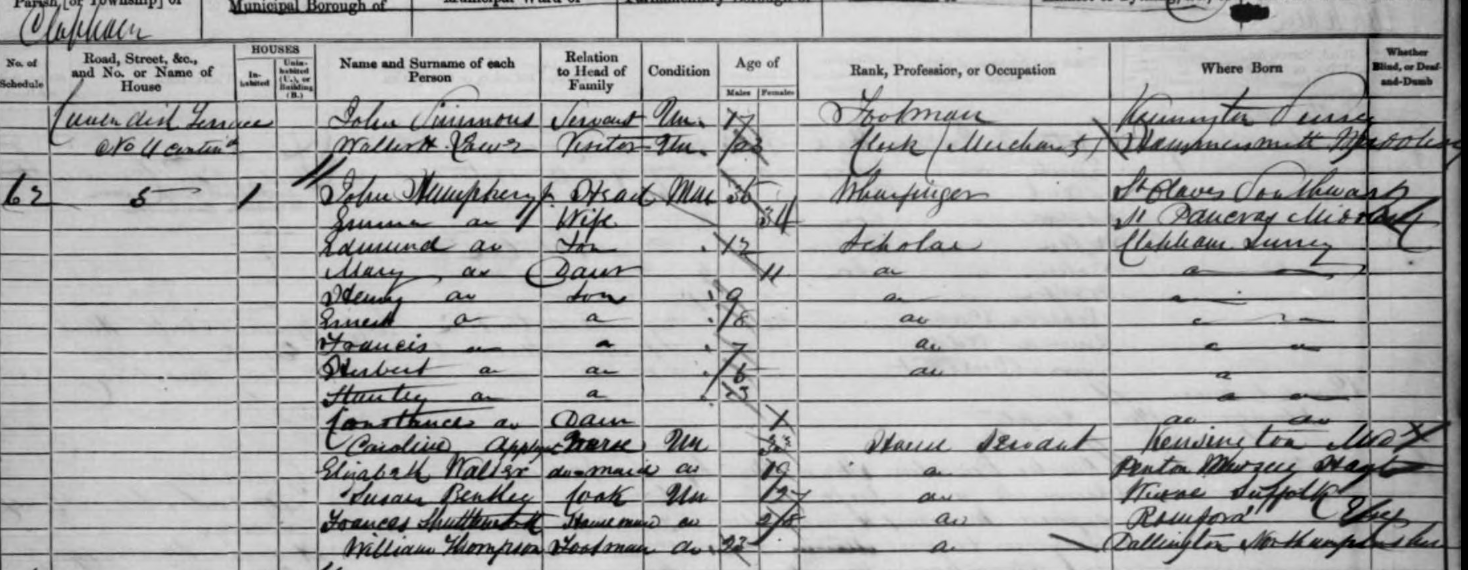
 
 
John Humphery and William Thompson on the 1861 census.
 

Baptised on 6 January 1826, in Bermondsey, St Olave, Southwark, John was the son of John and Mary Humphery who were living at Dean Street. On the baptism certificate the occupation of John’s father is given as Wharfinger too.

 
Baptism certificate of John Humphery.
 

On 5 October 1847
John married Emma Cubitt at St Leonard, Streatham, Lambeth, England. John’s profession is given as Squire, John’s father is named as John Humphrey, Alderman of London and Emma’s father is named as William Cubitt, Sheriff of London.
 
Marriage certificate for John Humphrey to Emma Cubbit.
 
After John’s death, it is possible to continue tracing Emma’s life via census returns. The 1871 census shows her aged 41, now the head of the family, living in Kensington with eight children. The 1881 census shows her living  in the Borough of Westminster at 63 Princes Gate with six children and nine servants and her living arrangements with a large number of servants remain similar in 1891 and 1901 too.
 

The Tallow Chandlers Association

On learning about John Humphery I contacted the Tallow Chandlers Association to see what more I could learn and they advised me as follows.

Between around 1760 and 1938 there were at least four John Humphery’s two of whom were Alderman. The first was John Humphery, a soap boiler from Shadwell and the first of the Humphery’s to become a member of the Tallow Chandlers’ Company – his father, William Humphery, was also in the tallow trade importing oil and fats to Hay’s Wharf in the 1960s.

The second John Humphery was the famous Alderman Sir John Humphery (1794 – 1863) who was MP for Southwark from 1832 to 1852, Sheriff of London and Middlesex in 1832, and Alderman for Aldgate in 1836. He was also Master of the Tallow Chandlers’ Company in 1838 and 1858. This John was in control of Hay’s Wharf from 1840 and commissioned William Cubitt (the father-in-law of two of his sons – John Humphery and Sir William Henry Humphery), to design and build new warehouses in 1856.

The third John Humphery (1825 – 1868) was one of six sons (that are have listed on the database) of Alderman Sir John Humphery and was known as John Humphery the younger on our records.

The fourth John was Lt. Col. Alderman Sir John Humphery (1872 – 1938). He was born to James Arthur Humphery (son of Alderman Sir John Humphery (1794 -1863) and brother of John Humphery the younger (1825 – 1868). Among his many accomplishments, this John was Sheriff of London in 1913, Alderman for Tower Ward and Master of the Tallow Chandlers’ Company in 1919 and 1926. He fought in the First World War and according to a comment on his record – was temporarily appointed Town-Mayor of Ypres when his regiment was divided into several independent squadrons and had no one left to command. He was also awarded various medals as a result of his service

British History Online

John Humphery and William Cubbitt are both recorded on the British History Online website as  aldermen in an entry about 1851 which reads: 
 
‘William Cubitt. An eminent builder and contractor, younger brother of Thomas Cubitt, the builder of South Belgravia. He was re-elected to the Mayoralty at the close of his first year of office, partly as a consolation for his defeat in the contest for the parliamentary representation of the City on the retirement of Lord John Russell. He started the Mansion House Lancashire Relief Fund while Lord Mayor. His son-in-law, Sir William Humphery (son of John Humphery, Lord Mayor 1842-3) succeeded him as M.P. for Andover. His re-election to the Presidency of St. Bartholomew’s Hospital after his resignation of his Aldermanry gave rise to litigation, which was not judicially decided till after his death, the office having hitherto been regarded as tenable only by an Alderman of London.’

Port of London Study Group

An article about Hay’s Wharf by Gillian Barton on the Port of London Study Group website writes about the the Humphery and Cubitt families too, stating:

In 1840 the wharf came under the control of John Humphrey Junior, an Alderman for the City of London, Master of the Tallow Chandler’s Company, Lord Mayor of London in 1842, MP for Southwark 1832-52 and proprietor of Hay’s wharf from 1838 – 1862. In 1856 he commissioned William Cubitt to design and build new warehouse accommodation. He created a small inland dock so barges could gain access from the river, with a five storey warehouse on each side of the new dock. Business was good, until the Great Fire of Tooley Street in 1861. Described as ‘the greatest spectacle since the Great Fire of 1666’, it destroyed the “best warehouses in the kingdom”. The fire started at Cotton’s Wharf, destroying 11 acres of land. London Bridge railway station also caught fire in the blaze. Most of the wharves were rebuilt in the late 1800s as a result of Humphrey’s partnership with Smith and Magniac (whose company later became Jardine Matheson).’

Other information
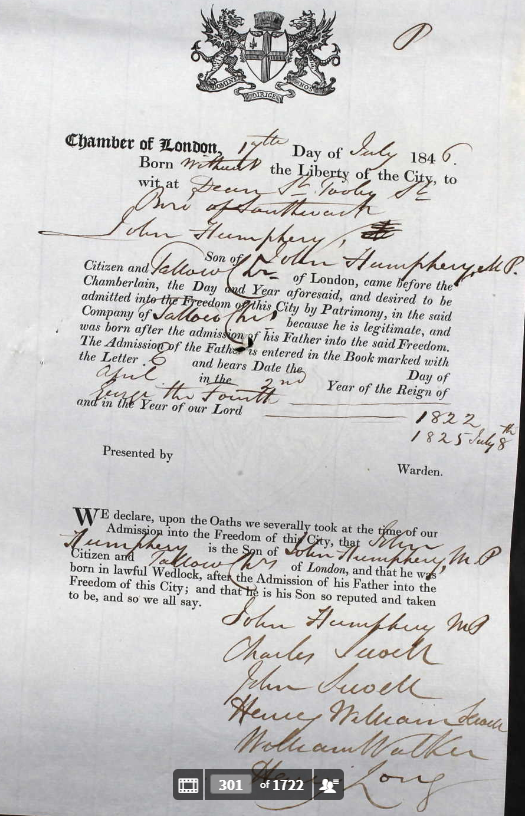
On 17 July 1846 John Humphery was awarded The Freedom of the City.  
 
 
Freedom of City document.
Freedom of the City Admission document for John Humphery.
 
John Clark from the group Historic Southwark: Camberwell, Southwark and Bermondsey explained ‘Originally you couldn’t carry on a trade or business in the City of London unless you were a ‘freeman’ of the City – that is, a ‘citizen’. Three main ways of becoming a freeman – apprenticeship (through one of the livery companies/trade guilds) (not very common these days); ‘redemption’ (paying a fee); or ‘patrimony’ (if your father was already a freeman when you were born).’
 
‘John’s freedom certificate shows it was by patrimony. His father the MP was ‘citizen and tallow chandler’ and the witnesses confirm that John Junior was his legitimate son.  A few hundred years earlier this would have meant that John Senior was a tallow chandler by trade, making candles out of tallow – but by the 19th century many of the livery companies had lost their links with the actual crafts and trades. But to become a freeman/citizen of London you had first to be a member (freeman) of one of the companies – so no obvious reason why John Senior opted for the tallow chandlers when making his first step to power and influence’.
 
The graves of two John Humphery’s can be found in Battersea Rise Cemetery and photos of these can be found on the Find a Grave website below.
 

The will of the second John Humphery recorded by the Tallow Chandlers Association was proved on 11 December 1868.
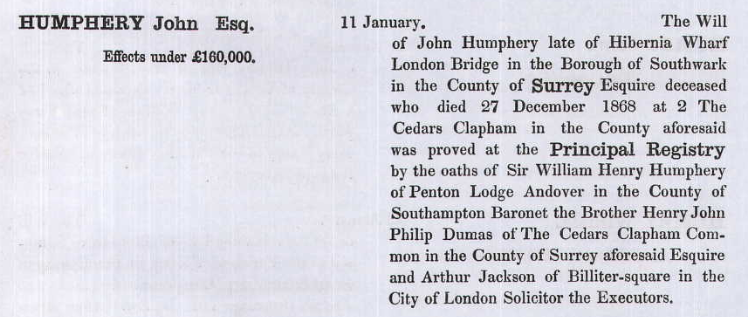
Will of John Humphrey.

Sources

John, Martha and Elizabeth Peach

I learned about John and Elizabeth Peach while researching the Thompson family, with their names appearing on the 1871 census together and with Lucy Munn’s described as Mother in Law. Elizabeth Peach also appears on the 1901 census, where she has a 21 year old servant named Lucy Thompson working 25 Margaret Street, Northampton. Elizabeth is described as a widow and ‘living on own means’.

1851

In 1851 John Peach, aged 34 is recorded as a market gardener with one employee. Married to Martha, they are living at Gold Street, Northampton.

1861

In 1861 John and Martha can be found living at 17 Gold Street. They have a six year old visitor called Selina Starmer and one servant.

1871

In 1871 John and Martha are living alone at Billing Road, St Giles, Northampton. Aged 54 John is described as a retired market gardener.

1881

Aged 64, John can now be found living at 8, Billing Road, Northampton. Again he is described as a retired market gardener but he is now married to Elizabeth Peach and Lucy Munns, described as mother in law, is living with them.

1885

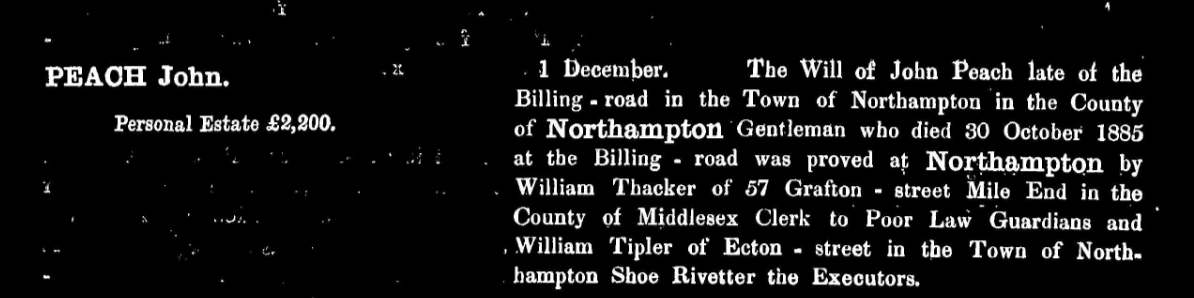
John Peach died in 1885 leaving a personal estate of £2.200.

Details of the will of John Peach.

1886

The Northampton Mercury reported the auction of three highly desirable properties at Gold Street, Victoria Street and Billing Road Northampton.

Thompson, Munns and Peach families

Prior to marrying my great grandmother Milly May Bowers, my great grandfather Joseph Charles Abram was married to Lucy Thompson.  Although not an actual ancestor, I have discovered her  family to be very interesting, so their stories appear below.

George and Lucy Munns

I learned about George and Lucy Munns while researching the Thompson family. Lucy Munn’s name appeared on the 1871 and 1881 census returns along with William and Harriett Thompson.

1841

George and Lucy Munns, both aged 35 can be found on the 1841 census, living at Todds Lane Johnsons Square, St Sepulchre, Northampton.

1851

In 1851 George and Lucy are living at 1, Nelson Street Square, St Sepulchre Northampton, Both described as shoemakers, they have four daughters, including a daughter Harriett aged seven.

1861

In 1861 George and Lucy are living at 27, Vernon Street, Priory of St Andrew, Northampton. Harriett aged 17 is employed as a shoe machine worker.

1871

In 1871 a Lucy Manns is recorded as living with William and Harriett Thompson at Russell Street, Northampton. William is employed as a riveter, Harriett as a machinist and Lucy as a laundress.

1881

In 1881 Lucy Munns is again recorded as living with William and Harriett, living at 42 Great Russell Street, Northampton. Interestingly though, Lucy Munns, a widow also aged 75 and described as Mother in Law can be found recorded at 8 Billing Road Northampton, living with John Peach (a retired Market Gardener) and his wife too.*

* The 1901 census shows Lucy Thompson aged 21, working as a servant for a widow, aged 73, named Elizabeth Peach, at 25 Margaret Street, Northampton. Elizabeth is described as ‘living on own means’.

William and Harriett Thompson

William and Harriett Thompson were the parents of Lucy Thompson, who was the first wife of my great grandfather Joseph Charles Abram.

1841

The 1841 census shows William aged three living in Dallington, Northampton, with his parents William and Mary and six brothers and sisters – George, John, Mary, Sarah, Richard and Elizabeth.

1861

In 1861, William aged 23, can be found living in the home of John and Emma Humphrey at 5, Cavendish Terrace, Clapham, Wandsworth. John and Emma have eight children and five servants including William. William’s occupation is given as a footman and John’s occupation is given as wharfinger, which is the owner or keeper of a wharf.

1871

In 1871 William is back in Northampton, living at Russell Street. He is now married to Harriett. Living with them are two other women, Lucy Manns aged 65 and Harriett Clarke aged seven.

1881

In 1881 William and Harriett are living at 42 Great Russell Street, Northampton. They have four daughters including Lucy aged one. Lucy Munns is living with them, aged 75 and she is described as Mother in Law. Interestingly though, Lucy Munns, a widow also aged 75 and described as Mother in Law can also be found recorded at 8 Billing Road Northampton, living with John Peach (a retired Market Gardener) and his wife too.*

1891

In 1891 William and Harriett are living at Great Russell Street. Lucy is now aged 11. William is described as a gentlemen’s gardener.

1901

In 1901 still at Great Russell Street, William’s occupation is now given as a market gardener and Harriett is recorded as a greengrocer shop keeper. **

1911

In 1911 William and Harriett are living at 18 Burns Street, Northampton.*** Living with them is a Mrs Peach, a boarder and a widow aged 83, with a personal description of ‘independent means’.

* The 1901 census shows Lucy Thompson aged 21, working as a servant for a widow, aged 73, named Elizabeth Peach, at 25 Margaret Street, Northampton. Elizabeth is described as ‘living on own means’.

** The 1890 Kellys directory has William listed as the greengrocer.

*** At the time of Lucy’s marriage to Joseph she was living at 35 Burns Street, Northampton.

The lost art of typewriting

Recently while reviewing a document I had written, Microsoft Word admonished me with the warning ‘only one space between words is better’. Oh no, I thought, not you too. The issue had come up in an office I worked in a few years earlier, with younger members of the team happy to inform me what I was doing wrong. The world it would seem had changed as the typewriter gave way to the computer. Type ‘one space or two after a full stop’ into a search engine and you will see the debate that is raging.

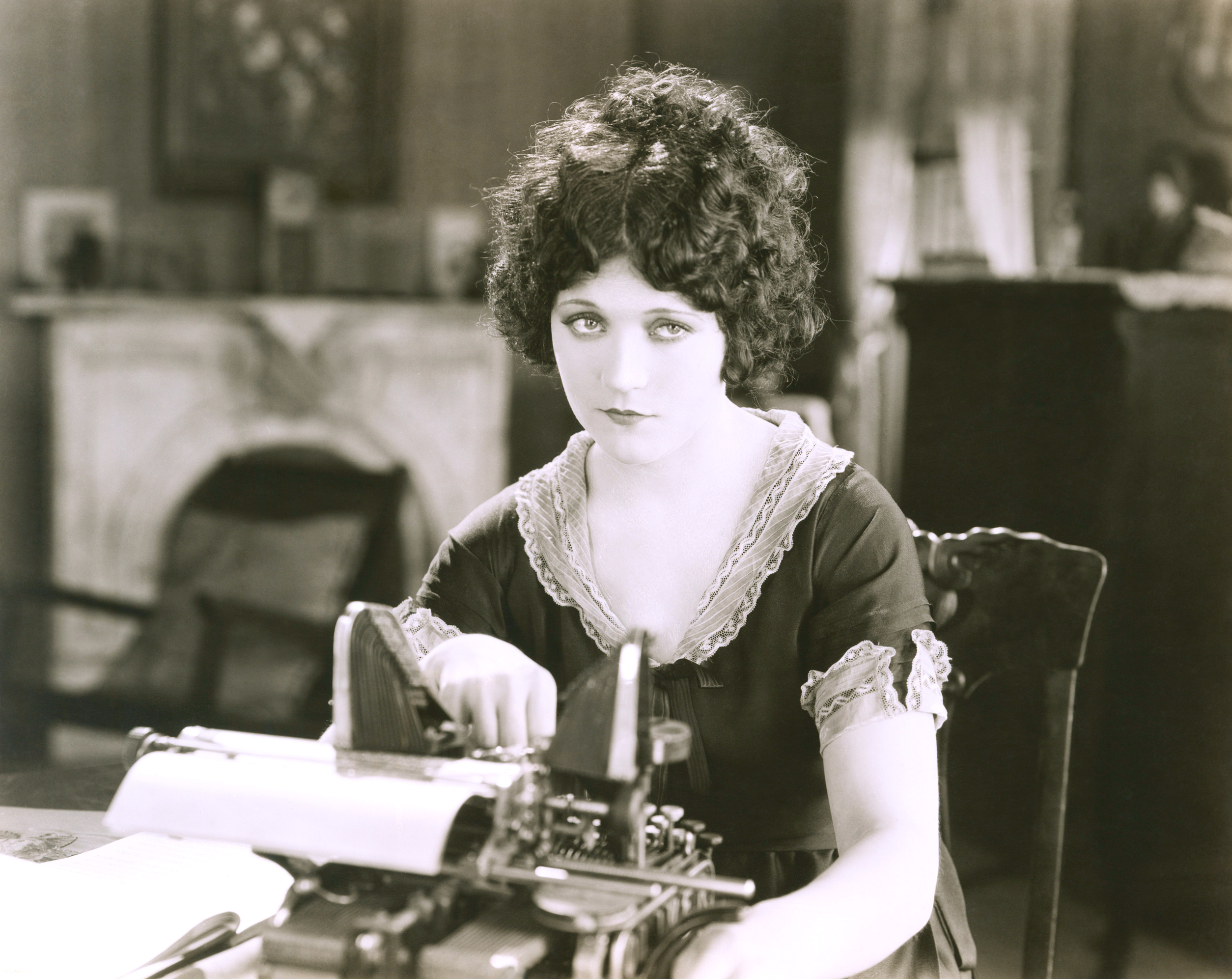
Thoughtful typist.

I learned to type in high school, in the 1980’s on a manual typewriter. I can still remember the click clack hammering sound of the keys being struck, the sound of the carriage return lever being hit when I needed to start a new line, the bell as the roller returned to the left hand margin and the sound of the roller as it turned moving the paper up out of the machine. Electric typewriters came along not long afterwards (although my first exams were taken on manual typewriters) and computers came fast on their heels.

History

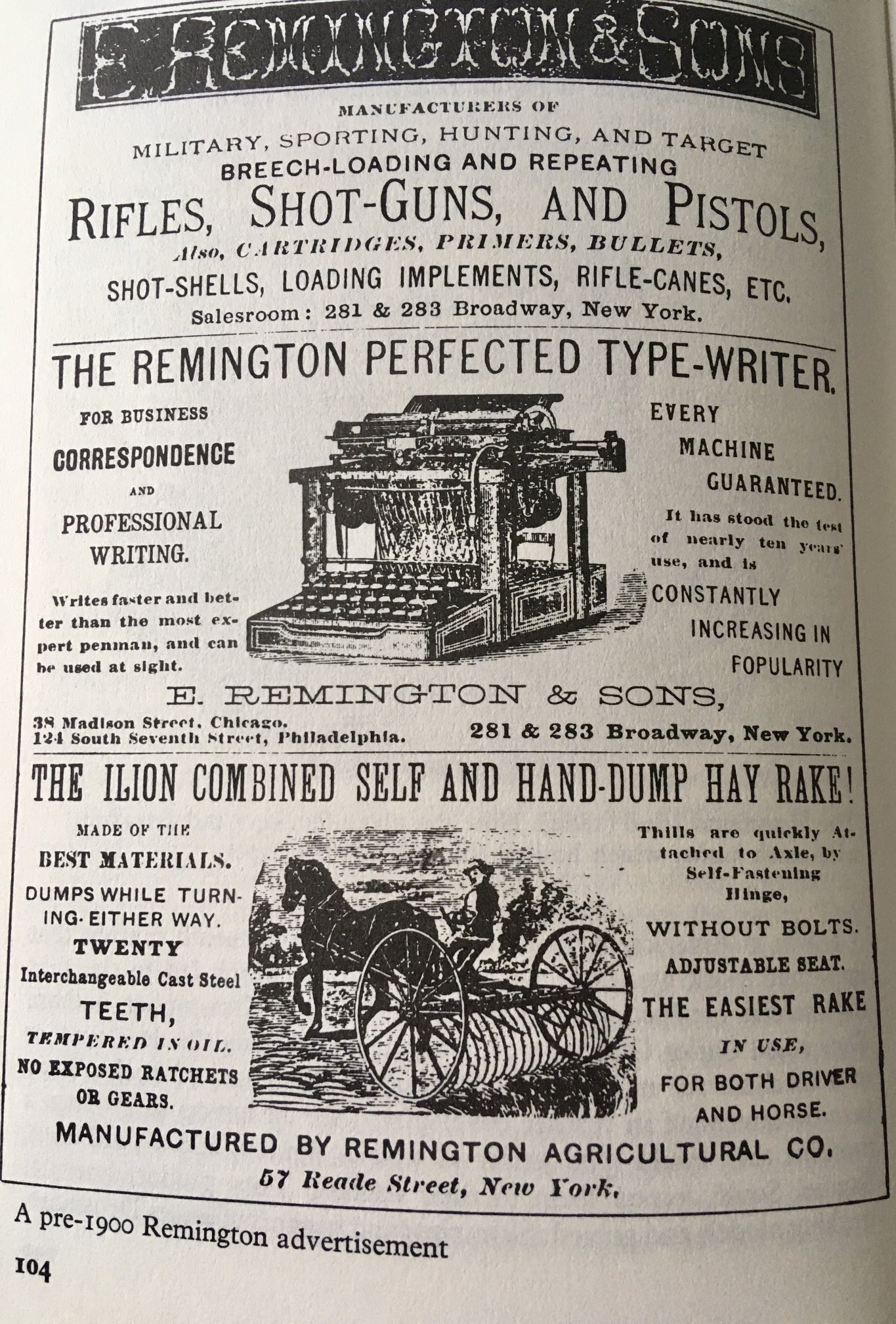
In the 1860s, Christopher Latham Sholes, an amateur inventor in Milwaukee invented the first typewriter, which he developed with Samuel Soulé, James Densmore and Carlos Glidden and first patented in 1868. Resembling a piano, it was originally built with an alphabetical arrangement of 28 keys, so everyone would know where to find them. In 1878 US Patent Number 207,559 marked the first documented appearance of the QWERTY layout and a deal with gun maker Remington, proved to be a huge success.

Remington typewriter advert.

By 1890, there were more than 100,000 QWERTY based Remington produced typewriters in use across the country and in 1893 when the five largest typewriter manufacturers – Remington, Caligraph, Yost, Densmore and Smith-Premier merged to form the Union Typewriter Company, they  agreed to adopt QWERTY as the design we know today.  However, the monospace type of a manual typewriter did not create a sufficient visual space between the end of one sentence and the beginning of the next, so users needed to use two spaces in order that sentences did not run into one another. Today with proportional fonts, only one space is necessary to create the necessary separation but for those of us who had it drilled into us that two spaces should always be used after a full stop, it a hard habit to break. 

Vintage typewriter keyboard.

A learned skill

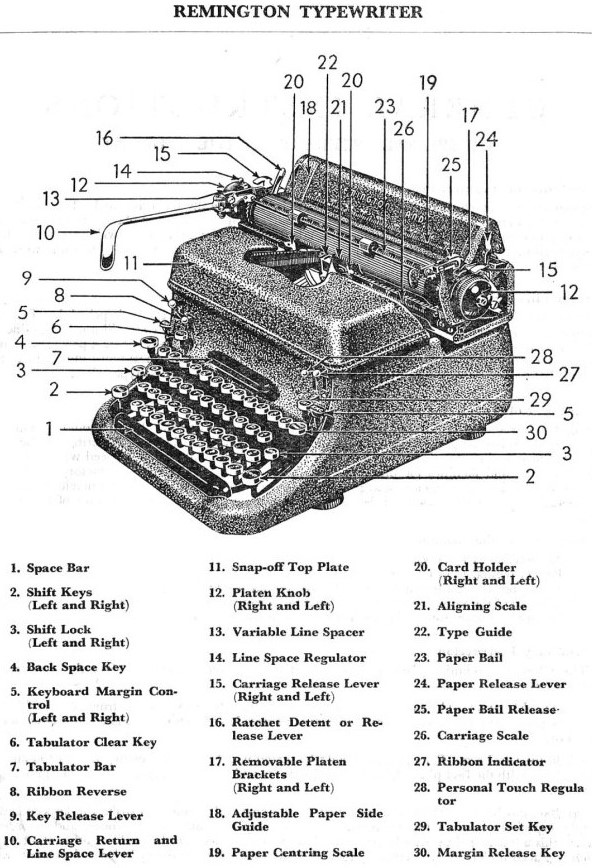
If you wanted to work in an office, typewriting was a skill that had to be learned and for which exams were sat and qualifications achieved. Typewriters were complex pieces of machinery as can be seen in the illustration below. The strange unfamiliar arrangement of the keys was the first of many things I had to learn before I could begin typing, such as how to insert a sheet of paper, how to wind the roller to bring the paper in and out of the machine, how to adjust the paper if it wasn’t straight and how to hold the paper in place with a ruled metal bar which was also used for setting margins and tabs. 

Remington typewriter parts.

Diagram showing Remington typewriter parts.   

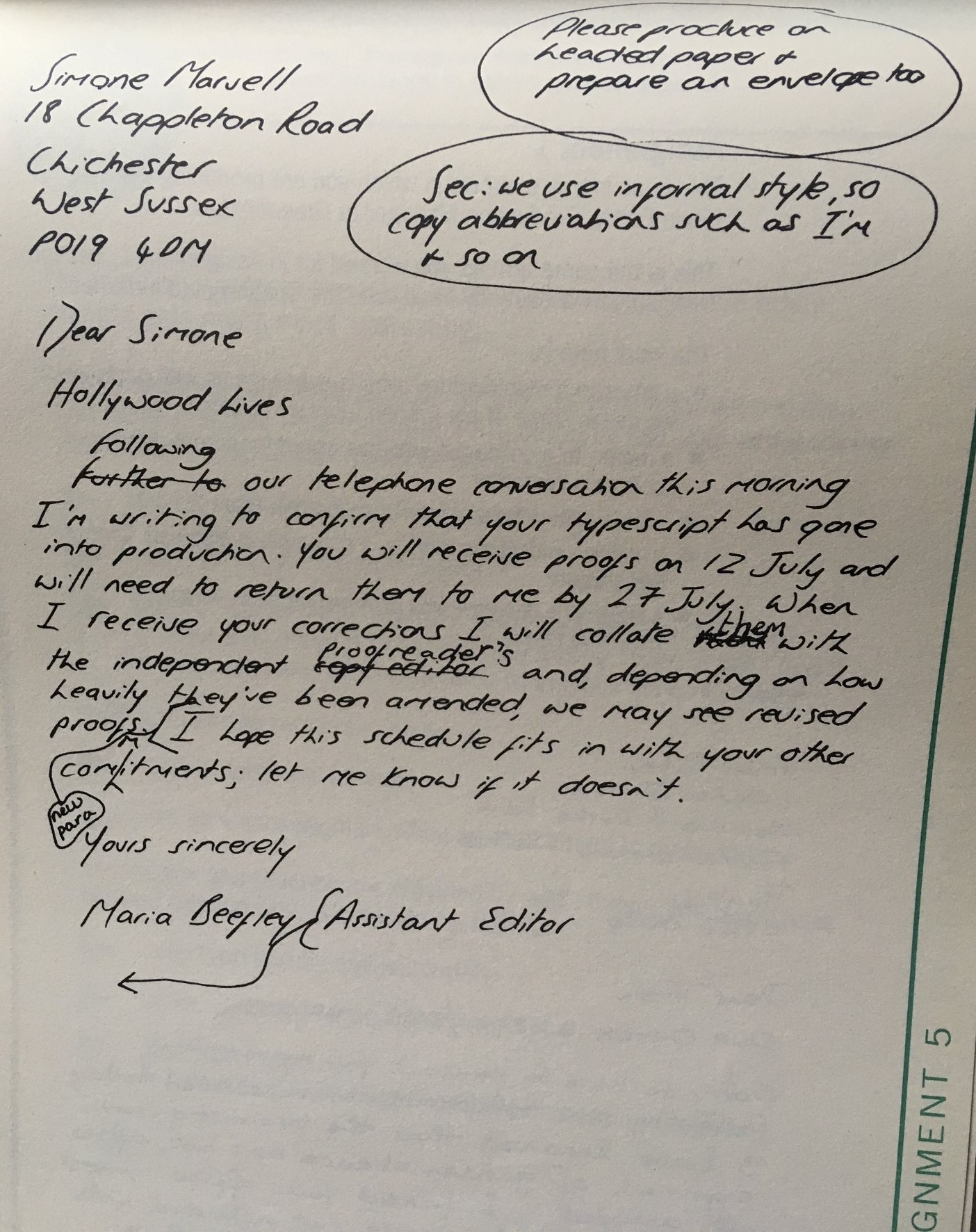
As my training progressed, I learned to touch type by typing the same letters over and over, for example asdsd, fadsf, dfsaf, so I would learn where the keys were without looking, before progressing to ‘the quick brown fox jumped over the lazy dog’. I was taught how to layout letters correctly, sometimes with full punctuation (that is using commas within dates and addresses); how to type envelopes and labels and I learned that the word ‘stet’ next to words that had been crossed through or changed, meant the writer wanted me to ignore the alteration – the word means ‘let it stand’. If my letter was to have an enclosure, the letters Enc needed to be added to the bottom of the letter.

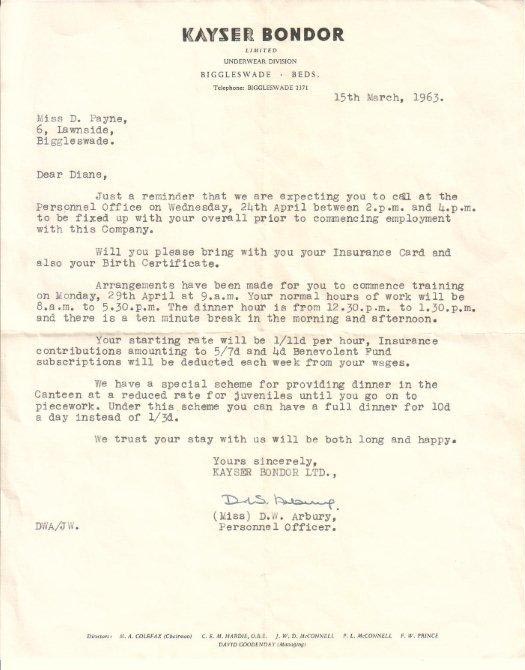
kayser-bonder

Example of a letter using full punctuation.  

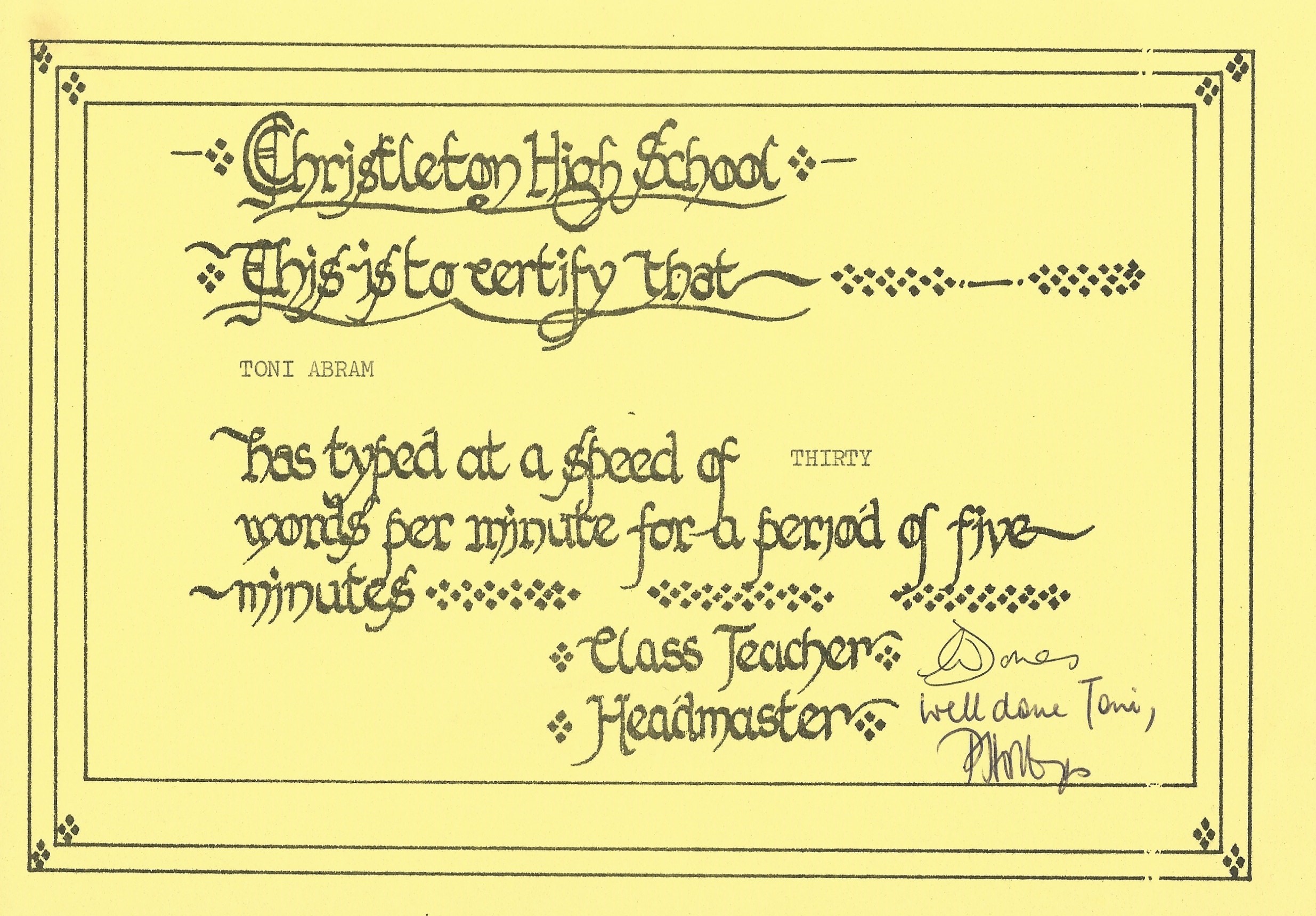
Then there was carbon paper, thin paper coated with ink which was used for making duplicate copies of a  document. So for example you may be asked to produce a letter with two carbon copies, say an office copy and a copy for another recipient and would have to construct a sandwich made of paper and carbon paper which then needed to be fed into the typewriter. Copy letters needed to have the letters  CC and the name of the recipient inserted at the end of the letter, so that everyone could see who received a copy of that letter. However, if you wanted copies of a letter to be sent without everyone knowing who had received it, you had to instead handwrite the letters BCC, which stood for blind carbon copy, along with the name of the recipient on the copy letter only (and also remember to put the right letter in the right envelope). Speed tests were undertaken too, as typing exams were timed, so you needed to be able to produce your work in the allocated time when you came to sit your exam. I remember feeling terrifically proud of mine, which were signed by my typing teacher and my headmaster.

Speed test certificate.Speed test certificate.

There was one font size and font style but no way to emphasise text in bold or italics. The typewriter ribbon, black on the top half, red on the bottom half, allowed the typist to type in one of the two colours, depending on how the machine was set. The ribbon also needed to be changed regularly by reaching into the top of the machine, removing the ribbon spool and replacing it with a new one.  Underlining if required was done by repeatedly hitting the underline key the length and distance of the text that needed underlining. Tables were created in a similar manner and rows and columns of figures had to be lined up correctly and evenly spaced. It was slow, methodical, detailed work and any mistakes had to be corrected manually, using a typewriter pencil, tippex liquid or tippex paper. However, presentation was of the utmost importance, so if errors could not be corrected neatly, you would need to start over with your document. 

type-a-letter-exerciseExample of an instruction to type a letter.
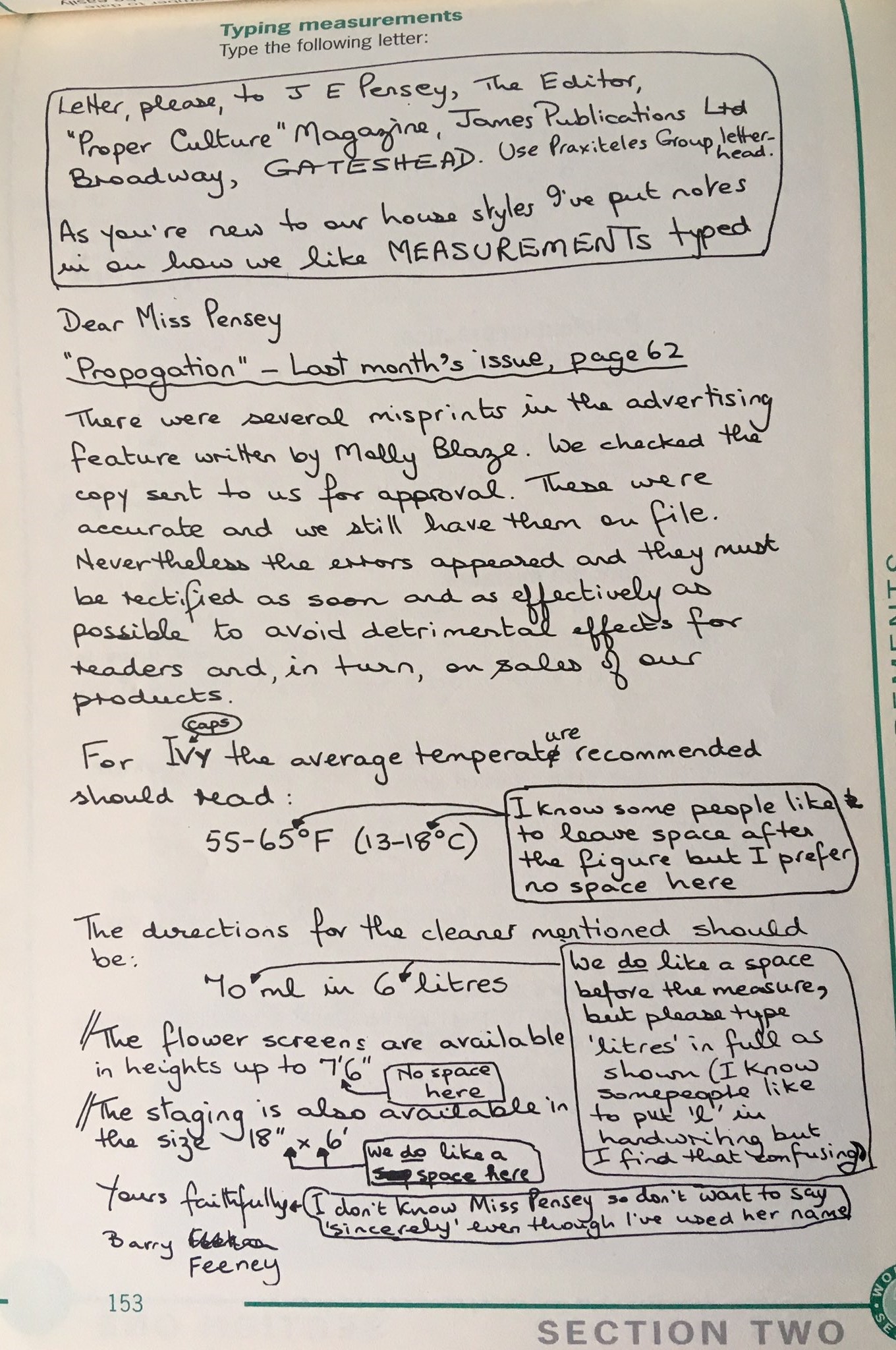
Examinations

I remember undertaking many practice papers in preparation for my exams and anxiously waiting my results. RSA and Pitman were the typewriting qualification boards and they had strict rules that needed to be adhered to if you wanted to pass your exams, meaning that attention to detail was a must. Two spaces after a full stop or a colon and one after a comma or semi colon were essential and you lost marks if you failed to do this.

RSA exams were timed and assessed in three areas – production (completing the work in the given time), accuracy and presentation. Failing in one area meant you failed the whole exam. Candidates could achieve RSA qualifications at three levels – elementary level (RSA one), intermediate level (RSA two) and advanced level (RSA three).

type-a-letter-exercise-2
Instruction to type a letter.

Today I am the proud holder of RSA qualifications at levels one, two and three, an RSA elementary qualification in audio typing, Pitman advanced and elementary qualifications, along with Computer Literacy and Information Technology (CLAIT) and European Computer Driving Licence (ECDL) qualifications. Then I learned how to create and update websites too, which I have now done for over 15 years. And I feel proud, not only for me but for those who went before me, doing it the hard way, learning their craft before computers ruled the world and then, as we entered the digital age, learning new skills and ways of doing things. 

So, if you feel annoyed when seeing two spaces after a full stop, just for a moment consider how important it actually is. And remember, there was a time when two spaces were the standard and the only way to do things. Typing wasn’t always as easy as it is today. And finally, you never know what changes may happen in your own lifetime, so maybe take a moment to think before you dismiss someone’s way of doing things out of hand. Be kind to those who may do things differently to you, as one day, you may find yourself in their shoes.

Note

Microsoft Word now enables users to change document spacing. If like me you find two spaces a hard habit to break but need to work to a house style, select editor on your toolbar, then ‘punctuation conventions’ and ‘one space’. Further information can also be found in help by typing ‘change the spacing between text.’

Sources

Further information 

Ickwell May Queen

May Day is a traditional event that dates back to ancient times when Romans celebrated the festival of Flora, the goddess of flowers and spring and when Celtic people celebrated the festival of Beltane to mark the halfway point between spring and summer. May Day customs include  Morris dancing and dancing around the maypole.

In Ickwell, Bedfordshire, the first documented account of celebrating May Day in the Parish of Northill can be found in the Church Wardens’ Accounts of c1565.   Payments are listed for the purchase of shoes for the dancers, of bells for the shoes, food and drink.  Payments were also made to various people for their paynes (efforts) and to mysnstrells.  

Ickwell May Queen, 1951

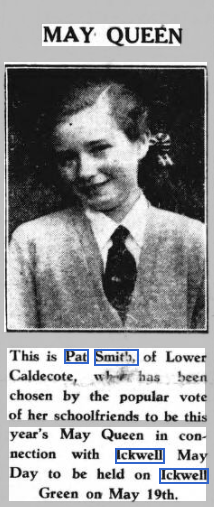
In 1951, my mum’s cousin Pat Smith was Ickwell May Queen. Her picture appeared in the Biggleswade Chronicle, where it was written she had been chosen to be May Queen by her school friends.

Biggleswade Chronicle 11 May 1951.
Biggleswade Chronicle, 11 May 1951.

A further article appeared in the Biggleswade Chronicle on 25 May 1951. It describes the murmur of the crowds, the steady beat of the drums and the sound of bugles in the distance, the humming bees and the fragrant horse chestnut trees and the sound of leather hitting the willow as spectators watched a cricket match.  It was reported that apple trees laden with blossom, against a backdrop of old world cottages, provided a perfect setting for May Day activities. 

The Queen led by her loyal subjects was led by the band of the Corps of Drums and as a company of the Bedfordshire and Hertfordshire Regiment arrived, the Queen surrounded by her attendants, sat on a flower bedecked throne drawn by a gaily decorated tractor.  The traditional song ‘Oh lovely, lovely, May’ was sung and hand bells were rung by Mr W Wagstaff. Then the ceremony of crowning the Queen was performed by Betty Lloyd, the previous years Queen, who placed a crown of flowers on the new Queens head and presentations of a garland of flowers and a sceptre were made.

As music struck up, girls dressed as may flowers, skipped over the buttercup-studded grass to the may pole, curtsied to the Queen and then formed a Guard of Honour.  Later the Queen, with  her Pages and Maids of Honour holding her long gold and green train, paraded around the arena before the Queen returned to her throne to graciously watch the proceedings. 

Modern day Ickwell

While May Day is still celebrated across Britain, what may well be unique to Ickwell is that they have a team of adults, ‘the Old Scholars’, who dance around the maypole too.  Almost without exception they are former pupils of the village school and some of them have children and even grandchildren also performing on the day. And in May 2020, fifty former May Queens attended Ickwell May Day celebrations.  The presentation of the locket to the May Queen 2000, Stephanie Turner was made by Mrs Vera Randall (nee Wagstaff), who had been May Queen in 1920.  

Further information 

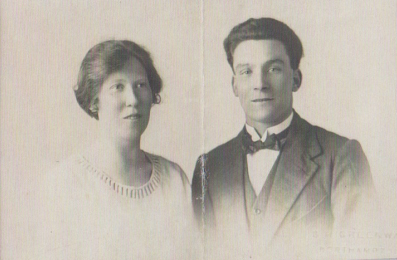
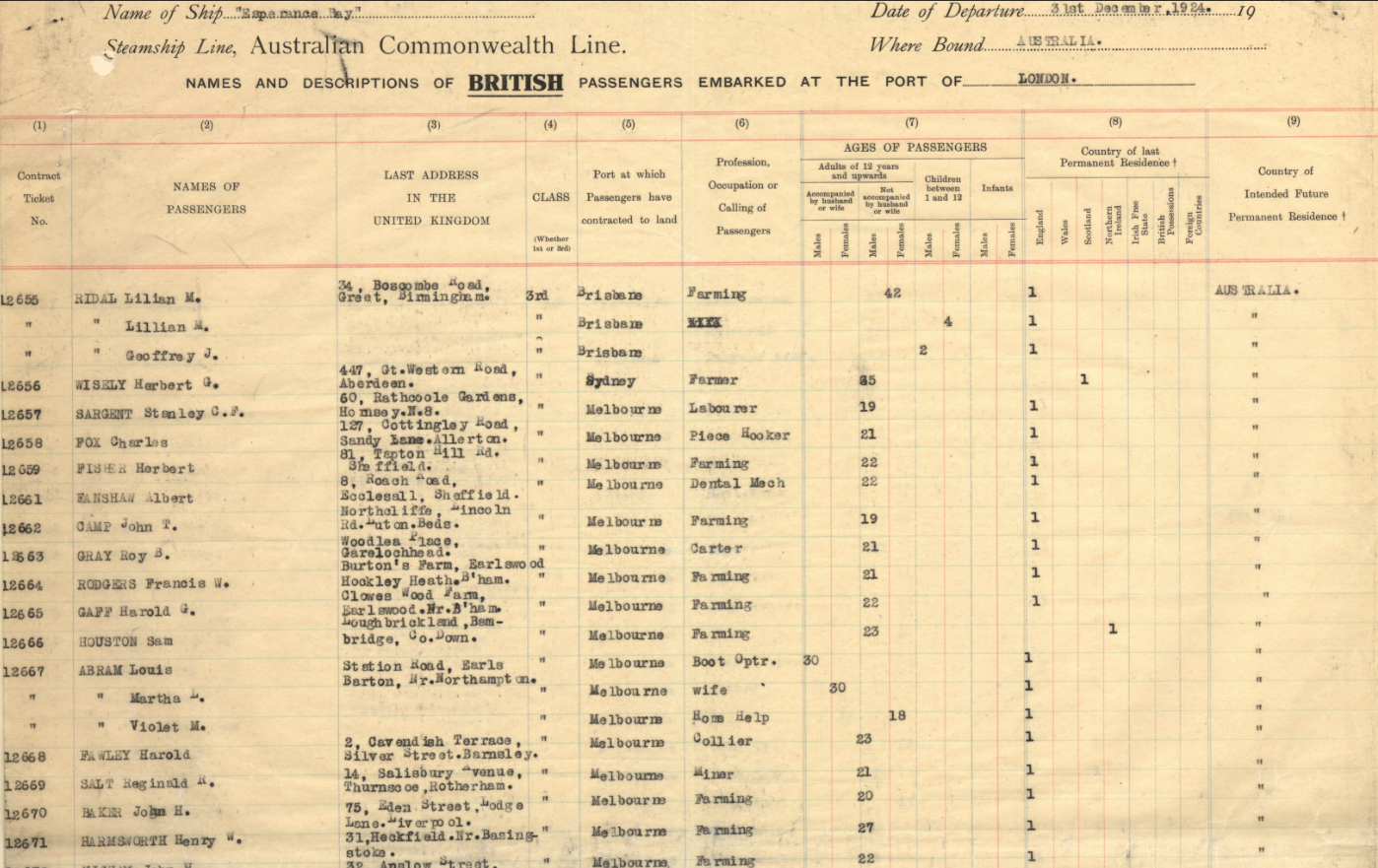
Walter Abram

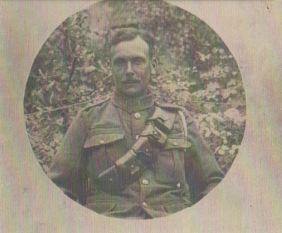
Walter Abram was born in  1896 in Northamptonshire. The 1891 census shows him living at 75, Lower Hester Street, Northampton, Kingsthorpe and the 1901 census, aged 14 at Station Road, Earl’s Barton. His occupation is shown as a shoe machine operative.

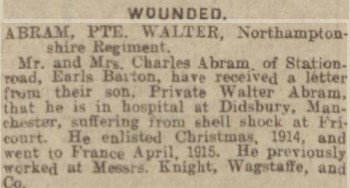
Northampton Mercury: 21 July 1916

In July 1916 a piece appeared in the Northampton Mercury which records that Walter had written to my great great grandparents advising he was in hospital at Didsbury suffering from shell shock, having enlisted in in 1914 and going to France in 1915.  

Walter and Mabel.

I believe that Walter married his wife Mabel in 1920 and on the 1939 register they can be found living together at Rusholme Northampton Road, Earl’s Barton. Walter’s occupation is recorded as a puller over in the boot trade.


William Abram

William Abram was born in All Saints, Northamptonshire in 1888.  The 1891 census shows him aged three living at Great Holme Street, Leicester, aged 13 at 75, Lower Hester Street, Northampton, Kingsthorpe and aged 23 at Station Road, Earl’s Barton.

William Abram

Alice Abram

In 1939, William can be found living at 50 Doddington Road, Earl’s Barton, married to Alice C Abram. His occupation is given as a console master (boot trade).