Betty May Abram

Betty May was the daughter and youngest child of my great grandparents Joseph Charles Abram and Milly May Bowers.  She was born in Halsted, Essex in 1924 and died in 2015.

Betty served in the RAF for a time but her records show she was dismissed under Kings Regs paragraph 652 for being with child.  She later  married Geoff Bryant in Wellingborough, Northamptonshire – they met while working in the Derngate office of the United Counties bus company in Northampton.  Interestingly, this is the same company her father took on during his time as proprietor of Earls Barton Motors.  Geoff was later a Company Director at C Butt Warehousing, a truck haulage company.  He died in 2016.

Henry Grey Faber

Henry Grey Faber was the husband of my great aunt Dorothy (my grandmother’s sister). Dorothy was Henry’s second wife and the couple were married at  Holy Trinity Church, Micklegate, York in 1960. Although Henry is not a direct ancestor, I was interested to learn about him, as I have a very clear memory of being told by my great aunt that his family appeared in Burke’s Peerage and I wanted to learn more about this.

My dad tells me Henry was known as Hal and that he worked as a solicitor. I have confirmed this to be correct by looking at census returns and have also found mentions of Henry’s legal career in the Gazette newspaper.

The 1891 census shows a Henry  G Faber was born in Durham in 1887, to Thomas Faber, aged 30 (born 1861 in Durham) and Ada Faber  aged 29 (born 1862 in Wimbledon, Surrey). A younger brother and sister, Frank S and Ada L are recorded too.  Aged 14 in 1901, Henry appears to have been a boarder at a school in Harrogate and in 1911, aged 24, he is recorded as being a solicitor, living again with his parents Thomas and Ada and with more sisters and a brother.

I have also located information about Henry on the 1939 register, working as a solicitor and living with Ellen G Faber and Elizabeth H F Faber. I believe Henry married Ellen Holberton in Totnes, Devon in 1916. Their daughter Elizabeth was born in Knaresborough in 1917 and in 1939 her  occupation is shown as VAD, which I have learned stands for Voluntary Aid Detachment, a voluntary unit of civilians providing nursing care for military personnel in the United Kingdom and various other countries in the British Empire.

It would be another 20 years before Henry would marry Dorothy, who was working as a school teacher at the time, living in the Morrison household at Faceby Manor Faceby, Stokesley R.D., Yorkshire (North Riding), England.

Searching for Henry Grey Faber on the Find My past website, I found details of his service, medals and awards and his first world war record.  Ellen it seems also served in the army as a staff nurse.

Henry’s father Thomas, born 1861, can be found on the 1871 census residing at Middleton One Row, Middleton St George, Darlington, Durham, England, with his parents Henry Grey Faber, aged 41 (born 1830 in Durham) and Elizabeth Faber, aged 38 (born 1833 in Durham). Also four brothers and two sisters.  The Faber family are all recorded as visitors to Sarah Moore aged 75 and her daughter Mary A Moore aged 37.

I believe that Henry’s grandfather, also called  Henry Grey Faber, was the first son of Thomas Henry and Eleanor Faber and that he was baptised on 1 December 1829 in Durham.  Henry can be found on the 1841 census, aged 11, at Shincliffe, St Oswald, Durham and Lanchester, Durham, England which appears to be a school. In 1851 aged 21 Henry can be found lodging in the household of George and Hannah Harrision at Church Street, Guisborough, Yorkshire & Yorkshire (North Riding), England and employed as a Solicitor’s Articled Clerk.  In 1871 he can be found aged 41 residing with the Moore family as described above.

Origin of the names Faber and Grey

Information about the origin of the Faber and Grey surnames can be found on the Ancestry.co.uk website.

I am interested to learn more about the surnames Faber and Grey, as the name Grey appears to have been used as a middle name by many people with the surname Faber, both male and female, including Henry and Edward, largely in Stockton on Tees. However, I have also found the name connected to  Dorset, London, Middlesex and Essex and would very much like to know more about this. See footnote about the family of Hamilton S Faber and in particular his grandparents Thomas Henry Faber and Eleanor Faber (nee Grey).

More photos

Unknown soldiers

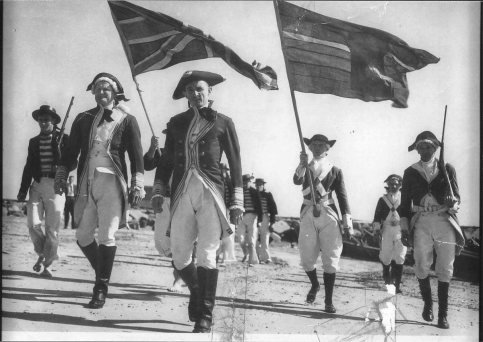
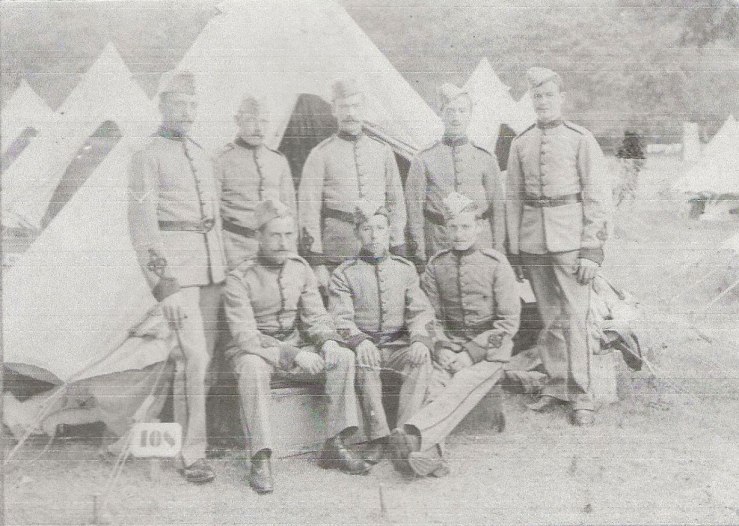
The photo on this page was given to me by my relative Keith Shortland and as such, I am presuming, for now at least, that one of the men shown is a Shortland ancestor. I  know that one of my Shortland ancestors, Richard, served in the 51st regiment, traveling to Australia with them around 1841. The photo isn’t clear enough to make out any badges but the uniform has an interesting design on the sleeves, so I hope in time to learn more about the men pictured.
Unknown soldiers

In papers given to me by my great aunt Dorothy, I learned that a Richard Shortland traveled to Australia with the 51st regiment of the British army (I believe the regiment was later re-named the King’s Own Yorks Light Infantry) around 1841, living there until he died in Sydney in 1887.

I believe I have located Richard on the British Army, Worldwide Index 1841 which shows he was serving in the State of Tasmania and includes his service number (1456) and rank and regiment (51st foot) and a National Archives reference number (WO 12/6203)  which National Archives advised refers to the muster roll or pay list for the 1st battalion of the 51st regiment in 1841 – 1842, one of a series of muster rolls for the battalion.

Further research into the 51st regiment has uncovered the following information.

The State Library and Archive Service advised:

‘According to a Correspondence File on the 51st Regiment (King’s Own Yorkshire Light Infantry) the 51st Regiment ‘was put under orders for Australia in 1837, to relieve the 21st Regiment in Van Diemen’s Land. They came out, according to custom, as guards on convict transports. Detachments arrived direct from England, via New South Wales between February 1838 and 1843. The regiment served in the colony under Lieutenant Colonel Elliott. The Returns of 1839 give the strength as 29 officers and 629 men. A detachment was stationed at Port Arthur in July of 1838; another was detailed for South Australia and left Hobart on 5 October 1841 per the ship Endora. The Regiment was put under orders for India, and part of the regiment left Sydney on 17 April 1841 per the ship Virtue but it was wrecked on the Great Barrier Reef. All were rescued with the exception of one woman. The Head Quarters staff together with four Companies under Lt Colonel Elliott, left Hobart on 8 August 1846 per the ships Agincourt and China. Three companies remained to reinforce the 96th Regiment and Lieut Colonel St Maur, until 27 January 1847 when they sailed per the ship Javato India via West Australia.’

‘Please be aware that Regiments took their records with them when they traveled. To find more specific information out about Richard Shortland contact the National Archives in England: http://www.nationalarchives.gov.uk/ Our office also has copies of pay lists and some British regiment muster rolls (as part of the War Office records in the Australian Joint Copying Project) Unfortunately, searching through this series is extremely time consuming and owing to the limited resources of this office I regret I am unable to conduct an extended search on your behalf. A Tasmanian Private Researcher, however, may be able to assist you and a list of researchers has been attached for your reference.’

‘There are also many references to the 51st Regiment’s time in VDL in the National Library of Australia’s TROVE website (digitised newspaper section).’

National Archives advised:

‘The main source of information for soliders in the British Army during the 19th century is the pension records in WO 97.  These have been indexed by name, both on our catalogue, and on Find My Past, so as the name you’re looking for does not turn up, you can assume that he left the army without becoming eligible for a pension.’

A query sent to the State Library of South Australia resulted in a search of the Tasmanian Archives and name index online but did not provide any relevant information. The library subsequently looked to New South Wales as that is where he lived and died and advised ‘‘State Records (of New South Wales) holds very few records relating to the early regiments stationed in the colony because, as they were British troops, the records remained with the Imperial Government. Hence, surviving records relating to those regiments are held by the Public Record Office, London. However, most State Libraries in Australia hold microform copies of the Muster Books and Pay Lists, which were copied as part of the Australian Joint Copying Project.’

A response to a question about army uniforms advised:

‘The uniforms are British and are worn by men of a Rifle Volunteer regiment. This regiment were part time soldiers, like the  modern day Territorial Army.’

The uniforms I was advised were ‘light grey and have coloured collars and cuffs, either red, blue or green, depending on which regiment they were in. The Rifle Volunteers would assemble regularly for drill and training and spend a few weeks in camp in the summer for proper tactical training.’

Army Museums advised:

‘The ‘uniforms in the photograph certainly appear to be the Colonial Service pattern worn in Australia’. They also advised that they had located 1456 Private Richard Shortland on the nominal roll of personnel from 51st Regiment of Foot stationed in Van Diemens Land, Tasmania in 1841.

In addition, they advised that the 51st Regiment of Foot, later re-titled the King’s Own Yorkshire Light Infantry (KOYLI) served in Australia from 1838 until 1846 when they moved to India. Their principle tasks I was told were typical garrison tasks – guarding convict settlements, hunting down bushrangers, suppressing armed resistance by Indigenous Australians, providing security on the goldfields, assisting local police to maintain public order, undertaking ceremonial duties and developing the nation’s military defenses.

The State Library and Archive Service in Australia advised as follows:

According to a Correspondence File on the 51st Regiment (King’s Own Yorkshire Light Infantry) the 51st Regiment ‘was put under orders for Australia in 1837, to relieve the 21st Regiment in Van Diemen’s Land. They came out, according to custom, as guards on convict transports. Detachments arrived direct from England, via New South Wales between February 1838 and 1843. The regiment served in the colony under Lieutenant Colonel Elliott.

The Returns of 1839 give the strength as 29 officers and 629 men. A detachment was stationed at Port Arthur in July of 1838; another was detailed for South Australia and left Hobart on 5 October 1841 per the ship Endora.

The Regiment was put under orders for India, and part of the regiment left Sydney on 17 April 1841 per the ship Virtue but it was wrecked on the Great Barrier Reef. All were rescued with the exception of one woman.

The Head Quarters staff together with four Companies under Lt Colonel Elliott, left Hobart on 8 August 1846 per the ships Agincourt and China. Three companies remained to reinforce the 96th Regiment and Lieut Colonel St Maur, until 27 January 1847 when they sailed per the ship Java to India via West Australia.
 

The naval Shortlands

Shortland is the surname of a British naval family, members of which served in Australia and New Zealand during the eighteenth and nineteenth centuries.  Since I was young, I remember being told that my family are descendants of Lieutenant John Shortland, who discovered the first coal in Australia whilst taking prisoners to Botany Bay and also discovered and named the Hunter River.
I have a collection of  photographs, cuttings and notes about the Shortland family from by great aunt Dorothy, both my direct ancestors and the naval Shortlands. Slowly I am gathering my own collection of information which seems to point to there being some truth in the story I have been told.

The photo below was given to me by my great aunt Dorothy. It was taken in 1947 and shows the re-enactment of the landing of Lieutenant John Shortland in New South Wales in 1797.

shortland-reenactment

The re-enactment was part of two months of celebrations which included a special issue of stamps, however the stamps showed the image of the wrong Lieutenant John Shortland.

Further information

More photos


Shoemaker or veteran

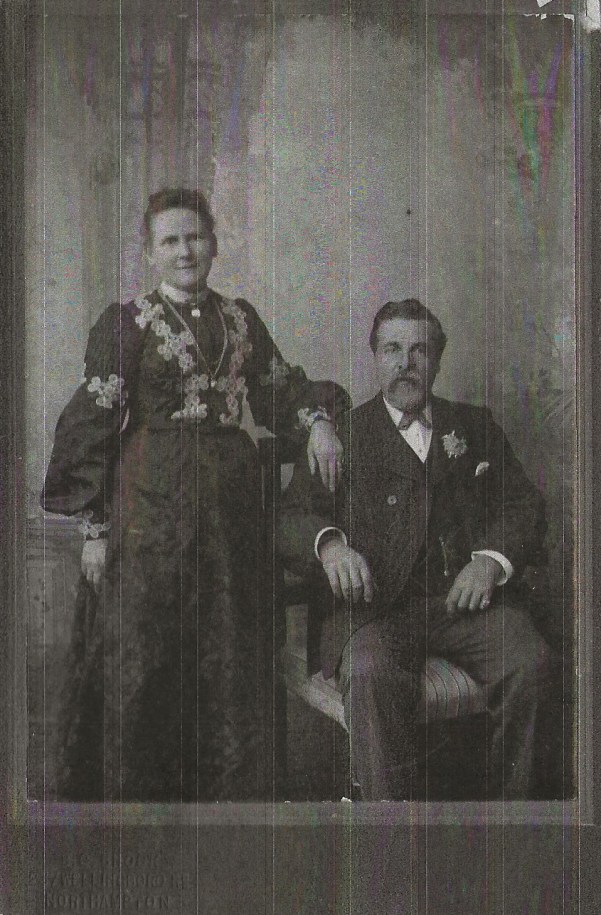
The photo on this page was given to me by my relative Keith Shortland. The man and woman make a striking couple but neither of us know who they are, the only clue is the name and address of the photographer which appears in the bottom right of the photo – B G Brock, 23 Wellingboro Road, Northampton.

The sheriff of Northampton

Northampton is known for shoe making and I know some of my ancestors were shoe makers in Northamptonshire (one is recorded as being a journeyman shoemaker meaning he traveled around the country to work).

A search of the National Archives has found two entries which reference the photographer.

In February 2018, Paul Boniface who was researching Victorian and Edwardian photographers in Northamptonshire got in touch and advised:

Benjamin George Brock ran a studio at 237 Wellingborough Road, Northampton between 1903 and 1907. In 1901 the census shows him as a lodger at 235 Wellingborough Road – occupation photographer and on 1 March 1903 he married Ida Blanche Allen. The 1911 census shows him living at 25 Beaconsfield Terrace, Northampton – occupation Foreign Correspondent.

The photo is a studio photo and the style of dress is in keeping with early Edwardian attire. Paul thought the emblem on the gentleman’s jacket was a flower (maybe a dahlia) and advised that a journeyman is the stage after an apprenticeship –  there was five to seven years worked as an apprentice and then three years as a journeyman.

If you check the size of the photo it will also give you an indication of the date. 2.5″ x 4″ (CdV) would point to the early years of Benjamin and 4″ x 6.5″ would be the latter say 1905-7.

Shoemaker or veteran, I don’t have the answers right now – whether I can learn more about the people on the photograph remains to be seen but I intend to try.

He rode to war on a penny farthing

Ernest Henry Shortland was the brother of my great grandmother Louisa Jane. Born in Weedon, Northamptonshire in 1876, for most of his life he worked as a wheelwright.

Ernest and wife Laura outside the house Ernest built at Braefield

As a young man, Ernest joined the local section of the First Battalion, the Northamptonshire Volunteers and would travel with his colleagues on Penny Farthing bicycles to Daventry weekly, to take part in combined company drill and exercises. On arriving in Daventry, the cycling soldiers were greeted with shouts of ‘here come the mounted infantry’.

At the outbreak of war, Ernest volunteered for service but because of his age was advised to join the County Police and this is how he came to Braefield. As a war time police officer, he had many experiences, including chasing German prisoners of war who had escaped Pattishall Camp. who were located hiding in a a wood and escorted back to Northampton.

Ernest died in Braefield aged 91 and at that time was the villages oldest man.

More photos

The railway man

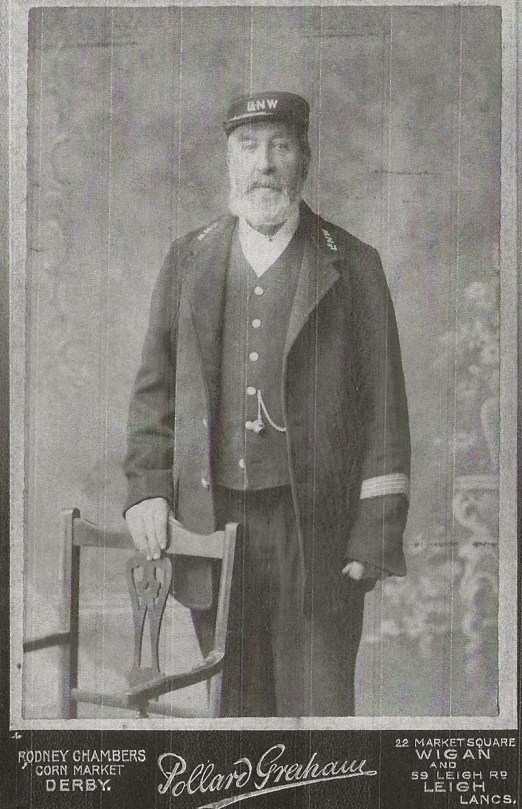
The photo below was sent to me by my relative Keith Shortland – Keith is the great grandson of Ernest Shortland and I am the great grand daughter of Ernest’s sister Louisa Jane.  Our family comes from Northamptonshire but we are aware of Shortland’s in other places too.

Railway man

Neither of us know anything about the man in the photo but there are a number of clues that in time may help us discover who he is.

The man is wearing a uniform and his hat and jacket both read ‘L&NW’.  I have learned this is the uniform of the London and North Western Railway (L&NWR). It has been possible to date the photo as 1922 or earlier. This is because L&NWR was absorbed into the London Midland and Scottish railway (LMS) on 1 January 1922.

The chevrons on the man’s jacket are interesting too but looking at photos online, these don’t appear to have been part of the standard uniform and to date I have been unable to find out anything about these.

On his waistcoat the man appears to be wearing a pocket watch and I have found photos of pocket watches online, with L&NWR showing on the watch face. These were made by John Walker of London and I wondered if this is the same watch the man in the photo is wearing and whether the watch could have been a long service award.  I contacted Simon Turner at G.W. Railwayana Auctions about the pocket watches that are displayed on his website. Simon advised ‘none were given out as awards, some members of staff provided their own and some were issued official company marked watches ie. Guards.’

I have also learned that leaving the bottom waistcoat button undone was custom, because of Prince/King Edward being quite rotund and being unable to do it up, so everyone else followed suit and this is still the norm today.

The photo was taken by Pollard Graham and gives addresses in Derby, Wigan and Leigh.  A history of this photographer can be found below.

The company appears to have started business in Derby in 1878. The Photo-Sleuth website states that a portrait business was operated from premises at Rodney Chambers, Corn Market in August 1890 and that from 1903 until 1910, Pollard Graham also operated in other Midland towns, including Peterborough, Burnley, Leigh and Wigan. All photos from these branches were styled ‘Pollard Graham,’ with no suffix’ (as is the photo shown on this website), so it would seem likely that the photo was taken during this period, although Pollard Graham, continued to take portraits at Rodney Chambers, Corn Market from 1926 until his death in 1932.

There’s no place like home

Going through old family photos, I have come across photos of places my family have lived. Below is a brief history of some of the places my family have called home.

39 Woodbridge Close, Luton

My first home was 39 Leagrave Close, Luton and it was here that I was born. My mum had wanted to give birth to me in hospital as I was her first baby but the doctor felt she was young and healthy, so a home birth it was.

Woodbridge Close was my parents first home after they were married in March 1967 and I came along in May 1971. The house was a mid terrace in a block of three properties and a new build which cost £4,250. Dad told me the heating/hot water came from a coal fired back burner in living room. The house had three radiators, the coal fire had to be refilled two to three times a day and an ash box emptied each morning.


Langport Drive, Vicars Cross

When I was seven months old we moved to Chester. My parents bought a new three bedroom house on Langport Drive in Vicars Cross for just under £5,000, after the first buyers pulled out and we moved in on 9 December 1971.  At the time of purchase the house had just a gas fire in living room and my parents had to find a plumber to fit the central heating.

The houses were built by Thomas Warrington Homes Limited and are a mix of bungalows, detached and semi detached properties, most of which have very recogisable windows on the front of the property – one large window divided up into many smaller windows. The bedroom windows overlooking the road had two similar smaller windows, with wooden shutters and mock black iron hinges. Today the windows still remain but the shutters and black hinges have now mostly be taken down.

My friend Ian and his sister Helen lived a few doors up the road in a detached property – their house was the last house on the right of the street. I remember it had a larger back garden than the rest of the houses and to the side of their house, out the front, there was a piece of land on which the children from the street would often play. The land signalled the top of the cul-de-sac, behind which a hedge was planted to separate the road from the busy A41 which ran directly behind it.

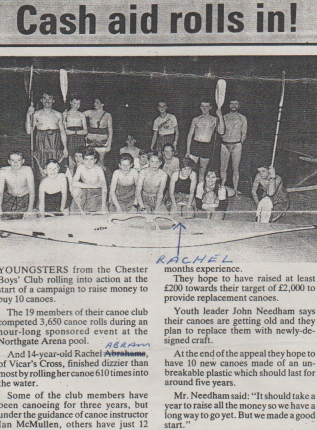
The black and white photos below show Ian and me as bables outside of my parents house.  The colour photos show Ian and me with our sisters Helen and Rachel.


Poplars Close, Luton

Poplars Close was my grandparents house until I was about 11 when they moved to Chester. I remember visiting my grandparents and also, because it was so close, getting to visit London and go the theatre at the same time which was always a treat.

The property was a large two bedroom bungalow called ‘Robin Hill’. The property was a large two bedroom bungalow, with a large garden out the back. I remember a greenhouse where my grandfather grew tomatoes and looking at the the photos today, I am struck by the size of the garden and how pretty it was. My grandfather must have spent a lot of time out there and I wish I could have talked to him about it, as I have grown to love gardens too and I think he could have taught me a thing or two.
My great grandfathers Albert Edward William Clarke and my great grandfather Joseph Charles Abram lived about 100 yards away from one another on Earls Barton. More information about both men can be found on this website.

32 Mears Ashby Road, Earls Barton

Mears Ashby Road was the home of my great grandfather, Joseph Charles Abram. Named ‘Rockaway’, it was a three bedroom semi detached house and was one of two houses which we believe he built after he retired from the army.

My dad and granddad lived in this house for around  4 – 5 months in 1952 too because my grandmother was in hospital. Dad remembers the property had a large flower garden but also a large area for growing vegetables. He explained to me that gardens were much bigger than they are today and growing vegetables had been encouraged during the war years as part of the Grow for Victory campaign.

The Limes, Earls Barton

My great grandfather Albert Edward William Clarke lived at The Limes.  The house still stands today.  Photos of the property can be seen below.


The Rag Trade

My mum has always been good with a needle and thread and when she left school, her first jobs were in the textile industries.

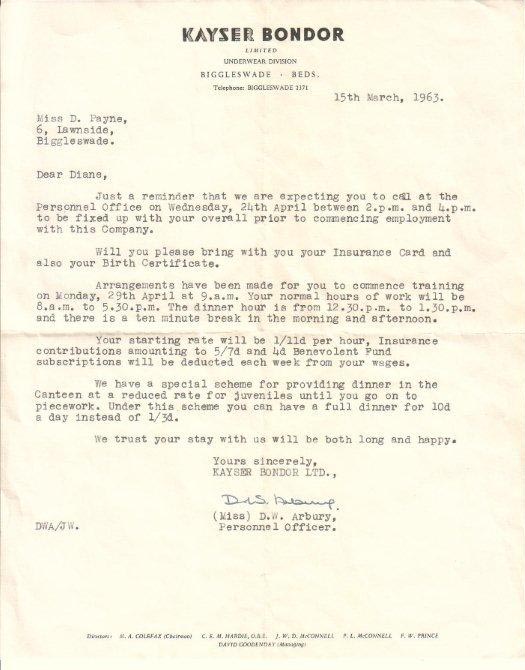
Mum first worked for a company called Kayser Bonder in Biggleswade.  The underwear made by the company, was known throughout the world during the 1950’s and 1960’s and Biggleswade was home to one of its factories for 53 years. The letter shown below was sent to my mum prior to her starting work at Kayser Bondor. She was fifteen years old at the time.

kayser-bonder
Mum also worked as a sewing machinist for Skirtex undertaking piece work (a type of work which pays a fixed rate for each unit produced or action performed regardless of time) and at Electrolux as an armature winder, both in Luton.

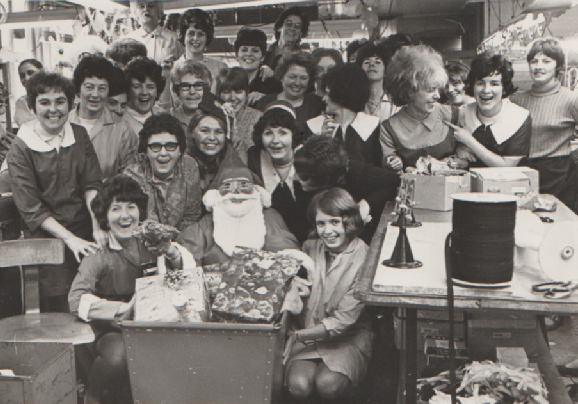
The photo below was taken at Skirtex. Mum is stood directly behind Father Christmas, to the right of a woman wearing glasses, who I know was called Connie, because I met her once.  Mum tells me the women had a radio and would sing while they worked and I can imagine them singing along loudly and giving hell to any man who walked across their factory floor.

mum-skirtex

Later, mum made clothes for my sister and I and also for my dolls – I still have a bag full of them, seemingly unable to throw them away, even though I am now much too old for such things.

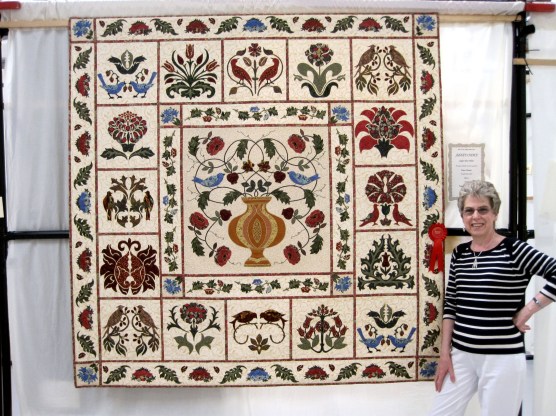
Then, almost forty years after mum began work with Kayser Bondor, she took early retirement and began making quilts. Turns out she is pretty amazing at it too and has won awards for her work. Mum’s quilts are displayed on her website below.

natures_treasures

Up in the air

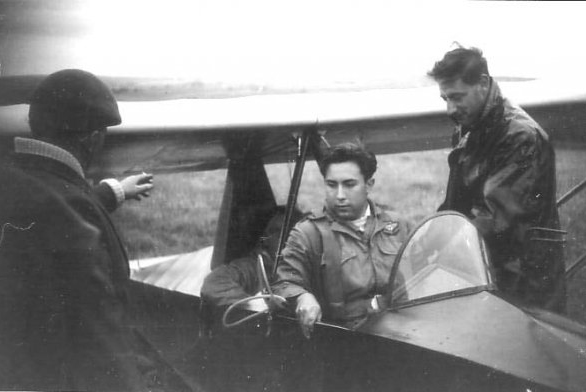
When he was young dad was a member of the  London Gliding Club on Dunstable Downs. Bedfordshire. He trained as a glider pilot and was ready to go solo but never saw the training through as he needed the money to buy a home. The photo below was taken at the Scottish Gliding Centre in 1962. The plane is a Slingby T31 trainer.

scottish-gliding-centre-1

However, he retained an interest in flying over the years and for four years in the mid 1960s he worked at Luton airport as a duty crewman in the airport fire service which he described as fire, security and any jobs the airport commandant requested  to maintain smooth running of the airport.

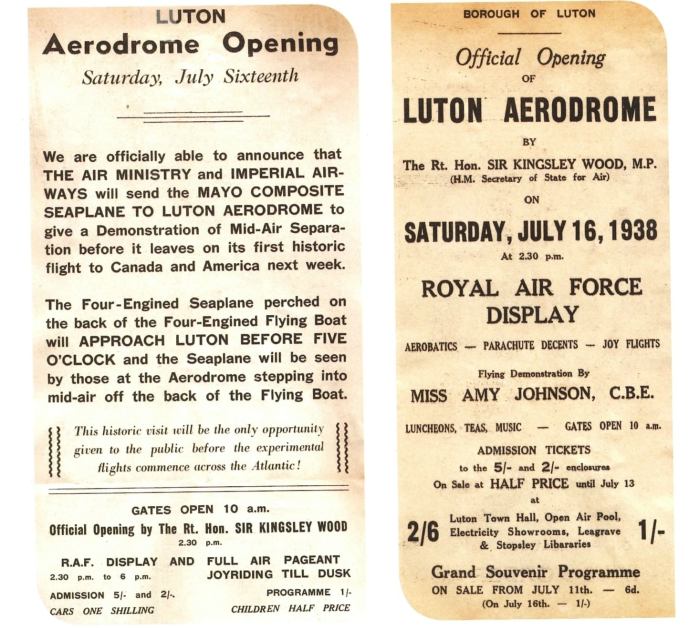
The airport was opened in 1938 by Sir Kingsley Wood, MP, the Secretary For Air, at which time it was known as the the Luton Aerodome and featured a flying demonstration by Amy Johnson, the first woman to fly solo from England to Australia in 1930 and who set a string of other records throughout her career.

Newspaper articles from the opening of Luton Aerodrome.