Henry Grey Faber

Henry Grey Faber was the husband of my great aunt Dorothy (my grandmother’s sister). Dorothy was Henry’s second wife and the couple were married at  Holy Trinity Church, Micklegate, York in 1960. Although Henry is not a direct ancestor, I was interested to learn about him, as I have a very clear memory of being told by my great aunt that his family appeared in Burke’s Peerage and I wanted to learn more about this.

My dad tells me Henry was known as Hal and that he worked as a solicitor. I have confirmed this to be correct by looking at census returns and have also found mentions of Henry’s legal career in the Gazette newspaper.

The 1891 census shows a Henry  G Faber was born in Durham in 1887, to Thomas Faber, aged 30 (born 1861 in Durham) and Ada Faber  aged 29 (born 1862 in Wimbledon, Surrey). A younger brother and sister, Frank S and Ada L are recorded too.  Aged 14 in 1901, Henry appears to have been a boarder at a school in Harrogate and in 1911, aged 24, he is recorded as being a solicitor, living again with his parents Thomas and Ada and with more sisters and a brother.

I have also located information about Henry on the 1939 register, working as a solicitor and living with Ellen G Faber and Elizabeth H F Faber. I believe Henry married Ellen Holberton in Totnes, Devon in 1916. Their daughter Elizabeth was born in Knaresborough in 1917 and in 1939 her  occupation is shown as VAD, which I have learned stands for Voluntary Aid Detachment, a voluntary unit of civilians providing nursing care for military personnel in the United Kingdom and various other countries in the British Empire.

It would be another 20 years before Henry would marry Dorothy, who was working as a school teacher at the time, living in the Morrison household at Faceby Manor Faceby, Stokesley R.D., Yorkshire (North Riding), England.

Searching for Henry Grey Faber on the Find My past website, I found details of his service, medals and awards and his first world war record.  Ellen it seems also served in the army as a staff nurse.

Henry’s father Thomas, born 1861, can be found on the 1871 census residing at Middleton One Row, Middleton St George, Darlington, Durham, England, with his parents Henry Grey Faber, aged 41 (born 1830 in Durham) and Elizabeth Faber, aged 38 (born 1833 in Durham). Also four brothers and two sisters.  The Faber family are all recorded as visitors to Sarah Moore aged 75 and her daughter Mary A Moore aged 37.

I believe that Henry’s grandfather, also called  Henry Grey Faber, was the first son of Thomas Henry and Eleanor Faber and that he was baptised on 1 December 1829 in Durham.  Henry can be found on the 1841 census, aged 11, at Shincliffe, St Oswald, Durham and Lanchester, Durham, England which appears to be a school. In 1851 aged 21 Henry can be found lodging in the household of George and Hannah Harrision at Church Street, Guisborough, Yorkshire & Yorkshire (North Riding), England and employed as a Solicitor’s Articled Clerk.  In 1871 he can be found aged 41 residing with the Moore family as described above.

Origin of the names Faber and Grey

Information about the origin of the Faber and Grey surnames can be found on the Ancestry.co.uk website.

I am interested to learn more about the surnames Faber and Grey, as the name Grey appears to have been used as a middle name by many people with the surname Faber, both male and female, including Henry and Edward, largely in Stockton on Tees. However, I have also found the name connected to  Dorset, London, Middlesex and Essex and would very much like to know more about this. See footnote about the family of Hamilton S Faber and in particular his grandparents Thomas Henry Faber and Eleanor Faber (nee Grey).

More photos

There’s no place like home

Going through old family photos, I have come across photos of places my family have lived. Below is a brief history of some of the places my family have called home.

39 Woodbridge Close, Luton

My first home was 39 Leagrave Close, Luton and it was here that I was born. My mum had wanted to give birth to me in hospital as I was her first baby but the doctor felt she was young and healthy, so a home birth it was.

Woodbridge Close was my parents first home after they were married in March 1967 and I came along in May 1971. The house was a mid terrace in a block of three properties and a new build which cost £4,250. Dad told me the heating/hot water came from a coal fired back burner in living room. The house had three radiators, the coal fire had to be refilled two to three times a day and an ash box emptied each morning.


Langport Drive, Vicars Cross

When I was seven months old we moved to Chester. My parents bought a new three bedroom house on Langport Drive in Vicars Cross for just under £5,000, after the first buyers pulled out and we moved in on 9 December 1971.  At the time of purchase the house had just a gas fire in living room and my parents had to find a plumber to fit the central heating.

The houses were built by Thomas Warrington Homes Limited and are a mix of bungalows, detached and semi detached properties, most of which have very recogisable windows on the front of the property – one large window divided up into many smaller windows. The bedroom windows overlooking the road had two similar smaller windows, with wooden shutters and mock black iron hinges. Today the windows still remain but the shutters and black hinges have now mostly be taken down.

My friend Ian and his sister Helen lived a few doors up the road in a detached property – their house was the last house on the right of the street. I remember it had a larger back garden than the rest of the houses and to the side of their house, out the front, there was a piece of land on which the children from the street would often play. The land signalled the top of the cul-de-sac, behind which a hedge was planted to separate the road from the busy A41 which ran directly behind it.

The black and white photos below show Ian and me as bables outside of my parents house.  The colour photos show Ian and me with our sisters Helen and Rachel.


Poplars Close, Luton

Poplars Close was my grandparents house until I was about 11 when they moved to Chester. I remember visiting my grandparents and also, because it was so close, getting to visit London and go the theatre at the same time which was always a treat.

The property was a large two bedroom bungalow called ‘Robin Hill’. The property was a large two bedroom bungalow, with a large garden out the back. I remember a greenhouse where my grandfather grew tomatoes and looking at the the photos today, I am struck by the size of the garden and how pretty it was. My grandfather must have spent a lot of time out there and I wish I could have talked to him about it, as I have grown to love gardens too and I think he could have taught me a thing or two.
My great grandfathers Albert Edward William Clarke and my great grandfather Joseph Charles Abram lived about 100 yards away from one another on Earls Barton. More information about both men can be found on this website.

32 Mears Ashby Road, Earls Barton

Mears Ashby Road was the home of my great grandfather, Joseph Charles Abram. Named ‘Rockaway’, it was a three bedroom semi detached house and was one of two houses which we believe he built after he retired from the army.

My dad and granddad lived in this house for around  4 – 5 months in 1952 too because my grandmother was in hospital. Dad remembers the property had a large flower garden but also a large area for growing vegetables. He explained to me that gardens were much bigger than they are today and growing vegetables had been encouraged during the war years as part of the Grow for Victory campaign.

The Limes, Earls Barton

My great grandfather Albert Edward William Clarke lived at The Limes.  The house still stands today.  Photos of the property can be seen below.


The Rag Trade

My mum has always been good with a needle and thread and when she left school, her first jobs were in the textile industries.

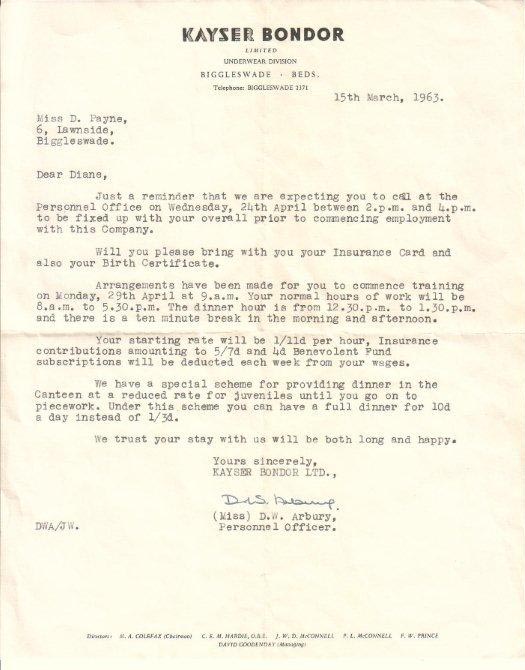
Mum first worked for a company called Kayser Bonder in Biggleswade.  The underwear made by the company, was known throughout the world during the 1950’s and 1960’s and Biggleswade was home to one of its factories for 53 years. The letter shown below was sent to my mum prior to her starting work at Kayser Bondor. She was fifteen years old at the time.

kayser-bonder
Mum also worked as a sewing machinist for Skirtex undertaking piece work (a type of work which pays a fixed rate for each unit produced or action performed regardless of time) and at Electrolux as an armature winder, both in Luton.

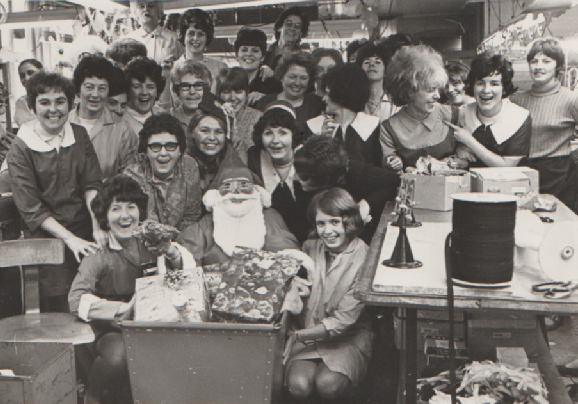
The photo below was taken at Skirtex. Mum is stood directly behind Father Christmas, to the right of a woman wearing glasses, who I know was called Connie, because I met her once.  Mum tells me the women had a radio and would sing while they worked and I can imagine them singing along loudly and giving hell to any man who walked across their factory floor.

mum-skirtex

Later, mum made clothes for my sister and I and also for my dolls – I still have a bag full of them, seemingly unable to throw them away, even though I am now much too old for such things.

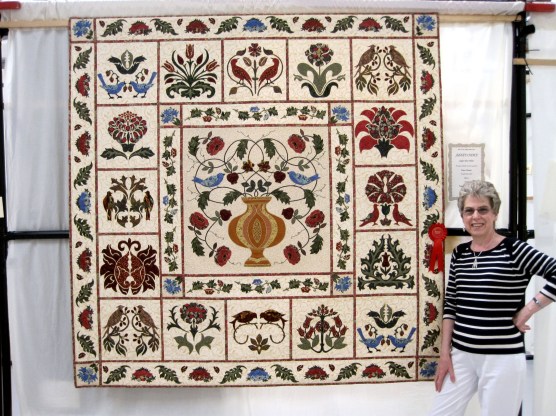
Then, almost forty years after mum began work with Kayser Bondor, she took early retirement and began making quilts. Turns out she is pretty amazing at it too and has won awards for her work. Mum’s quilts are displayed on her website below.

natures_treasures

Up in the air

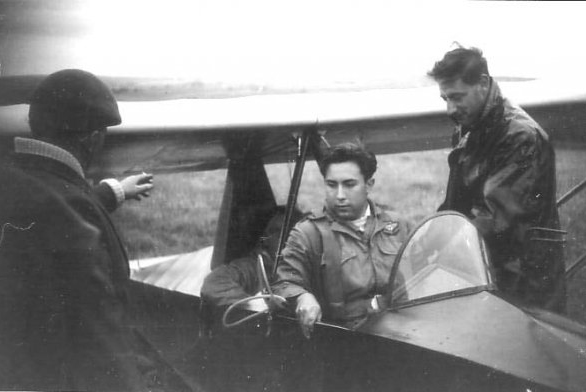
When he was young dad was a member of the  London Gliding Club on Dunstable Downs. Bedfordshire. He trained as a glider pilot and was ready to go solo but never saw the training through as he needed the money to buy a home. The photo below was taken at the Scottish Gliding Centre in 1962. The plane is a Slingby T31 trainer.

scottish-gliding-centre-1

However, he retained an interest in flying over the years and for four years in the mid 1960s he worked at Luton airport as a duty crewman in the airport fire service which he described as fire, security and any jobs the airport commandant requested  to maintain smooth running of the airport.

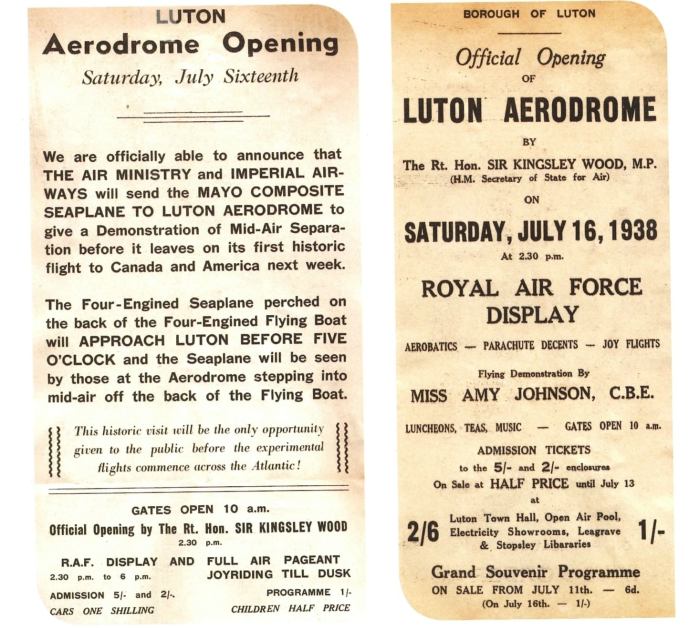
The airport was opened in 1938 by Sir Kingsley Wood, MP, the Secretary For Air, at which time it was known as the the Luton Aerodome and featured a flying demonstration by Amy Johnson, the first woman to fly solo from England to Australia in 1930 and who set a string of other records throughout her career.

Newspaper articles from the opening of Luton Aerodrome.

School days

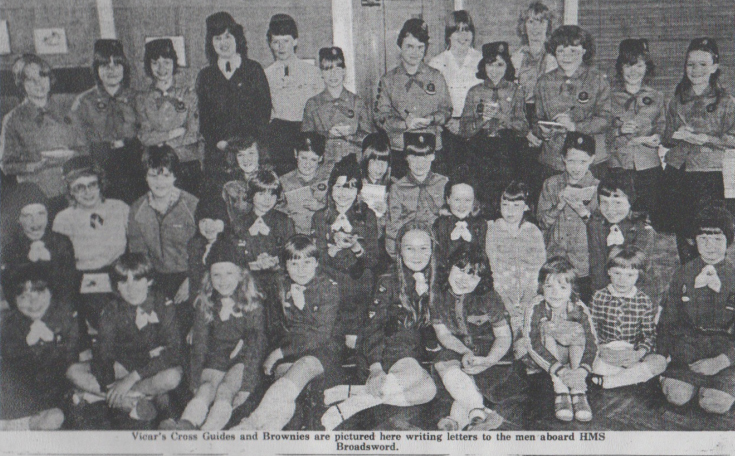
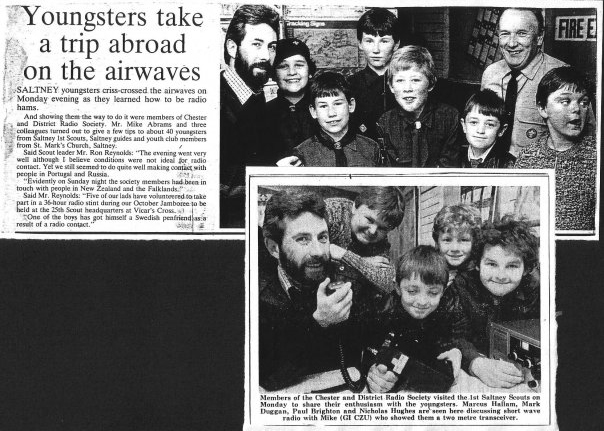
My sister and I spent our childhood in a place called Vicars Cross in Chester. The house we grew up in was on Langport Port Drive, a cul-de-sac and part of a large estate, with two schools, the Square One youth centre (the Youthie), a scout hut (here my dad would disappear one weekend a year for the Jamboree on the Air event, making radio contact with scout and guide groups around the world), a pub, a church, a library and a shopping parade with a home and garden store (later a chemist),  post office, newsagent and greengrocers (Meloncauli) right on our doorstep.

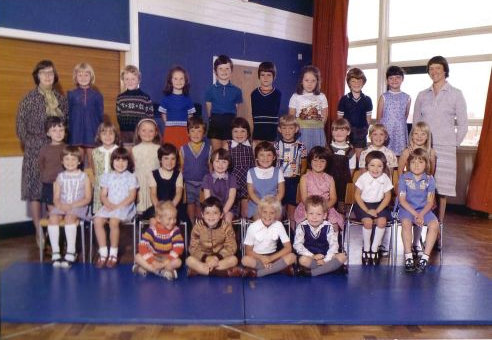
Oldfield infant school was two minutes walk from our house, which mostly meant  we got to go home for lunch. I remember milk time (milk was delivered in crates by the milk man and each pupil received a bottle of milk to drink each day) and a tuck shop. Mrs Cope was my teacher and I remember her teaching us patchwork. Mrs Hale was the headteacher – I remember she had a glockenspiel in her office and the sound the wooden bars made when they were hit. I also remember Mrs Simpson – she once told us that it snowed on her wedding day in June.  (I have learned in recent years that snow fell in the UK in June 1975, halting a Derbyshire versus Lancashire cricket game).

The junior school was a hop, skip and jump along a path which took you across the school playing fields to the larger school which still stands – the infant school has now been demolished and today houses stand in its place. Here we were prepared for attending high school, so lessons were more structured but I also remember singing (the headteacher, Miss Payne I think, trying to get us to sing The Beatles ‘When I’m 64’ and gently reprimanding the boys who really weren’t feeling it) and country dancing classes in the school hall.

I don’t remember there ever being any question that Rachel and I would attend the local schools or go to the same schools as one another, it was just the way things were then. Rachel and I both attended the same high school too, in the pretty nearby village of Christleton.

Each school day we would get the bus with other pupils or at least try to – there was always lots of pushing and shoving and shouting and not being the pushing and shoving and shouting type, I frequently landed up standing, as the bulging bus made its way along the winding roads to the school. I really don’t know how the drivers put up with us – we were perfectly horrid.

I remember my first day at Christleton High School very clearly – it was a sprawling metropolis compared to my earlier schools and I felt very much like a small fish in a big pond, with my huge school bag full of books. I guess the school must have realised that the younger pupils might feel this way though, as there were two playgrounds – one for years one to three and a second one for the older pupils including the sixth formers, who all seemed very grown up and had a room at the school just for them.

English and Home Economics were my favourite classes. Maths and science, not so much. One year I got straight A’s in Religious Education (RE). No one was more surprised than me. Called to Mr Birch’s office (the deputy headteacher), I thought I was in trouble but was rewarded with a stick of rock.

There were a number of school canteens and we had to eat with members of our school house. I remember we used to cover our school books in wrapping paper – maybe to protect them or maybe to be individual, anyhow, it was the thing to do. Also, we had two school uniforms, a winter uniform and a summer uniform made with fabric from Laura Ashley. It seemed that every year we would petition for the girls to be able to wear trousers during the winter months but this was never allowed. I also remember my science teacher, Mr Bradley shaving his beard off for charity and everyone crowding into the school hall to watch.

End of year assemblies were held in the sports hall, the only place big enough for the whole school to congregate and I remember sitting on the hard stone floor, usually reserved for tennis, football and five a side. One year I remember a teacher telling us all we would not need to know Pythagoras Theorem once we left school. He was right but they made us learn it anyway … the square on the hypotenuse is equal to the sum of the squares on the other two sides. Why I still remember that I have no idea and more importantly, what does it mean?

There were no proms back then but on my last day, 22 May 1987, I took my camera into school and took photos of my school friends and we signed books and school shirts to wish one another well. By this time, I was pretty much going in for exams and revision sessions only – I remember spending a lot of time with my friends Emma and Claire at their home in the village and walking home with friends along the canal.

Later that summer, I started work as a YTS trainee earning £28.50 a week which at the time seemed like a small fortune and with which I think purchased a George Michael single and some makeup. At the time of writing this, it has been almost 30 years since I left school, sometimes it seems only yesterday, at others, a lifetime away.

5a

More photos

Margaret and my Australian family

Putting together these pages, I have felt incredibly fortunate to know so much and have so many photos of my family and I am indebted to Margaret Creighton (nee Abram) for sharing so much of the Abram family history with me.

Margaret is my dads second cousin once removed and the daughter of Reginald Abram, one of the many children of my great great grandparents Charles and Emily. After the first world war ended, Charles and Emily stayed in England and Charlie and Millicent (my great grandparents) settled in England too but many of the family emigrated to Australia, with Reg going in approximately 1922 – 1923.

Below are some photos of my Australian family.

Photo one: Margaret with husband Graham, mother Connie (wife of Reginald Abram, one of the children of my great grandparents Charles and Emily) and sister Joan, 20 March 1093
Photo two: Margaret and Graham with Connie aged 90 1/2 years holding her great grandson Robert, also Robert’s mother Teenga
Photo three: Margaret’s eldest child Rodney with wife Jenny
Photo four: Margaret’s middle child, Greg
Photo five: Margaret’s youngest child Andrea

Frederick and Ellen

Frederick Charles William Payne and Ellen (known as Nelly) Brooker were my grandparents.

Both were born in Bedfordshire, Frederick in September 1915 and Ellen in February 1916. Interestingly, I have noticed that all four of my grandparents were born within a year of one another – my grandfather Louis Bowers Abram was born in September 1916 and my grandmother Delia Eileen Clarke was born in March 1916.

Frederick was the only son of Ellen Rose Payne and Ellen was the daughter of David Brooker and Ellen Kefford, who had two other children, a son called Arthur and a daughter called Phil.

The couple were married by special licence two days before Frederick had to report for military service, during which time Frederick was reported missing in action.  They had three children. Pamela Ann and Freda were twins born in 1940 but Freda only lived to be three days old – her death certificate states she was a premature twin born at  seven months. Frederick’s occupation at the time is given as Private Number 198808 Royal Army Service Corps (Butchers Assistant).  My mum Diane was born seven years later in 1948.

Stephen and Mary

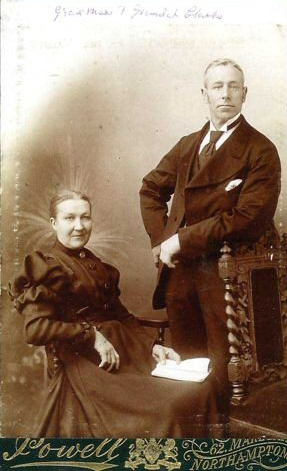
I know very little about this photo but on the top, in writing that looks like my grandmothers, it appears to say grandmother and grandad Clarke.

My grandmothers grandparents were Stephen Clarke born in Welton in 1840 and Mary Ann Wright from Watford. The couple married in Watford on 15 January 1864 and had a number of children, including by great grandfather Albert Edward William Clarke.

stephen-and-mary-clarke

The pommie mafia

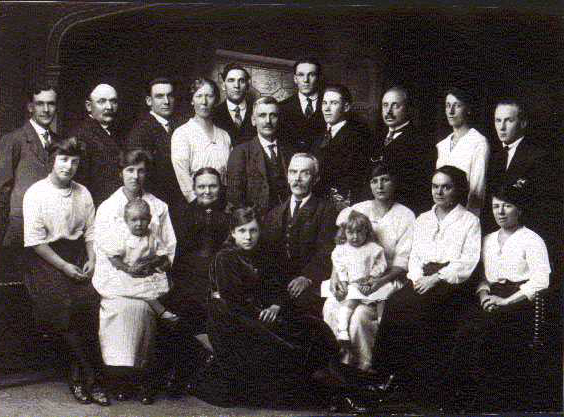
The photo below was given to me by my relative Margaret Creighton who lives in Australia. It shows my great great grandparents Charles and Emily Abram (nee  Hutchings) pictured front and centre, with their youngest daughter Violet, seated in between and surrounded by many of their children. Margaret’s father was Reginald (Reg) Abram and is pictured on the back row of the photo. When Margaret gave me the photo, she told me her husband used to refer to it as ‘the pommie mafia’.

the-abram-family

Back row, from left to right: Will, Frank, Walter, Mabel, Albert, George, Louis, Reg, Will (Millie’s husband), Bet-Martha (Louis’s wife), George (Frank’s son),
Front row, left to right: Gladys (daughter), Alice (Will’s wife), Vera (Will’s daughter), Emily, Violet, Charles, Kit (Albert’s wife) Gwen (Albert’s daughter), Millie, Annie (Frank’s wife)

Further information about Charles and Emily’s children can be found below.

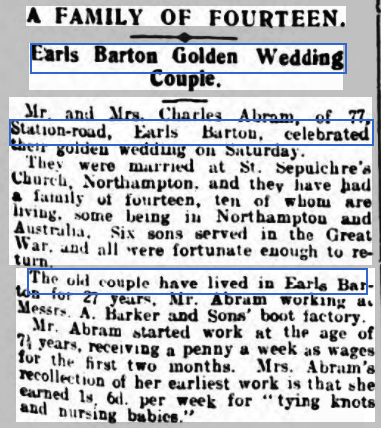
It is believed there were at least two  other siblings that died. One was a female named Mary, the other was a male but his name is not known. A newspaper article from 1930 at the time of  Charles and Emily’s Golden wedding anniversary records there were fourteen children, with six of these serving in the Great War and all of them returning home.

Golden wedding announcement: Northampton Chronicle and Echo, 24 March 1930

When asked about the photo above in her 100th year, Violet re-called a number of things.   The photo was taken not long after Walter and Mabel’s wedding and one of the brothers, George had come over from America to visit. The dress that Violet wore was blue velvet.

Charlie Abram, my great grandfather, was not in the photo because he was in Africa serving in the war. Violet remembered that Charlie had been married prior to marrying my great grandmother Millicent May Bowers and that his first wife had been a ‘dark skinned lady’. (Records show that Joseph’s first wife was Lucy Thompson, her father was William was a gardener and her mother was called Harriet. Joseph and Lucy married on 16 April 1906).

Violet said she was about the same age as Gladys (Frank’s daughter) but Gladys had died aged 29. She noticed that Theresa, who they called Sis, wasn’t in the picture but she couldn’t remember why and that Kit and Albert’s son Sonny had also died young but was unsure at what age.

After the war, Charles and Emily and my great grandparents Charlie and Millicent settled in England but many of the family emigrated to Australia.  Violet re-called that Rose (Kathleen) was not in the photo as she was already in Australia – she had left with her husband, an Australian soldier, around 1919. Reg followed in approximately 1922 – 1923 and Louis, Bet-Martha and Violet left around Christmas 1924, arriving in Australia on 9 February 1925.  George didn’t want them to go and had tried to convince them along with Charles, Emily and other family members to go to America.

More photos

Mum and dad

My mum and was born in Biggleswade (sometimes referred to as Giggleswade in our family) in 1948.  Biggleswade is the home of Jordans cereals and at one time it was recorded that it had 52 pubs. (Mum has told me on several occasions that her Uncle Arthur once saw a ghost skating on Biggleswade pond … there may be a connection between the ghost and the number of pubs).

Mums parents were Ellen Brooker and Frederick Charles William Payne. Mum had two sisters who were twins – Pamela Ann and Freda, seven years older than herself but Freda died when she was only three days.

Mum spells her name Diane but on her birth and baptism certificates, her name is spelt Dianne.  The house she grew up in was known as a pre-fab and was one of more than 150,000 prefabricated buildings built all over the UK between 1946 and 1948 to rehouse ex-servicemen and their families or bombed-out people.  They were only supposed to last 10 to 15 years but many are still standing.

Mums first job was working for a company called Kayser Bonder in Biggleswade as a sewing machinist, she also worked for Skirtex as a sewing machinist and Electrolux as an amateur winder, both in Luton. As a sewing machinist she did piece work, a type of work which pays a fixed rate for each unit produced or action performed regardless of time. After having my sister and me, she worked as a childminder and later worked for Tesco and Mothercare. On retiring, she took up quilt making, something she had always wanted to do and it turns out she is amazing at it.

Dad was born in August 1944, the only child of my grandparents Louis Bowers Abram and Delia Eileen Clarke. When he was young dad spent a lot of time at airfields watching aircraft and was a member of The London Gliding Club in Dunstable. In his late teens he became an airport fire security officer, which was the starting point for 35 years as a fire/security officer protecting people, fine arts (including works by Leonardo da Vinci), power stations and research facilities. The roles were very active and often involved climbing vertical ladders of 90 – 100 feet.

Dad told me his earliest memory is aged three – four years old sitting on the tailboard of a removal lorry with a wire haired fox terrier, moving from a city side street house in Northampton to a bungalow in the Northamptonshire countryside, two miles from the nearest small town with open country side front and back. When he was younger he also enjoyed CB radio and later progressed to ham radio, studying with City and Guilds to obtain the required licence and becoming involved with local scout group who had a radio jamboree once a year.

More photos