Eliza Butts was the wife of Richard Shortland who came from England to Australia in 1841. I found myself researching Eliza, as it seemed learning about Richard and Eliza, may lead me to learn more about the story I have been told, that my family is descended from Lieutenant John Shortland but she turned out to be interesting in her own right and I have now amassed quite a bit of information, which is published here.
Richard and Eliza married on 15 November 1847, at age 16 in Armidale, New South Wales and they had 12 children – their marriage certificate records Eliza as being a minor but that she is marrying with the consent of her father. Eliza passed away on 19 March 1910, at age 79 in Sydney.
A search of the My Heritage website found that Eliza was born on 5 December 1830, in Bisley, England, to Jacob Butt and Ann Butt. I have also learned that Eliza’s father Jacob was a clothier named Robert Butt. Eliza’s mother Ann was also the daughter of a clothier named Moses Smart.
Further information about Jacob can be found on the Wiki Tree website below.
The website explains that after they married, Jacob and Ann lived in France Lynch, just north of Chalford where there were mills. However, in the 1830s the industrial revolution had an impact and over a third of the people were unemployed. Many were starving. The Bisley vestry records show that Jacob occasionally obtained financial assistance to enable his family to survive.
In 1837 the Rev Thomas Keble was involved in raising funds to enable 68 people to emigrate to Australia on The Layton. Jacob, his wife Ann and children were chosen. Sadly there was an outbreak of measles on this journey and some of the children died at sea.
The Butt family appear to have been assisted immigrants. Assisted immigrants were able to travel to Australia through the financial assistance of the government, organisations, or wealthy individuals.
Jacob, Anne and their family were among the first group of 13 families (68 people) to leave Bisley in England and travel to Australia, arriving in January 1838 aboard The Layton. I have located information about the family on the WikiTree website below.
The website explains that the barque Layton left Bristol on 8 September 1837, and arrived in Sydney in January 1838. It was carrying 122 emigrants and 110 children. An outbreak of measles caused the deaths of 70 children.
A copy of the passenger shipping records can be found below.
Pam Shortland is the daughter of Percy Douglas Shortland. Percy was born in 1880 and married Edith Ramsay in 1919. The couple had three children, Pam, John and Judith. Percy died in 1954 and is buried in Rookwood cemetery, Sydney.
Pam’s grandparents were John Shortland and Louisa Douglass who were married in Richmond, New South Wales in 1878. John is thought to have been the fourth son of Richard Shortland who came to Australia from England in 1841 and married Eliza Butts.
Pam told me:
‘Eliza Butts came from England when the spinning industry went bankrupt and proceeded to have I am told 12 children. Richard must have worked hard because he succeeded in buying up many houses and hotels which he left to his children although the girls seem to have been provided with money. The story I heard was John raised his family on the rent he collected from his houses. Richard died in 1887 or there abouts. The family talked about these aunts and uncles but I can’t remember meeting them.’
‘After a fair amount of research I haven’t been able to go much further except to discover Richard’s father was the eldest of the family and he joined the army when his father died at quite a young age leaving a number of dependant children. His father was also called Richard and Richard’s wife was Mary. I cannot recall her surname.’
Stories about both Richard and Eliza can be found on this website.
In 2019 I contacted the College of Arms to see what I could learn about the Faber family. I had been told that the Faber family appeared in Burke’s peerage, my dad recalled that in the dining room at his aunt Dorothy’s home there was a full set of dining table china with the Faber coat ofarms on each item and I had also found images online relating to a sword belonging to a Henry Grey Faber which I wanted to learn more about.
The College of Arms
The College of Arms is the official heraldic authority for England, Wales, Northern Ireland and much of the Commonwealth including Australia and New Zealand. As well as being responsible for the granting of new coats of arms, the College maintains registers of arms, pedigrees, genealogies, Royal Licences, changes of name, and flags. The heralds, besides having ceremonial duties, advise on all matters relating to the peerage and baronetage, precedence, honours and ceremonial as well as national and community symbols including flags. Christopher Vane, Chester Herald at the College of Arms, explained as follows.
Arms belong to lines of descent and not surnames. Two branches of the same family may have quite different arms while others branches may not be entitled to arms at all. At all times significant numbers of people have just assumed “arms” irregularly and without lawful authority. This may be a matter of regret to the heralds but it is a fact of life. The heralds have always had difficulty controlling the irregular use of arms. Such irregular use of arms is often of historical interest. In practice where “arms” are just assumed it is not uncommon for a family to assume “arms” which are similar or even identical to the arms of another family with the same or a similar surname.
We have at the College of Arms an extensive pedigree for the Faber family which was recorded in 1902 by Hamilton S Faber, the man whom you mentioned in your email of 28th February. He was the first cousin of Henry Grey Faber’s father.
There were two branches of the Faber family with different coats of arms and crests. The arms to which Henry Grey Faber was entitled were granted in 1928. They were granted on the application of Hamilton S Faber’s widowed mother to the descendants of her late husband’s father, Thomas Henry Faber. Henry Grey Faber was the grandson of Thomas Henry Faber and thus he became entitled to the arms by descent.
The arms were thus granted sometime after the sword was manufactured. The crest could have been engraved on the sword at a later date. Alternatively it may be that the relevant branch of the Faber family had been using the arms informally prior to the grant in 1928: see paragraph 2 above.
The arms and crest so granted in 1928 can be blazoned as follows: coat of arms Or a Rose Gules barbed and seeded proper on a Chief Azure two Mullets Argent and crest Issuant out of a Coronet composed of three Roses Or a dexter Cubit Arm in armour the hand proper grasping a Rose Gules barbed seeded and slipped and encircling the wrist a Wreath of Oak also proper fructed Gold.
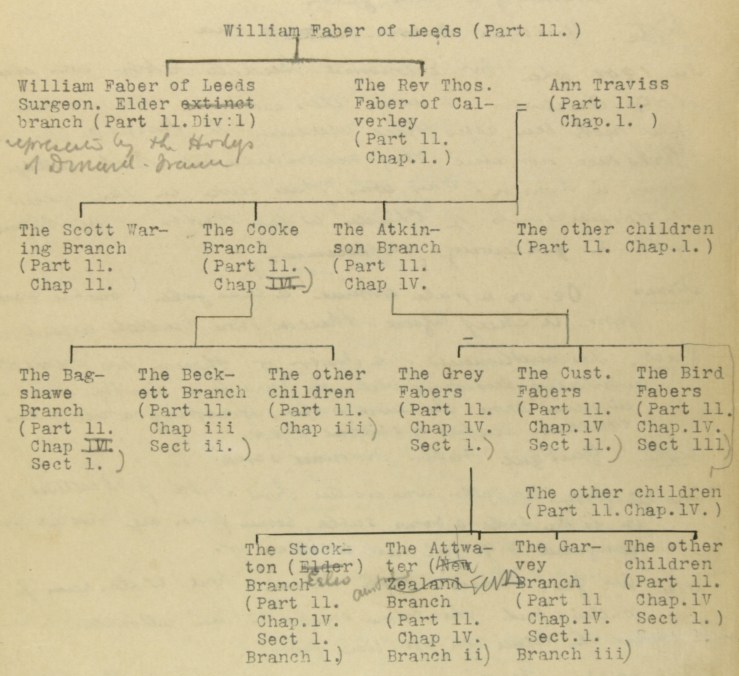
There was another branch of the family, which had rather different arms. This branch of the family included two peers, the first and last Lord Faber and the first and last Lord Wittenham. The pedigree recorded at the College of Arms is headed by William Faber of Leeds (d.1775). He had a son, Rev. Thomas Faber (1729-1821), Vicar of Calverley, Yorkshire, who is shown as having four sons. Henry Grey Faber was descended from the third son, Thomas Henry Faber of Bishop Auckland. This Thomas Henry Faber was the father of the Thomas Henry Faber to whom I referred earlier. Lords Faber and Wittenham were descended from Rev. Thomas Faber’s second son, Charles David Faber.
Family tree showing the Faber family from William Faber of Leeds.Family tree showing Henry Grey Faber was descended from Thomas Henry Faber of Bishop Auckland.
Pedigrees for the family can be found in the 1952 and 1972 editions of Burke’s Landed Gentry, but I think that these entries will still be in copyright. Your great aunt appears in the entry in the 1972 edition.
Frederick William Faber (1814-1863), the hymn writer, was the fourth son of the elder Thomas Henry Faber.
The sword of Captain H G Faber of the 5th Battalion
While searching for information about Henry Grey Faber I found images online showing a sword described as ‘The sword of Captain H G Faber of the 5th Battalion, who departed for France in 1915. He was present at the Second Battle of Ypres in 1915, The Somme 1916, Arras and Passchendaele in 1917. Became a Major in 1918. Blade of 32 1/4 inches engraved with Family Crest and H.G.F., Royal Arms, Crowned ER VII, foliage and retailer – Samuel Brothers, and back edge with – London Made and numbered 1115. Plated hilt with Crowned ER VII and wire bound fishskin grip complete. Sword bag marked with H.G. Faber, Norton-On-Tees, 10th Oct 1906.’
The seller of the sword explained the reference to 1897 is the pattern of the sword, which is when this style of sword and hilt started to be used and is still used today. The images of the sword on this website, are used with the permission of Jemswords. I have also located an image on the My Family Silver website, which shows the same crest that appears on the sword. Written under the image it says ‘Hamilton S., Esquire, M.R.C.S., L.R.C.S., of St. George’s Hospital, Hyde Park Corner, London, S.W.’
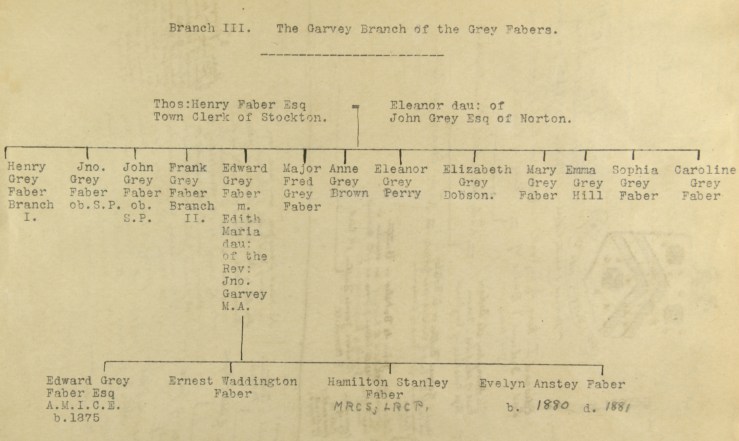
I learned about Hamilton Stanley Faber from The College of Arms when researching the Faber family. They advised me they held an extensive pedigree for the Faber family, recorded in 1902 by Hamilton S Faber, who was the first cousin of Henry Grey Faber’s father. I subsequently found that Hamilton’s work had been posted online and a link is posted below.
Family tree showing the Garvey branch of the Grey Fabers including Hamilton Stanley Faber.
The information I have learned about Hamilton Stanley Faber and his family is as follows.
1881: Hamilton Stanley Faber, aged 2, is recorded at living at 1, Esplanade, Teignmouth East, Newton Abbot, Devon, England, with his parents Edward G Faber (a wine merchant) aged 45, Edith M Faber aged 30 and Edward G Faber, Ernest M Faber and Evelyn A Faber. Also, a governess and two nurses.
1901: Hamilton S Faber, aged 22, is a medical student, living at 95, Fordwych Road, Hampstead, London & Middlesex, England, living with parents Edward G Faber (retired from owning ironworks), Edith M Faber and Ernest W Faber aged 24 (member of the London Stock Exchange).
1911: Hamilton Stanley Faber, aged 32, is working as Doctor Mp Mrcs Lrcp and living at 28 Chichele Road Cricklewood NW, Willesden, Middlesex, England with his mother Edith Maria Faber (now a widow), Edward Jocy Faber and Ernest Waddington Faber. Also two servants.
1939: Hamilton S Faber is working as a medical practioner and living at 25 Chichele Road , Willesden M.B., Middlesex, England with Jean (Caslow) Faber and three others.
Edward G Faber
Hamilton’s father Edward G Faber was born in 1836 and can be found on 1841 census. A marriage of Edward Grey Faber to Edith Maria Garvey is also recorded at Christ Church With St Paul, Forest Hill, Lewisham, England on 9 April 1874. The fathers names are given as Thomas Henry Faber and John Garvey, a Clerk in Holy Orders.
The 1841 census records Edward, aged 5 (born in Durham 1836) as living at High Street, Stockton, Durham, England with parents Thomas Henry Faber aged 55 (born 1786) and Eleanor Faber aged 36 (born 1805 in Durham). Also siblings Ann, Eleanor, Frank, Edward, Elizabeth and Mary.
My great aunt Dorothy (my grandmother’s sister) married Henry Grey Faber in 1960. Dorothy was his second wife. This page covers the research I have done on Dorothy and Henry Grey Faber and the extended research I have done on the Faber and Grey families.
Henry Grey Faber served in the 5th Durham Light Infantry. He appears to have started army life in the Volunteer Forces in 1905 before becoming a Colonel in later life. I have been fortunate to learn much about his time in the army and have a number of wonderful photos too.
Jo Faulkner who worked for a time at Preston Hall Museum in Stockton on Tees advised me that ‘Colonel Faber was a senior officer in the Durham Light Infantry. Colonel G O Spence who is also in the photograph was a prolific collector of arms and armor and bequeathed his collection to Stockton Council, it is in the Preston Hall Museum collection. I also remember that Colonel Faber donated a few objects, one of them being a Georgian sedan chair. I did look after the collections at this museum but no longer work there so I am unable to check the details for you. After WW1 Spence lived in a house built at Far End Farm near Yarm and Faber lived at Worsall Grove, which was just a little further along the road towards Worsall, so I think they remained friends. My great grandparents lived on the neighbouring farm ‘Morley Carr’. My great uncle (born 1931) says that when he was a small boy at Worsall school Colonel Faber would have all the children doing drill outside. Yes, I believe Faber was a partner in a solicitors practice, I’ve come across his name in local history studies from time to time.’
Christopher Young at Preston Park Museum and Grounds also provided help and very generously allowed me to display the photos he sent me on this website.
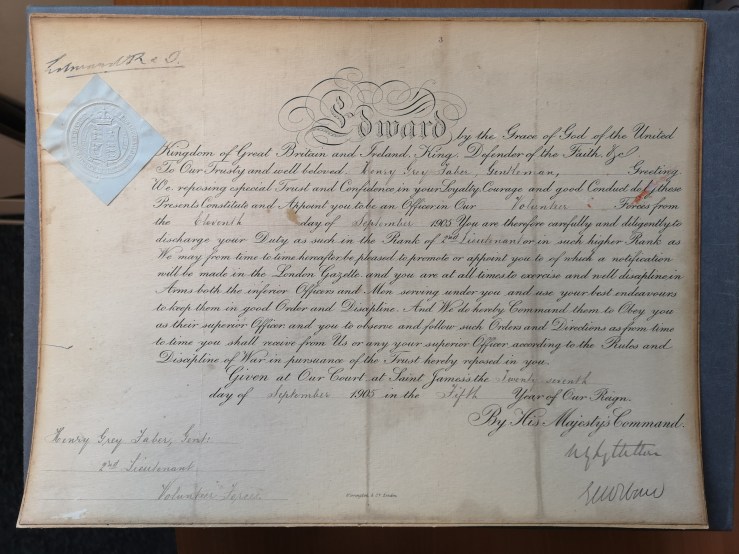
The document below shows Henry’s official posting as an Officer and appears to have been signed by the King.
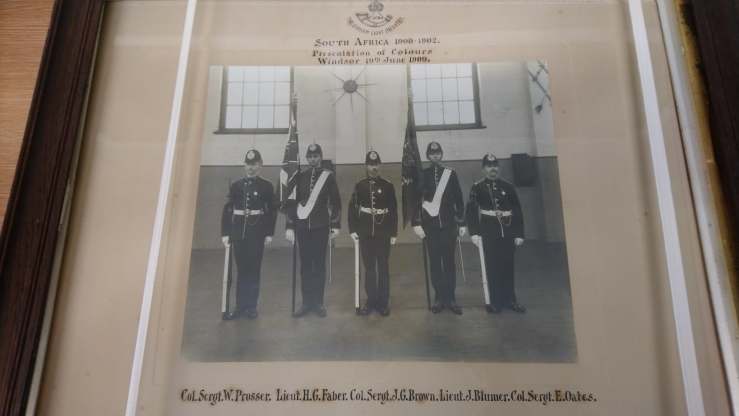
Henry can be seen in the photo below, taken at Windsor in 1909. He would have been 22 at the time.
Further information about Presentation of Colours can be found below.
I subsequently learned that The Royal Collection Trust displays a painting on its website by Jean Baptiste Édouard Detaille of the above event. The painting marked the culmination of significant army reforms that had been taking place, instigated by the Secretary of State for War, Richard Haldane (1856-1928). They grew out of the Territorial and Reserve Forces Act of 1907, which saw the abolition of existing Volunteers and Yeomanry and the establishment of a Territorial Force of fourteen infantry divisions, fourteen cavalry brigades all financed by local organisations, but liable for service under War Office command. The reforms were an attempt to prepare England for a possible attack by Germany and the King played active part in the discussions.
The painting depicts a moment, towards the end of the ceremony, when the two hundred newly blessed colours were drooped in salutation as the National Anthem was played. The King then stepped forward into the square and gracefully acknowledged the homage of his Territorial Army.
The painting and further information about this can be found on The Royal Collection Trust website below.
Henry is also pictured on the front row of the photo below, second from the right, which shows Officers of the 5th Battalion of The Durham Light Infantry, taken on the eve of the battalion’s departure for France in April 1915.
I first came across the photo on the Flickr page of Steve Heimerle who also has an interest in the 5th Battalion.
Interestingly, on the ground, far right, a second man, Second-Lieutenant E W Faber is named. I believe Henry and Edward were cousins, sharing a grandfather, also called Henry Grey Faber. On checking the 1901 census on the Find My Past website, I located an Edward W Faber, aged 6, born in Eaglescliife, Durham in 1895 – he is recorded as being the son of Charles (a solicitor born in Stockton) and Edith Faber. On the 1911 census, I again located a Edward W Faber, aged 16 living with Charles and Edith and a brother, aged nine called Charles, with the middle name of Grey, the same as Henry.
Durham County Record Office hold information about both Henry, Edward and the Durham Light Infantry, including:
a copy letter from Second Lieutenant H. [sic] Faber, The Cottage, Eaglescliffe, describing how he was wounded in Belgium and how his life was saved by a cigarette case
a newspaper cutting concerning a silver cigarette box and hair brushes, formerly belonging to Lieutenant Faber of The Durham Light Infantry
notes compiled by the son of Lieutenant E W Faber, concerning his late father’s military career, and his connection with Corporal Pennock, and Colonel H Faber.
letter from ‘Hal’ [Lieutenant-Colonel H.G. Faber] to his mother describing a trip to Windsor, Berkshire, June 1909
battalion orders by Major H.G. Faber, officer commanding the 13th Battalion, The Durham Light Infantry, 2 November
newspaper cutting concerning the annual sports day of the 5th Battalion, The Durham Light Infantry, at Hipswell Camp, Catterick, Yorkshire, 1922
group photograph of officers of the 5th Battalion, The Durham Light Infantry, in service dress, at Ripon Summer Camp, Yorkshire, 1924
The above information can be found on the Durham County Record Office website.
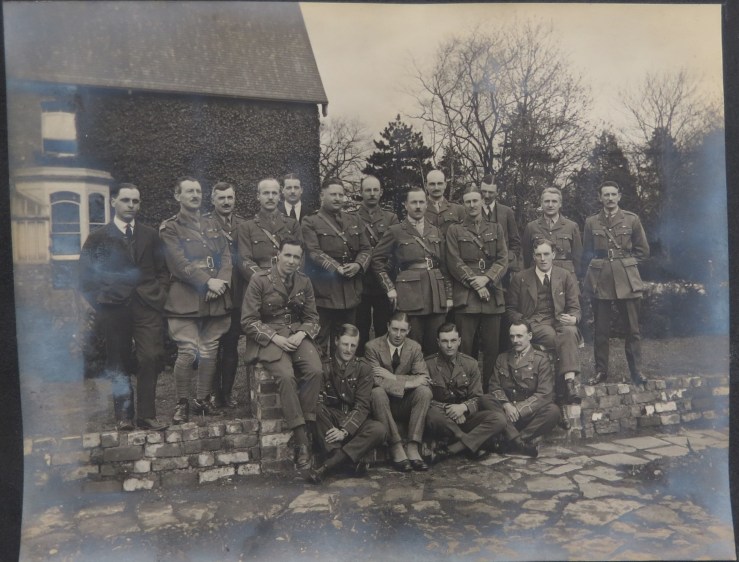
The photo below is dated 1919 (Henry is thought to appear on the top row, fourth from the right). Again the photo is used with permission of Preston Park Museum and Grounds, who also guided me to references of H G Faber and E W Faber which appear in a book about the Durham Light Infantry.
Further information
Further information about the Durham Light Infantry and about Durham during the war can be found below.
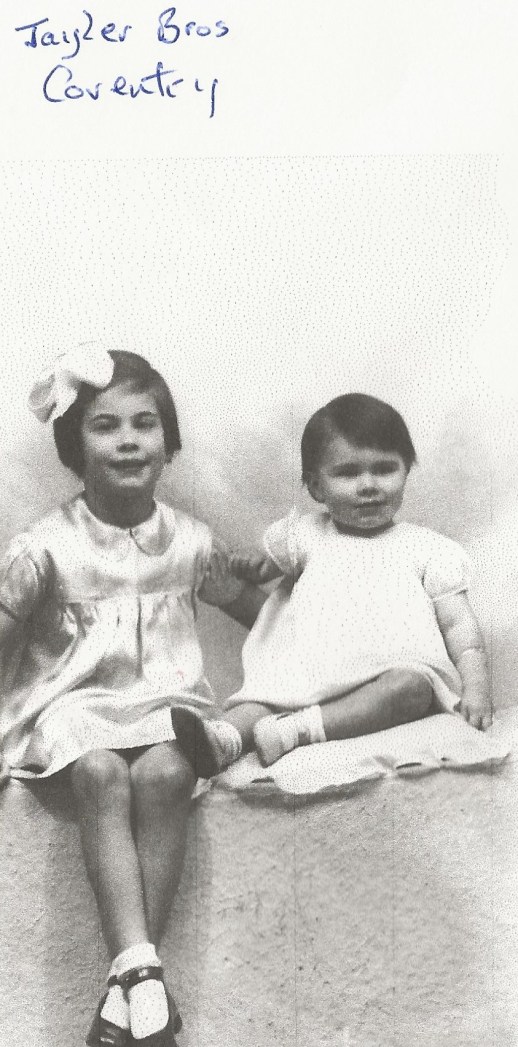
The photo below was given to me by Keith Shortland. The two children pictured are believed to be Keith’s cousins, Gillian and Marion. Their mother and father were Ken and Marion Stephens, who ran a hairdressers in the Radford area of Coventry. Keith also told me that Ken’s sister, Maude Stephens, was one of the few ladies running a men’s hairdresser in Southam.
A hand written note on the photo indicates the photo was taken by Tayler Brothers of Coventry. Information about the Tayler Brothers studio and the Tayler Brothers project which archived photos to tell stories of Coventry’s past can be found on the Photomining website below.
‘Tayler Brothers ran a photographic studio in Primrose Hill Street, Hillfields, Coventry, from just before the first world war until the 1970s. The Studio was on what is now Sidney Stringer Academy, just past the junction with Vine Street. Tayler Brothers were commercial photographers, and did not keep a record of their past work. The photograph you have looks like it could be from the 1950s, from the clothes, shoes etc.’
The number 32037 appears on the reverse of the photo. Mark Cook also advised Photomining ‘have a photo numbered in the 28 thousands that we think is late 40s and one that is in the 40 thousands that we think is late 50s’ so believe that the photo above lies between these dates.
Joseph and Ann Abram (nee Cox) were my great great great grandparents. I have been able to locate the couple on the 1861 census, where Joseph, a shoemaker aged 23 and Ann aged 21 were living at 4 Lower River Terrace, St Sepulchre in Northamptonshire with three children, Emma, Charles (my great great grandfather aged 1) and Harriett.
I believe Joseph was the son of James and Rebecca and I have located him on the 1841 census aged 3 and the 1851 census aged 12. Sadly, it appears that Joseph died aged just 28. The death certificate shows he had been suffering from Phthisis Pulmonalis (Tuberculosis) for 13 months.
Ann appears to have married William Maloney in 1869 to and her story continues on the 1871 census, where, aged 31, she is living at St George Square in Northampton but now with William Maloney of Ireland, Charles (aged 11 and recorded as Charles Abram Maloney) and three other children, George, Emma and John W Maloney.
In 1881 William and Ann can be found living at 12 Alpha Street, Northampton, with four children, Jeremiah (aged 9)*, Eugene, William and John Maloney. Finally, in 1891, Ann can be found at 50 Adelaide Street, Northampton. She is a widow and working as a laundress. Eugene, William and John are still living with her.
* Jeremiah Maloney does not appear on the 1891 census with his mother and siblings but I believe I have located him, aged 19, living as a boarder at Luther Street, Leceister in the home of William and Sarah Abrams (both recorded as being born in Northamptonshire) and their children Herbert and Amy, along with two other boarders, Ellen Maloney aged 24 and and Eva M aged 1. (I believe that Jeremiah Maloney married Ellen Frost in 1889).
Betty May was the daughter and youngest child of my great grandparents Joseph Charles Abram and Milly May Bowers. She was born in Halsted, Essex in 1924 and died in 2015.
Betty served in the RAF for a time but her records show she was dismissed under Kings Regs paragraph 652 for being with child. She later married Geoff Bryant in Wellingborough, Northamptonshire – they met while working in the Derngate office of the United Counties bus company in Northampton. Interestingly, this is the same company her father took on during his time as proprietor of Earls Barton Motors. Geoff was later a Company Director at C Butt Warehousing, a truck haulage company. He died in 2016.
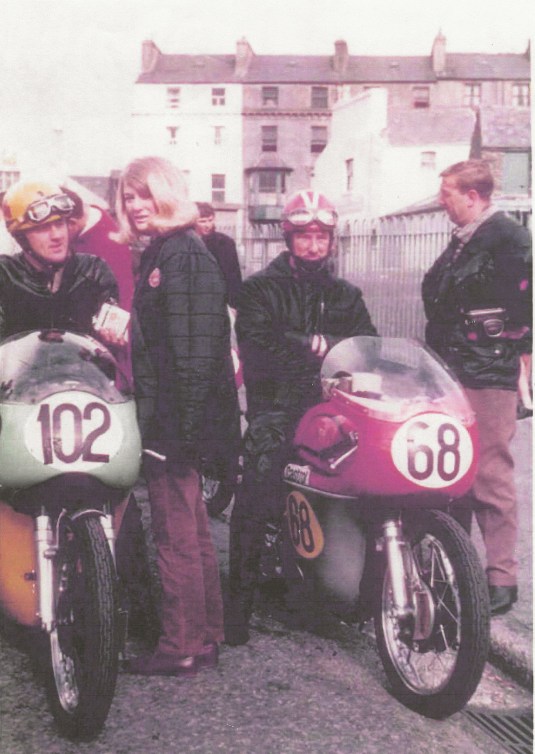
Many of the photos on these pages were given to me by Keith Shortland. Keith is the son of Ernest Shortland (my great grandmother Louisa Jane’s brother).
The photo below shows Keith on bike 102, with wife Sandy, just prior to the 1969 MGP.


 A little bit of this ~ A little bit of that
