Abram’s Buses and Earls Barton Motors

Earls Barton is a village in Northamptonshire, situated in the borough of Wellingborough. The name comes from Bere-tun, which is Saxon for ‘a place for growing barley’. The prefix ‘Earls’ comes from a long association with the Earls of Northampton and Huntingdon. Earls Barton is known for its Anglo-Saxon and shoe making heritage it is also the place where my ancestors lived and worked.

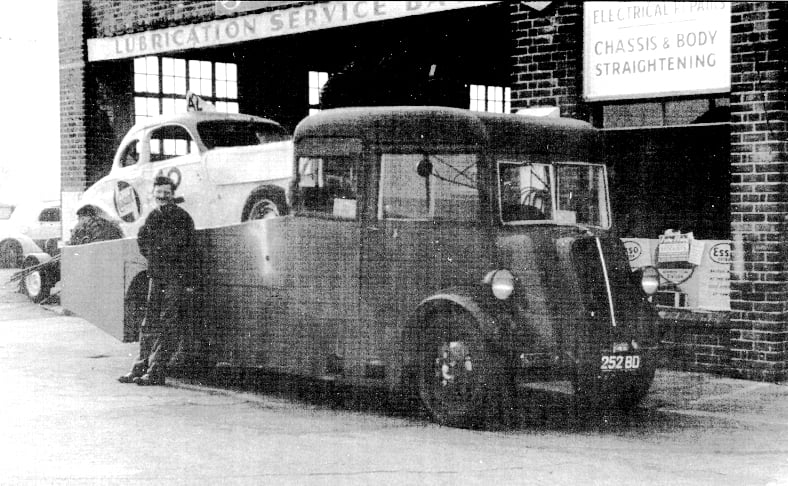
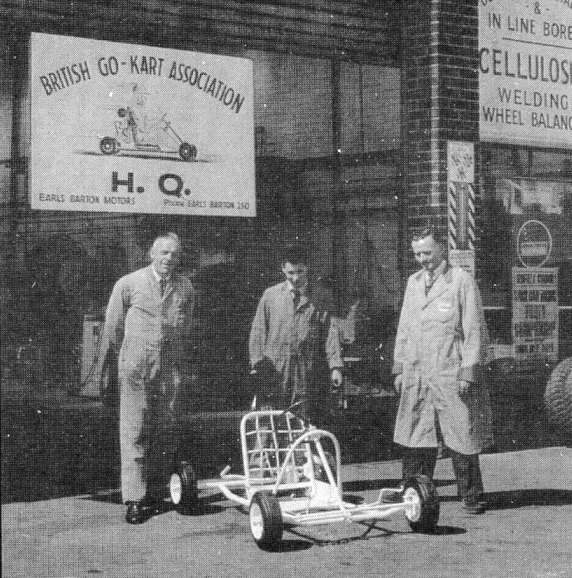
On leaving the army in 1922 my great grandfather Joseph Charles Abram returned to the village where his parents Charles and Emily lived. He built two houses on the Mears Ashby Road, choosing to live in one and sell the other. He was also the proprietor of Abram’s Buses and later Earls Barton Motors, known locally as Abram’s garage.

Abram’s Buses

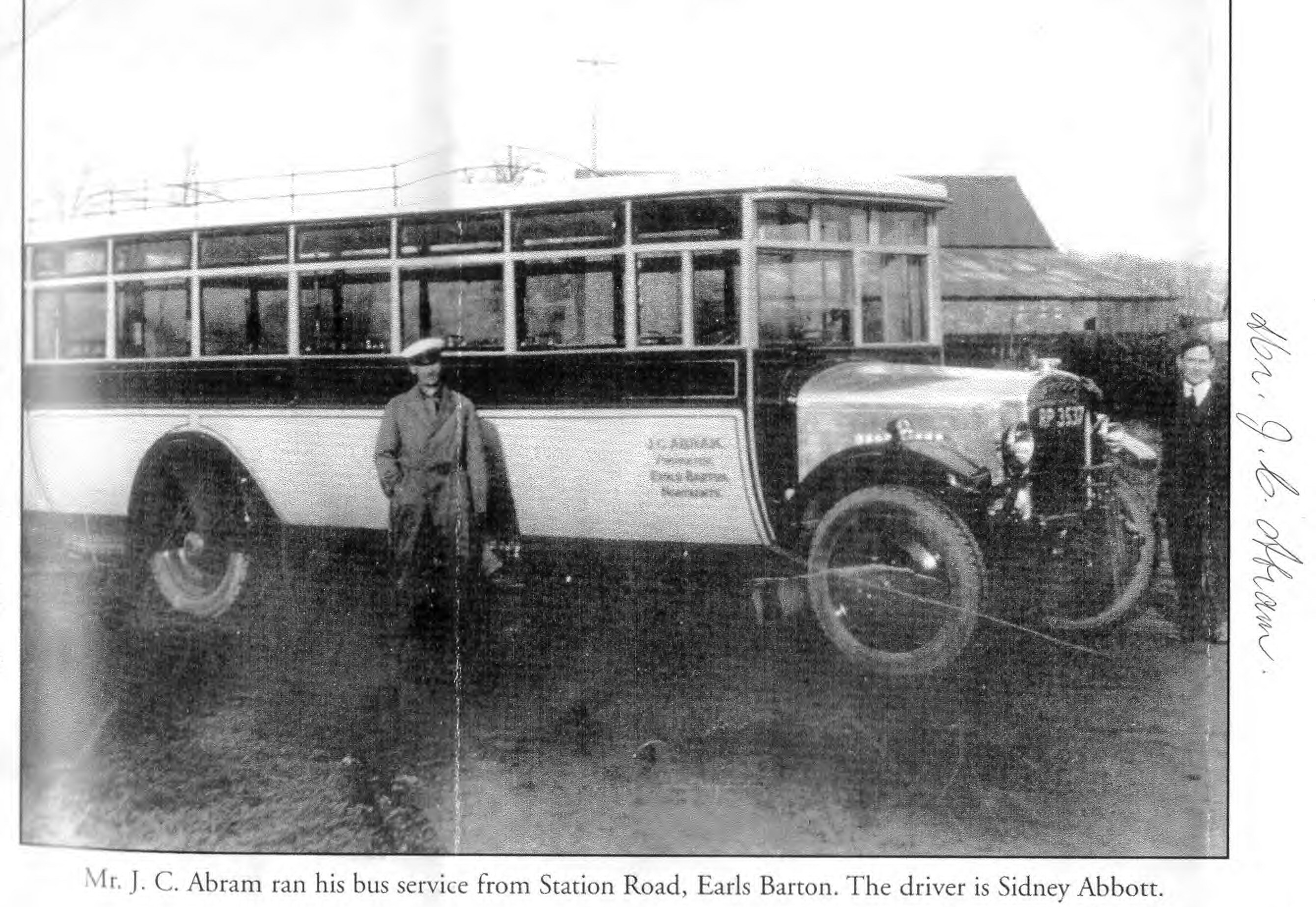
The first motor bus had arrived in Earls Barton in 1921 and was owned by the village carrier who would have transported passengers and goods between towns and villages in the area. In 1924 Joseph purchased his first bus — a model T Ford saloon from Henry Oliver Ltd, a Northampton based Ford agent, for which he paid £221. The same year he was summoned for leaving a motor bus in Wellingborough without having taken due precautions to prevent it starting in his absence. Superintendent McLeod explained the vehicle had been left in Sheep Street where a constable had been able to jump on the vehicle and stop it before it had got too far. Joseph was fined £1
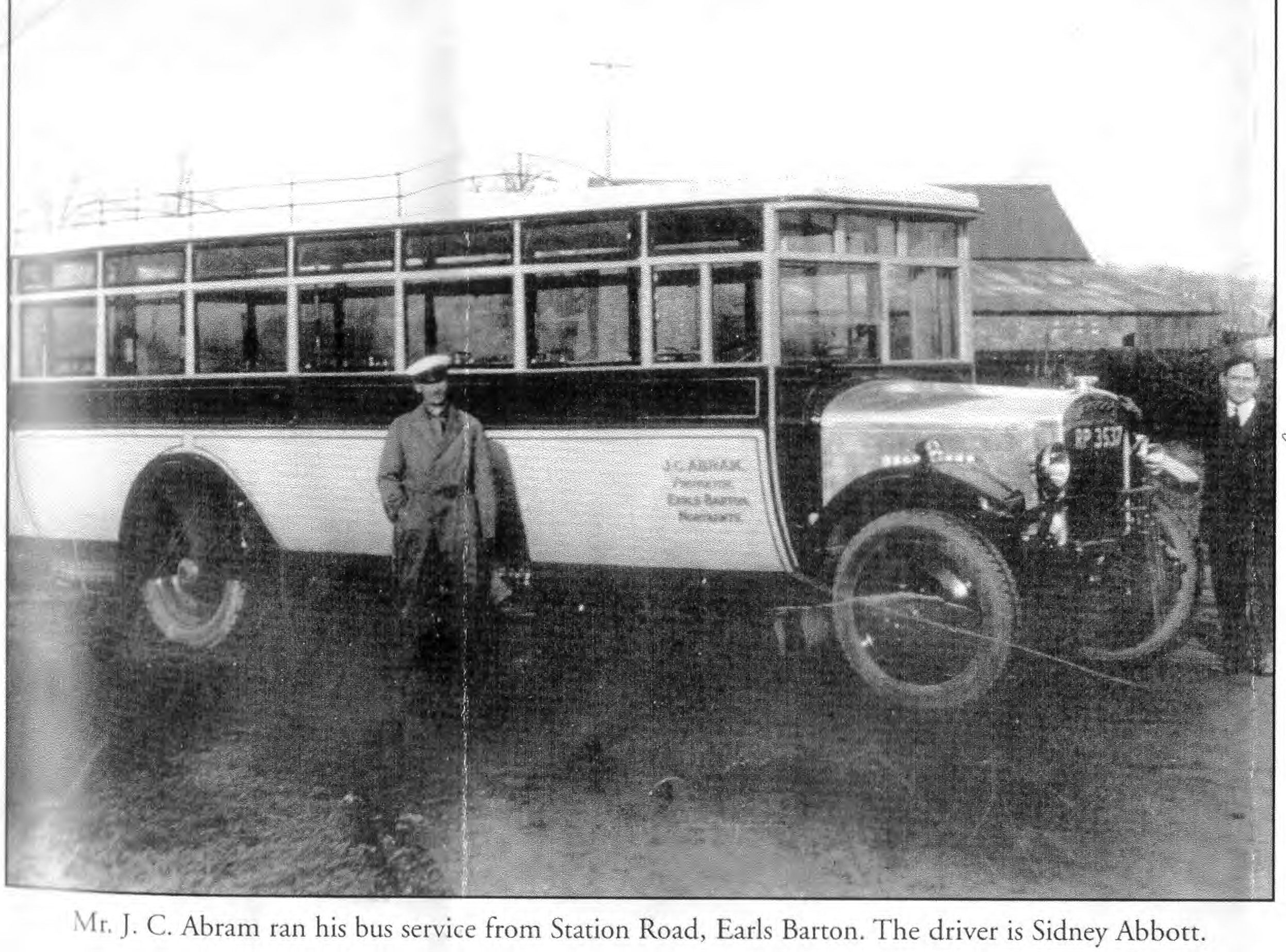
Joseph Abram and bus

The main service Joseph provided operated between Earls Barton and Wellingborough but services also included a Saturday only service between the months of September to April for football supporters, services from Barker’s Shoe Factory in the village, an August Bank Holiday service to Castle Ashby, excursions to Yarmouth, Clacton and Skegness and a number of evening tour trips.

By August 1928 Joseph had a fleet of four buses. Newspaper articles from the time show that as the omnibus proprietor of a small bus company, Joseph took on the United Counties bus company on the road, in the press and in the courtroom —the much larger company had an operating area covering Northamptonshire, Bedfordshire, Buckinghamshire and Huntingdonshire, with services that reached into Lincolnshire, Leicestershire, Oxfordshire, Cambridgeshire,  Rutland, London and Nottingham.

In a letter to the editor of the Northampton Mercury, Joseph wrote “I have been running my two buses (trying merely to get a living) for some few years now between Earls Barton and Wellingborough and was the first to commence early morning journeys for workmen between those places.” United Counties responded saying that “the authorities concerned should think seriously about granting a ‘small man’ a licence”. 

It was also reported in the press that Joseph applied for a new co-ordination between his services and the United Counties Omnibus Bus Company Ltd between Earls Barton and Wellingborough, due to overcrowding on the route and United Counties not keeping to the  scheduled times. As such “a start two minutes later could be of great importance.”  Mr Troup applying on behalf of Joseph said “The last Earls Barton census had a population of 2,800, yet no fewer than 111 passenger buses ran into it every Saturday and 120 out.” He continued that “on Wednesday and Fridays 93 buses ran in and out, 68 on Monday, Tuesdays and Thursday and on Sundays 48 in and 49 out.” The Chairman (Mr J H Stirk) asked “does everybody move at Earls Barton every Saturday” and Mr Troup replied “I think they must.”  William George Austin a United Counties inspector also advised that Mr Abram had complained on one occasion about a bus starting four minutes late but the driver said he started promptly having set his watch by the Regal Clock in Wellingborough which was met by laughter. It was concluded there were too many buses on the route but a decision would be deferred until loadings of the two services had been supplied.

Other newspaper reports exist of accidents, dangerous driving and a false statement made to the police by a driver for the United Counties Omnibus Company, who later admitted making the statement “because he was annoyed at the time by a woman who was one of Abrams’ customers insulting him.” When Joseph applied to run a service to Castle Ashby on the flower show day in the summer, it was report United Counties objected on the grounds there was an adequate service and that passengers had been left stranded which Joseph denied. The Chairman granted the application nonetheless saying “see you bring home all the people you take.” In the same article it was reported Joseph complained United Counties had a five minute service against him for a village of 3,000 people, so as to “squeeze the blood out of your body.”

In December 1930 Joseph offered his services and vehicles to United Counties but did not in fact sell his business to them until 1932. In March of that year Joseph advised them he was willing to dispose of his business which included four vehicles, two plots of land, a petrol pump and wooden garage — the business was sold on 23 March 1932.

On Friday 20 November 1931 the Northamptonshire Mercury reported that ‘an application had been made by J C Abram of Earls Barton to run his buses between Wellingborough and that place’ and further newspaper articles from the time show that as an Omnibus Proprietor of a small bus company he took on the United Counties bus company on the road, in the press and in the courtroom.

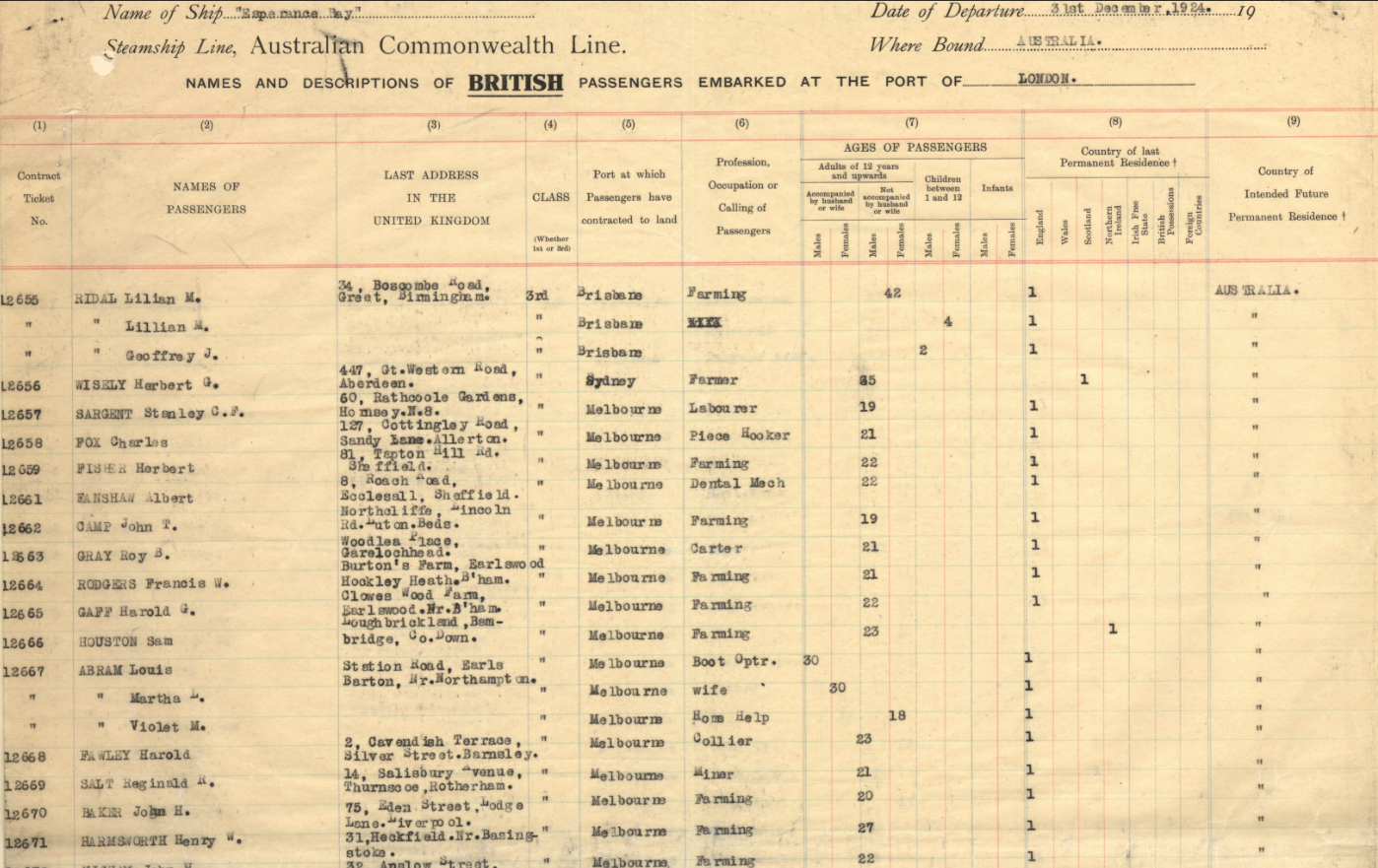
The document below, produced by The Omnibus Society, records Joseph’s life from September 1924 when Joseph purchased his first bus, to May 1932 when he sold his business to United Counties.

Joseph is also mentioned in the book United Counties Buses: A Fleet History, 1921 – 2014.

Earls Barton Motors (Abram’s Garage)

The sale of Abram’s Buses almost certainly assisted Joseph with his purchase of Abram’s Garage which Joseph advertised as ‘the reliable physicians for all motoring ailments.’ Complete overhauls and repairs were carried out to all makes of cars and commercial vehicles, with all repairs carried out by expert mechanics under personal supervision of the proprietor. Newspaper advertisements from the time also show that Joseph sold vehicles from the garage including a 1933 Austin light 124 saloon, 1934 Fordson end tipping lorry, 1932 Lanchester saloon and a 1930 Singer saloon.

In 1935 during his time as proprietor, Joseph was called as a witness at Wellingborough Police Court following an escapade by three youths who pleaded guilty to a number of offences including possessing a firearm. Joseph told how on 14 May dogs had awakened him — getting out of bed he heard clicking noises and saw a car driven away. The following morning he found two petrol pump globes had been broken apparently by bullets. Later the police found the pellets but Joseph could not say who was responsible. And the 1939 census of Earls Barton records Joseph as a Motor Engineer Garage Proprietor living at Abram’s Garage, Main Road with his wife Millicent (Milly May) and daughter Betty. Also residing with them is Albert E Evans, a haulage contractor and motor engineer. 

World war two

During the war the garage was used for repairing aircraft parts for Sywell aerodrome. A document from the Harrington Museum states:

‘The number or aircraft needing repair increased rapidly during 1940 and the accommodation at the main centre at Sywell was found to be inadequate. This together with the policy of dispersal and the benefit of taking work to the people instead of the reverse with consequent saving in travelling, led to premises being requisitioned including Abram’s Garage, Earls Barton – used for
undercarriage and bomb beams.’

The full document can be viewed below.

The home guard

 
Joseph is known to be a member of the Home Guard during World War two. The Home Guard was set up in May 1940 as Britain’s ‘last line of defence’ against German invasion. Members were usually men above or below the age of conscription and those unfit or ineligible for front line military service. The full Home Guard ledger is in Earls Barton  museum and lists all the streets and homes in the village. Each home is listed with how many occupants whether they were in the Home Guard or ARP wardens it even lists if the house had a ladder or a hosepipe in case of an air raid.A document from this time also lists buildings other than dwelling houses used by the Home Guard and Abram’s Garage is shown as post number 12.

Ooold Soljer and Two Beauts


And on 31 March 1943 the garage was recorded as sustaining a broken window when, during a practice air raid, two B17 flying fortresses, Ooold Soljer and Two Beauts, collided, shedding bombs and spreading wreckage in Mears Ashby and Earls Barton — an information board now stands in Mears Ashby which advises visitors about the crash.
 

Aubrey Leighton

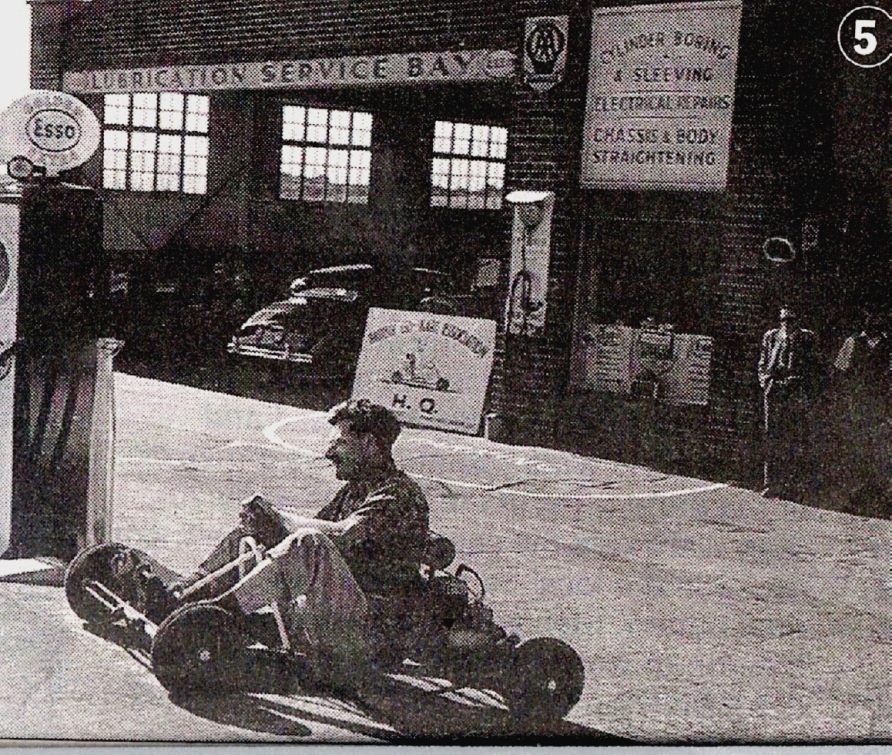
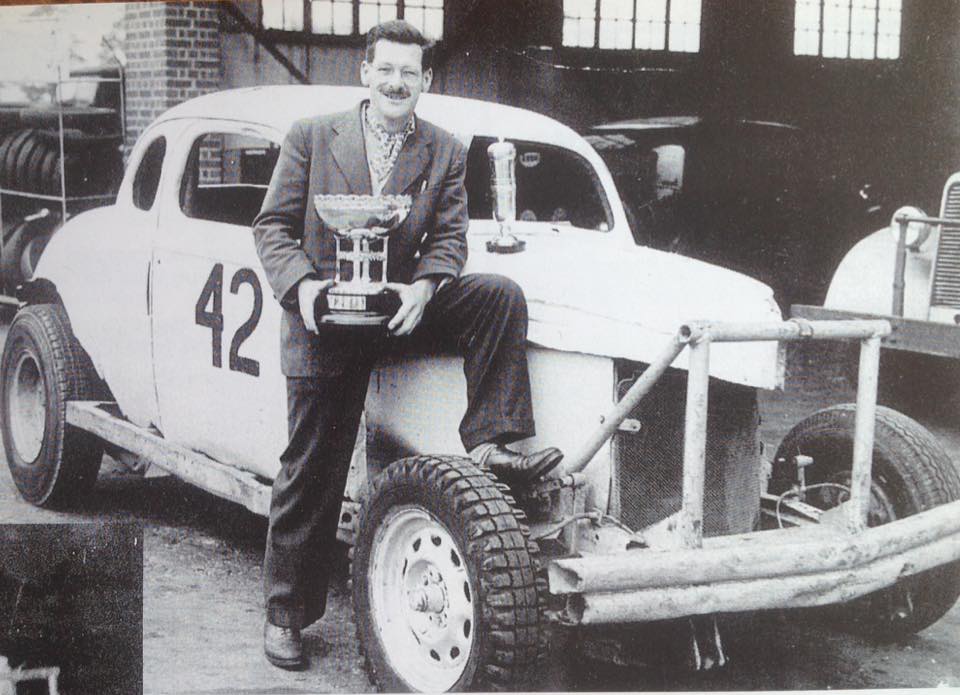
Joseph is believed to have run the garage successfully until sometime after the war and when he retired, he sold the garage to Aubrey Leighton, one of the pioneers of F1 stock car racing. Aubrey began racing in 1955 when the sport was about a year old. He went on to win 48 Finals, plus the National Points Championship in 1963. In only his third season of racing, Aubrey won the 1957 World Championship, staged at Belle Vue.
abran-garage-stock-car-4

abran-garage-stock-car-3
abran-garage-stock-car
 
abran-garage-stock-car-2


The Abram family however remained in Earls Barton. Joseph’s parents Charles and Emily who are first recorded as living there on the 1911 census can be found on the 1921 census and the 1939 census also. And on 24 March 1930 the Northampton Chronicle and Echo reported the old couple, who had lived in Earls Barton for twenty seven years, had fourteen children, six of who had served in the Great War with all of them returning home, had celebrated their 30th wedding anniversary. 

Joseph died in 1970 at which time his residence was recorded as Mears Ashby Road, Earls Barton. There is no fancy obituary for Joseph, he was not a prince or a king, a politician or a film star, he was simply an ordinary man doing his best to make a living during an extraordinary time in history — yet reading his words and those of the people who knew him bring him to life and ensure he is not forgotten. How lucky am I to call this ‘regular joe’ my ancestor?

Sources

Earls Baron Parish Council

Abram’s Buses

Abram’s Garage

Newspaper articles

  • Northampton Chronicle and Echo
    Summoned
    28 November 1924
  • Northampton Mercury
    Charge against a bus driver dismissed
    2 July 1926
  • Northampton Mercury
    Buses and competition:
    A letter to the editor of the Mercury from J C Abram, Omnibus proprietor
    5 November 1926
  • Northampton Chronicle and Echo
    Saloon buses for hire (party arrangements)
    27 May 1927
  • Northampton Mercury
    An error of judgement costs a bus driver £2 at Wellingborough
    21 October 1927

  • Northampton Mercury
    Bus overturns on joy trip to Hunstanton
    9 August 1929
  • Northampton Chronicle and Echo
    A family of fourteen
    24 March 1930

  • Northampton Mercury
    An application to run buses from Wellingborough to Earls Barton
    20 November 1931
  • Northampton Mercury
    Application for a new co-ordination
    26 February 1932
  • Northampton Mercury
    Petrol Pumps damaged
    31 May 1935

  • Northamptonshire Evening Telegraph
    Vehicles for sale
    17 June 1939

  • Northamptonshire Evening Telegraph
    Semi detached house for sale
    15 September 1939
More photos

Walter Abram

Walter Abram was born in  1896 in Northamptonshire. The 1891 census shows him living at 75, Lower Hester Street, Northampton, Kingsthorpe and the 1901 census, aged 14 at Station Road, Earl’s Barton. His occupation is shown as a shoe machine operative.

Northampton Mercury: 21 July 1916

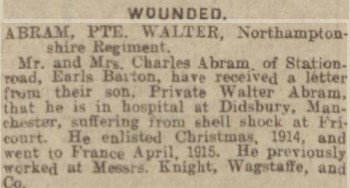
In July 1916 a piece appeared in the Northampton Mercury which records that Walter had written to my great great grandparents advising he was in hospital at Didsbury suffering from shell shock, having enlisted in in 1914 and going to France in 1915.  

Walter and Mabel.

I believe that Walter married his wife Mabel in 1920 and on the 1939 register they can be found living together at Rusholme Northampton Road, Earl’s Barton. Walter’s occupation is recorded as a puller over in the boot trade.


Jeremiah Maloney

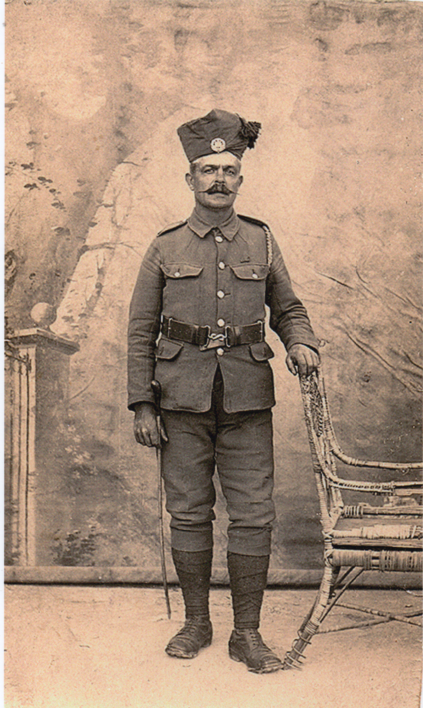
Jeremiah Maloney was the son of my great great great grandmother Ann Abram (nee Cox).  On the 1861 census, I have been able to locate Ann, living with my great great great grandfather, where Joseph, a shoemaker aged 23 and Ann aged 21 were living at 4 Lower River Terrace, St Sepulchre in Northamptonshire with three children, Emma, Charles (my great great grandfather aged 1) and Harriett. The photo below was given to me by my relative Margaret Creighton in Australia. Jeremiah is shown wearing a British army uniform but also a turban which appears to have a Northamptonshire Regiment badge on it.

jeremiah-maloney

Sadly, it appears that Joseph died aged just 28.  The death certificate shows he had been suffering from Phthisis Pulmonalis (Tuberculosis) for 13 months. In 1869 Ann appears to have married William Maloney and her story continues on the 1871 census, where, aged 31, she is living at St George Square in Northampton but now with William Maloney of Ireland, Charles (aged 11 and recorded as Charles Abram Maloney) and three other children, George, Emma and John W Maloney.

In 1881 William and Ann can be found living at 12 Alpha Street, Northampton, with four children, Jeremiah (aged 9), Eugene, William and John Maloney.  Finally, in 1891, Ann can be found at 50 Adelaide Street, Northampton.  She is a widow and working as a laundress. Eugene, William and John are still living with her.

Jeremiah Maloney does not appear on the 1891 census with his mother and siblings but I believe I have located him, aged 19, living as a boarder at Luther Street, Leceister in the home of William and Sarah Abrams (both recorded as being born in Northamptonshire) and their children Herbert and Amy, along with two other boarders,  Ellen Maloney aged 24 and and Eva M aged 1.  (I believe that Jeremiah Maloney married Ellen Frost in 1889).

Jeremiah’s army service records are detailed below.

  • First name(s) Jeremiah
  • Last name Maloney
  • Birth year 1871
  • Birth parish St Sepulchres
  • Birth town Northampton
  • Birth county Northamptonshire
  • Birth country England
  • Service number 6568
  • Regiment Northamptonshire
  • Regiment Year 1902
  • Attestation date 12 Mar 1902
  • Attestation age years 31
  • Attestation corps 3rd Northamptonshire
  • Document type Attestation
  • Series Wo 96 – Militia Service Records 1806-1915
  • Archive The National Archives
  • Archive reference WO 96 Box851
  • Box record number 286
  • Record set British Army Service Records
  • Category Military, armed forces & conflict
  • Subcategory Regimental & Service Records
  • Collections from Great Britain, England

The South Africa 1900-1902 Medal Roll, 3rd Militia Battalion records a Private J Maloney,  was awarded the Queens South Africa Medal with Claps for Cape Colony and South Africa 1902.

Joseph Charles Abram

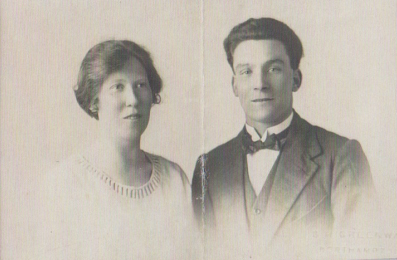
Joseph Charles Abram was my great grandfather.  Married to Millicent May Bowers, the couple had three children – my grandfather Louis Bowers Abram, Betty and Joseph Bowers Abram, their first son, born in Tempe, Pretoria, South Africa, in 1913, where Joseph Charles was stationed on army service.  The child lived for two short months – he died of enteritis and heart failure and is buried in South Africa.

joseph-charles-mears-ashby

Joseph served in the army from January 1901 to March 1922, receiving the 1914 Star, the British War Medal 1914 – 1918 and the Victory Medal 1914 – 1918 as well as being mentioned in Despatches on 30 December 1918.

On discharge, Joseph Charles Abram was involved in a number of projects.  He is believed to have run two pubs – the Red Lion in Stambourne, Essex (around 1924 when his daughter Betty May Abram was born) and the Kings Arms in Woodbridge,  Suffolk.

He built two houses at Mears Ashby Road in Earls Barton. Choosing to live in one of these, the second property he sold. Newspaper articles from local newspapers in 1939 advertised a semi detached house with six rooms (three being bedrooms),  central heating, bath, electricity, gas and main water. The houses still stand today.  

joseph-abram-bus

He also ran Earls Barton Motors (known locally as Abram’s garage), from which he sold vehicles and ran a bus service in the early 1930’s.  operating a small local service with trips to Wellingborough and back at weekends costing four pennies return. During the war the garage was used for repairing aircraft parts for Sywell aerodrome and in March 1943 the garage sustained a broken window when two Air Force Bombers collided and crashed.

Further information about Joseph

Albert Edward William Clarke

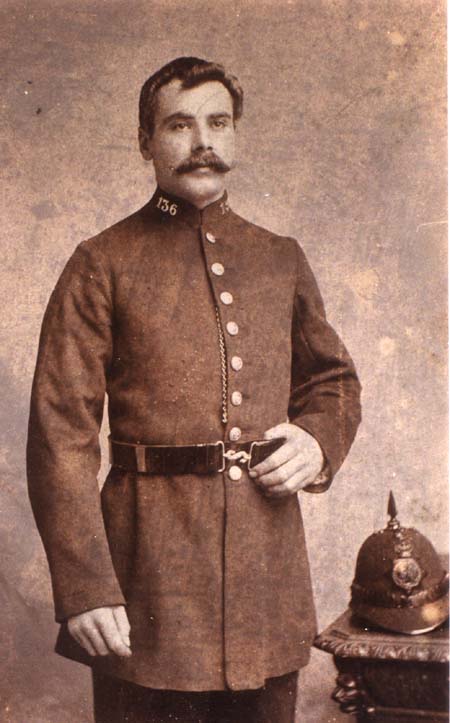
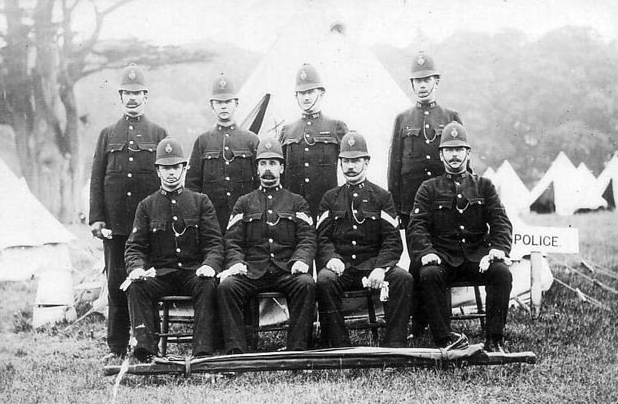
Albert Edward William Clarke was my great grandfather on my fathers side of the family. He served with the Northamptonshire Constabulary from 1 December 1899 until he retired on 6 October 1931.

albert-clarke-1

On joining the force he was described as a native of Welton, Northamptonshire and during his service he served at Kettering, Oundle, Paulerspury, Daventry, East Haddon, Northampton, Pottersbury and Naseby. On retirement he held the rank of Sergeant and was described as having an exemplary character.

The 1901 census shows Albert, aged 24, living alone at Police Station House, London Road, Kettering. His occupation is shown as Police Constable. The 1911 census shows Albert living with Louisa at Factory Road, Potterspury, Paulerspury. His occupation is given as Sergeant of Police.

albert-clarke-4

The photo above is a postcard sent by Albert on 7 June 1911 to Mrs A E Clarke (my great grandmother), Police Station, Pottersbury, Stony, Stratford, Bucks. On the back it reads: ‘Dear Lou Hope you are all well pleased to say I am alright, not quite as busy as on Monday. I do not know yet if it will be Sunday or Monday we shall leave here with love to you all. Ted’.

I also have a book of common payer given to Albert  by Louisa. At approximately 5cm by 9cm I can barely read the writing but on the inside front cover it says ‘From Lou, to Albert, Xmas 1889. In loving memory of the past’.

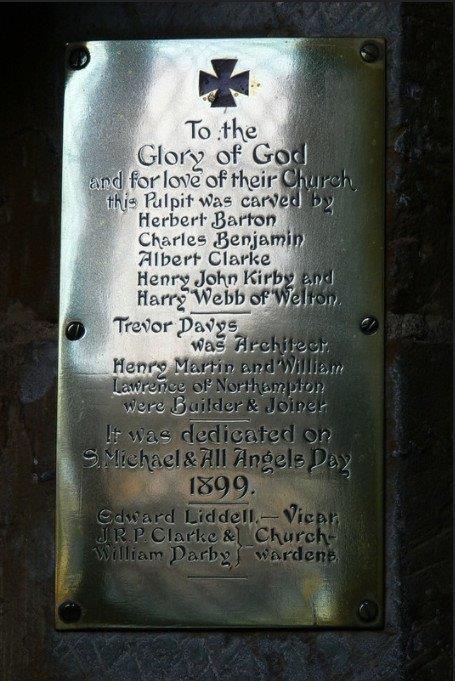
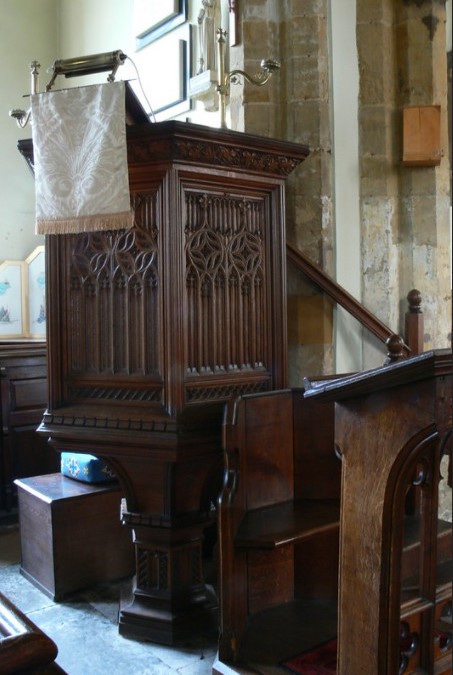
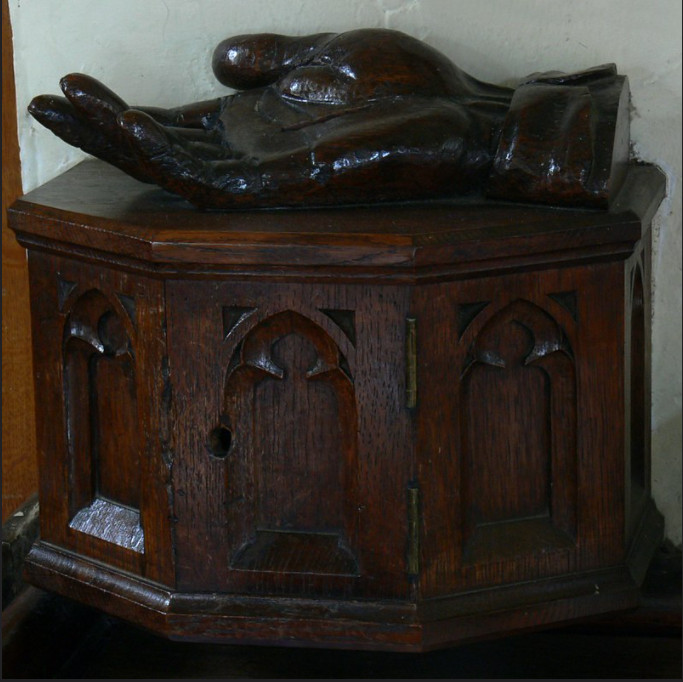
Albert is remembered at St Martins Church, Welton by a plaque that records that he and a number of other local men carved the pulpit.

plaque-1

pulpit-2020

pulpit-2-2020

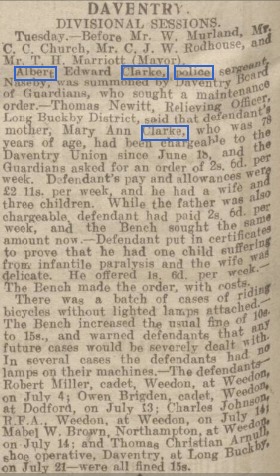
The newspaper article below appeared in the Northampton Mercury on 2 August 1918. It records Albert Edward William Clarke as a Sergeant in Naseby. He had been summoned by the Daventry Board of Guardians who sought a maintenance order for his mother Mary Ann Clarke.

Northampton Mercury, 2 August 1918

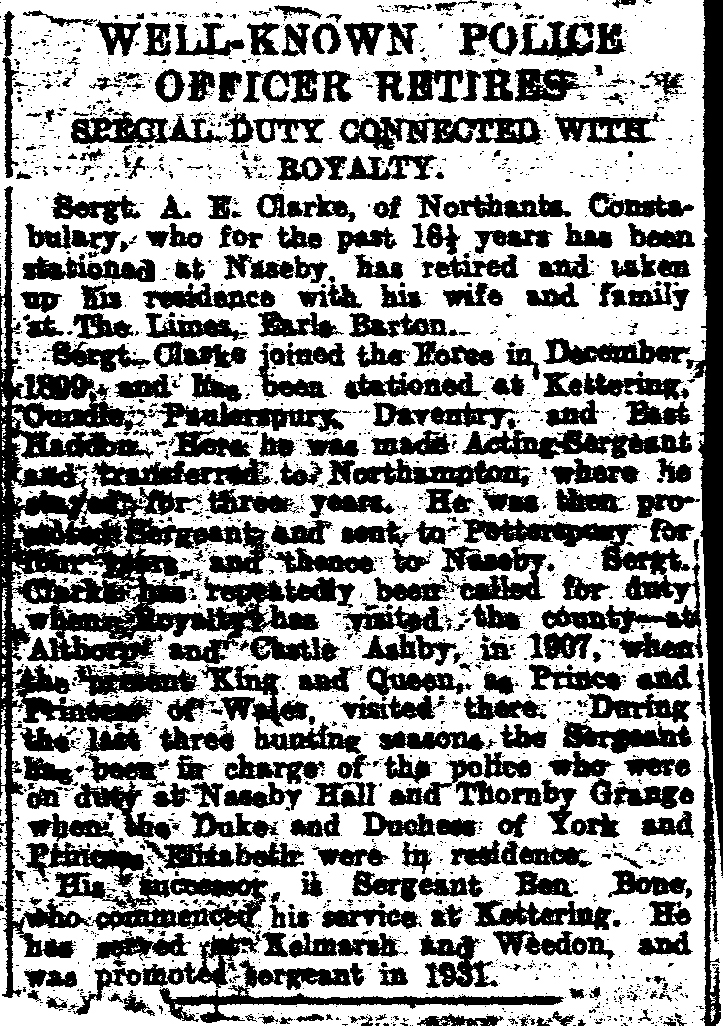
Albert’s retirement was reported in local newspapers and stated he had ‘repeatedly been called for duty when royalty had visited the county at Althorpe and Castle Ashby in 1907 when the present King and Queen, Prince and Princess of Wales, visited there. During the last three hunting seasons the Sergeant has been in charge of the police who were on duty at Naseby Hall and Thornby Grange when the Duke and Duchess of York and Princess Elizabeth were in residence.’

albert-retirement-1

At the time of his death it was reported that he ‘knew personally both the present King and Queen and the late King George and Queen Mary, for during his police service he was called upon to undertake the duty of guarding their Majesties. This was when King George and Queen Mary stayed at Althorpe several years ago and when the present King and Queen were at Naseby Hall and Thornby Hall as Duke and Duchess of York.’

death-notice

More photos

Joseph and Ann

Joseph and Ann Abram (nee Cox) were my great great great grandparents. I have been able to locate the couple on the 1861 census, where Joseph, a shoemaker aged 23 and Ann aged 21 were living at 4 Lower River Terrace, St Sepulchre in Northamptonshire with three children, Emma, Charles (my great great grandfather aged 1) and Harriett.

I believe Joseph was the son of James and Rebecca and I have located him on the 1841 census aged 3 and the 1851 census aged 12. Sadly, it appears that Joseph died aged just 28.  The death certificate shows he had been suffering from Phthisis Pulmonalis (Tuberculosis) for 13 months.

Ann appears to have married William Maloney in 1869 to and her story continues on the 1871 census, where, aged 31, she is living at St George Square in Northampton but now with William Maloney of Ireland, Charles (aged 11 and recorded as Charles Abram Maloney) and three other children, George, Emma and John W Maloney.

In 1881 William and Ann can be found living at 12 Alpha Street, Northampton, with four children, Jeremiah (aged 9)*, Eugene, William and John Maloney.  Finally, in 1891, Ann can be found at 50 Adelaide Street, Northampton.  She is a widow and working as a laundress. Eugene, William and John are still living with her.

* Jeremiah Maloney does not appear on the 1891 census with his mother and siblings but I believe I have located him, aged 19, living as a boarder at Luther Street, Leceister in the home of William and Sarah Abrams (both recorded as being born in Northamptonshire) and their children Herbert and Amy, along with two other boarders,  Ellen Maloney aged 24 and and Eva M aged 1.  (I believe that Jeremiah Maloney married Ellen Frost in 1889).

There’s no place like home

Going through old family photos, I have come across photos of places my family have lived. Below is a brief history of some of the places my family have called home.

39 Woodbridge Close, Luton

My first home was 39 Leagrave Close, Luton and it was here that I was born. My mum had wanted to give birth to me in hospital as I was her first baby but the doctor felt she was young and healthy, so a home birth it was.

Woodbridge Close was my parents first home after they were married in March 1967 and I came along in May 1971. The house was a mid terrace in a block of three properties and a new build which cost £4,250. Dad told me the heating/hot water came from a coal fired back burner in living room. The house had three radiators, the coal fire had to be refilled two to three times a day and an ash box emptied each morning.


Langport Drive, Vicars Cross

When I was seven months old we moved to Chester. My parents bought a new three bedroom house on Langport Drive in Vicars Cross for just under £5,000, after the first buyers pulled out and we moved in on 9 December 1971.  At the time of purchase the house had just a gas fire in living room and my parents had to find a plumber to fit the central heating.

The houses were built by Thomas Warrington Homes Limited and are a mix of bungalows, detached and semi detached properties, most of which have very recogisable windows on the front of the property – one large window divided up into many smaller windows. The bedroom windows overlooking the road had two similar smaller windows, with wooden shutters and mock black iron hinges. Today the windows still remain but the shutters and black hinges have now mostly be taken down.

My friend Ian and his sister Helen lived a few doors up the road in a detached property – their house was the last house on the right of the street. I remember it had a larger back garden than the rest of the houses and to the side of their house, out the front, there was a piece of land on which the children from the street would often play. The land signalled the top of the cul-de-sac, behind which a hedge was planted to separate the road from the busy A41 which ran directly behind it.

The black and white photos below show Ian and me as bables outside of my parents house.  The colour photos show Ian and me with our sisters Helen and Rachel.


Poplars Close, Luton

Poplars Close was my grandparents house until I was about 11 when they moved to Chester. I remember visiting my grandparents and also, because it was so close, getting to visit London and go the theatre at the same time which was always a treat.

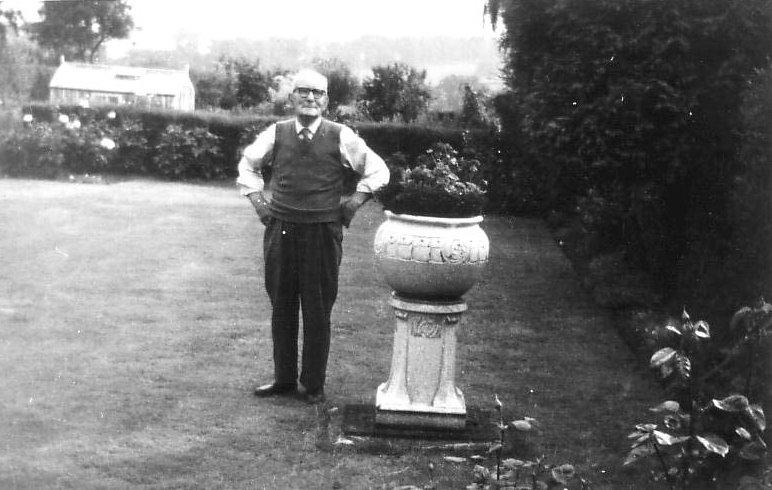
The property was a large two bedroom bungalow called ‘Robin Hill’. The property was a large two bedroom bungalow, with a large garden out the back. I remember a greenhouse where my grandfather grew tomatoes and looking at the the photos today, I am struck by the size of the garden and how pretty it was. My grandfather must have spent a lot of time out there and I wish I could have talked to him about it, as I have grown to love gardens too and I think he could have taught me a thing or two.
My great grandfathers Albert Edward William Clarke and my great grandfather Joseph Charles Abram lived about 100 yards away from one another on Earls Barton. More information about both men can be found on this website.

32 Mears Ashby Road, Earls Barton

Mears Ashby Road was the home of my great grandfather, Joseph Charles Abram. Named ‘Rockaway’, it was a three bedroom semi detached house and was one of two houses which we believe he built after he retired from the army.

My dad and granddad lived in this house for around  4 – 5 months in 1952 too because my grandmother was in hospital. Dad remembers the property had a large flower garden but also a large area for growing vegetables. He explained to me that gardens were much bigger than they are today and growing vegetables had been encouraged during the war years as part of the Grow for Victory campaign.

The Limes, Earls Barton

My great grandfather Albert Edward William Clarke lived at The Limes.  The house still stands today.  Photos of the property can be seen below.