Abram’s Buses and Earls Barton Motors

Earls Barton is a village in Northamptonshire, situated in the borough of Wellingborough. The name comes from Bere-tun, which is Saxon for ‘a place for growing barley’. The prefix ‘Earls’ comes from a long association with the Earls of Northampton and Huntingdon. Earls Barton is known for its Anglo-Saxon and shoe making heritage it is also the place where my ancestors lived and worked.

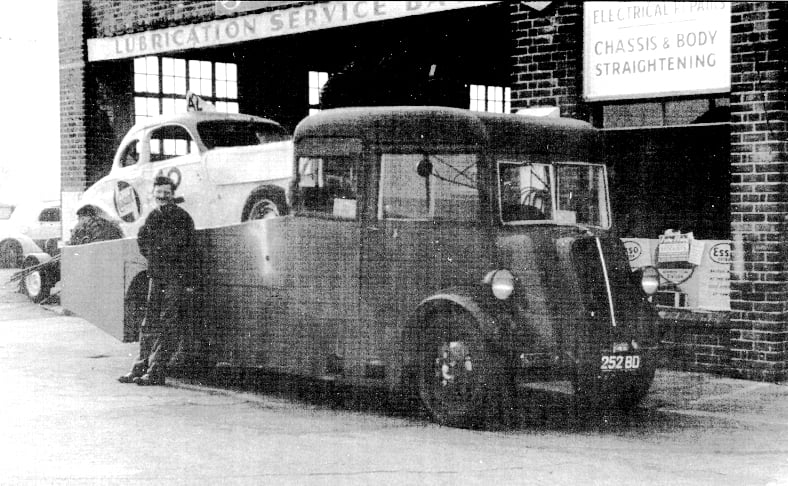
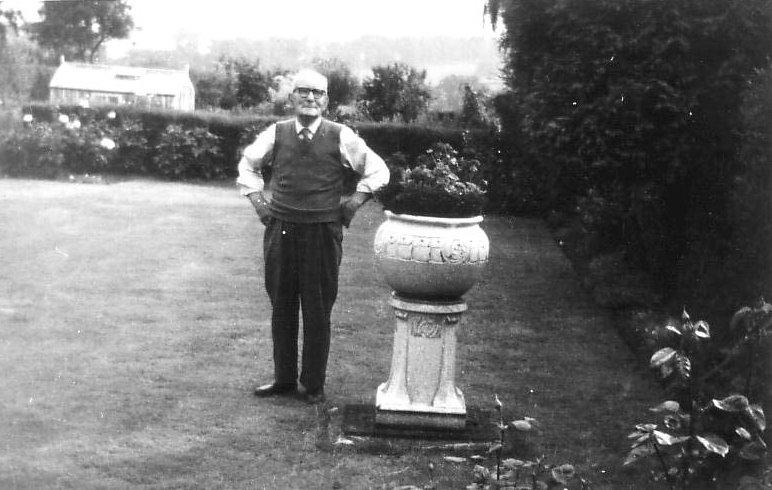
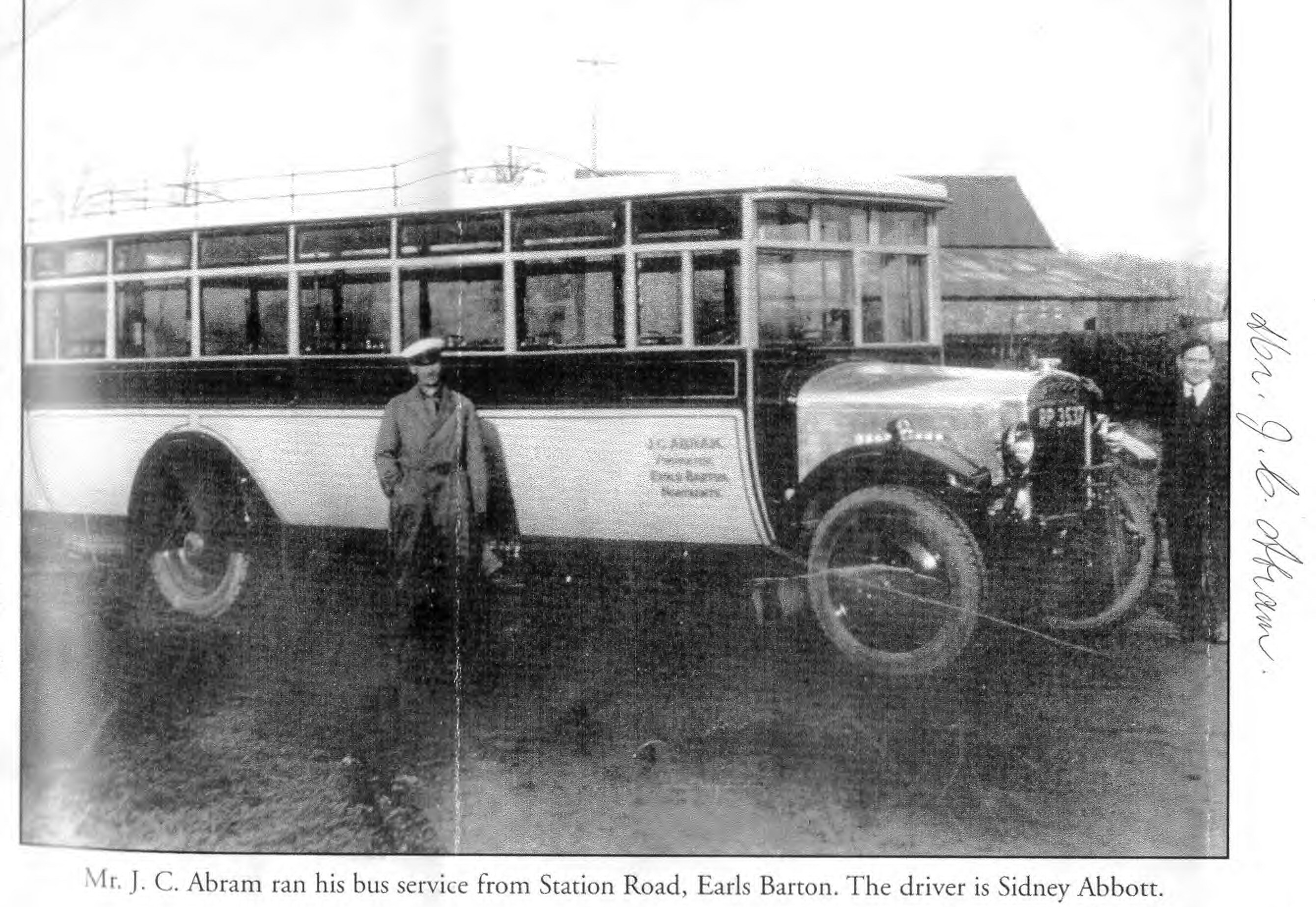
On leaving the army in 1922 my great grandfather Joseph Charles Abram returned to the village where his parents Charles and Emily lived. He built two houses on the Mears Ashby Road, choosing to live in one and sell the other. He was also the proprietor of Abram’s Buses and later Earls Barton Motors, known locally as Abram’s garage.

Abram’s Buses

The first motor bus had arrived in Earls Barton in 1921 and was owned by the village carrier who would have transported passengers and goods between towns and villages in the area. In 1924 Joseph purchased his first bus — a model T Ford saloon from Henry Oliver Ltd, a Northampton based Ford agent, for which he paid £221. The same year he was summoned for leaving a motor bus in Wellingborough without having taken due precautions to prevent it starting in his absence. Superintendent McLeod explained the vehicle had been left in Sheep Street where a constable had been able to jump on the vehicle and stop it before it had got too far. Joseph was fined £1
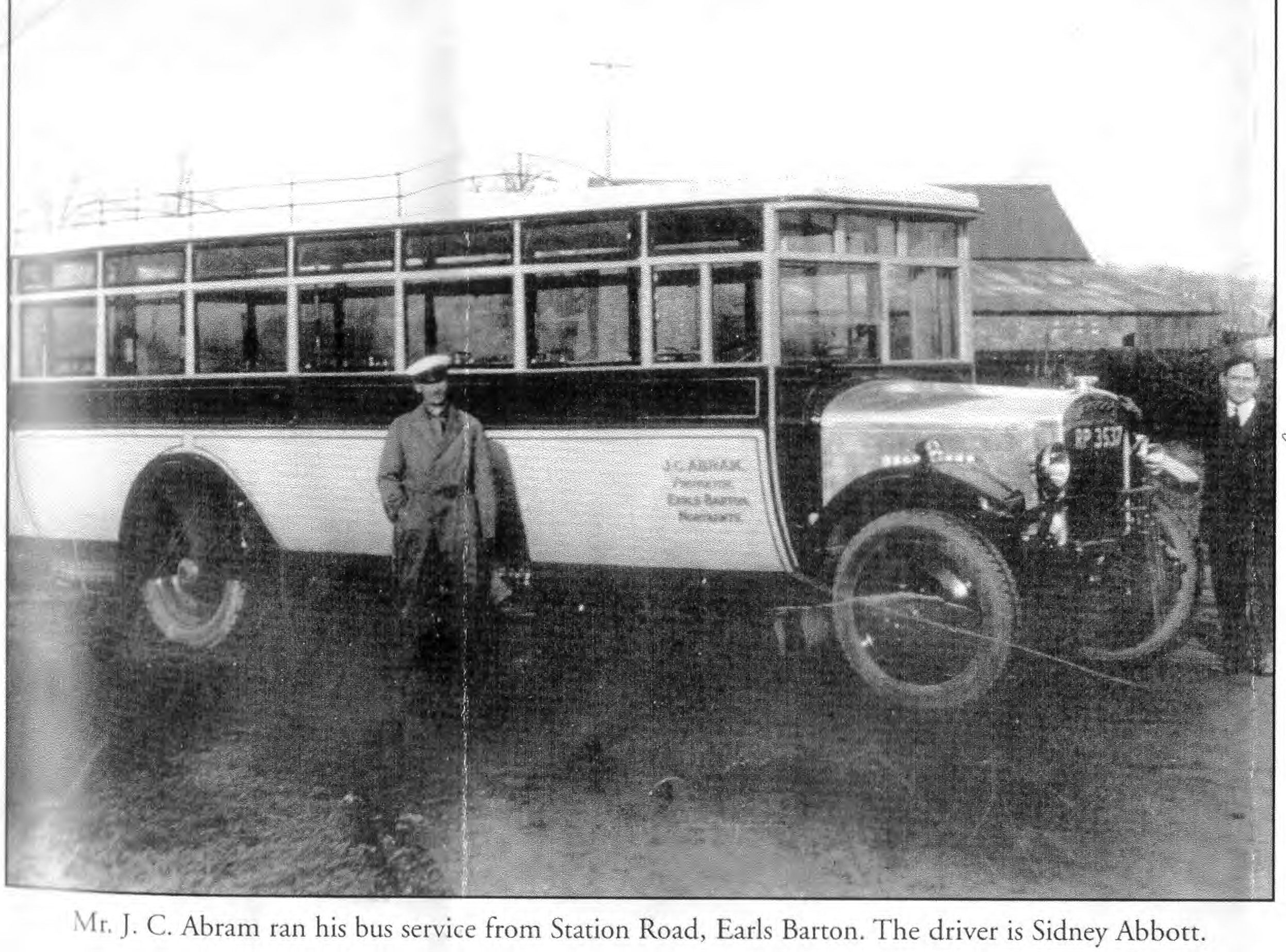
Joseph Abram and bus

The main service Joseph provided operated between Earls Barton and Wellingborough but services also included a Saturday only service between the months of September to April for football supporters, services from Barker’s Shoe Factory in the village, an August Bank Holiday service to Castle Ashby, excursions to Yarmouth, Clacton and Skegness and a number of evening tour trips.

By August 1928 Joseph had a fleet of four buses. Newspaper articles from the time show that as the omnibus proprietor of a small bus company, Joseph took on the United Counties bus company on the road, in the press and in the courtroom —the much larger company had an operating area covering Northamptonshire, Bedfordshire, Buckinghamshire and Huntingdonshire, with services that reached into Lincolnshire, Leicestershire, Oxfordshire, Cambridgeshire,  Rutland, London and Nottingham.

In a letter to the editor of the Northampton Mercury, Joseph wrote “I have been running my two buses (trying merely to get a living) for some few years now between Earls Barton and Wellingborough and was the first to commence early morning journeys for workmen between those places.” United Counties responded saying that “the authorities concerned should think seriously about granting a ‘small man’ a licence”. 

It was also reported in the press that Joseph applied for a new co-ordination between his services and the United Counties Omnibus Bus Company Ltd between Earls Barton and Wellingborough, due to overcrowding on the route and United Counties not keeping to the  scheduled times. As such “a start two minutes later could be of great importance.”  Mr Troup applying on behalf of Joseph said “The last Earls Barton census had a population of 2,800, yet no fewer than 111 passenger buses ran into it every Saturday and 120 out.” He continued that “on Wednesday and Fridays 93 buses ran in and out, 68 on Monday, Tuesdays and Thursday and on Sundays 48 in and 49 out.” The Chairman (Mr J H Stirk) asked “does everybody move at Earls Barton every Saturday” and Mr Troup replied “I think they must.”  William George Austin a United Counties inspector also advised that Mr Abram had complained on one occasion about a bus starting four minutes late but the driver said he started promptly having set his watch by the Regal Clock in Wellingborough which was met by laughter. It was concluded there were too many buses on the route but a decision would be deferred until loadings of the two services had been supplied.

Other newspaper reports exist of accidents, dangerous driving and a false statement made to the police by a driver for the United Counties Omnibus Company, who later admitted making the statement “because he was annoyed at the time by a woman who was one of Abrams’ customers insulting him.” When Joseph applied to run a service to Castle Ashby on the flower show day in the summer, it was report United Counties objected on the grounds there was an adequate service and that passengers had been left stranded which Joseph denied. The Chairman granted the application nonetheless saying “see you bring home all the people you take.” In the same article it was reported Joseph complained United Counties had a five minute service against him for a village of 3,000 people, so as to “squeeze the blood out of your body.”

In December 1930 Joseph offered his services and vehicles to United Counties but did not in fact sell his business to them until 1932. In March of that year Joseph advised them he was willing to dispose of his business which included four vehicles, two plots of land, a petrol pump and wooden garage — the business was sold on 23 March 1932.

On Friday 20 November 1931 the Northamptonshire Mercury reported that ‘an application had been made by J C Abram of Earls Barton to run his buses between Wellingborough and that place’ and further newspaper articles from the time show that as an Omnibus Proprietor of a small bus company he took on the United Counties bus company on the road, in the press and in the courtroom.

The document below, produced by The Omnibus Society, records Joseph’s life from September 1924 when Joseph purchased his first bus, to May 1932 when he sold his business to United Counties.

Joseph is also mentioned in the book United Counties Buses: A Fleet History, 1921 – 2014.

Earls Barton Motors (Abram’s Garage)

The sale of Abram’s Buses almost certainly assisted Joseph with his purchase of Abram’s Garage which Joseph advertised as ‘the reliable physicians for all motoring ailments.’ Complete overhauls and repairs were carried out to all makes of cars and commercial vehicles, with all repairs carried out by expert mechanics under personal supervision of the proprietor. Newspaper advertisements from the time also show that Joseph sold vehicles from the garage including a 1933 Austin light 124 saloon, 1934 Fordson end tipping lorry, 1932 Lanchester saloon and a 1930 Singer saloon.

In 1935 during his time as proprietor, Joseph was called as a witness at Wellingborough Police Court following an escapade by three youths who pleaded guilty to a number of offences including possessing a firearm. Joseph told how on 14 May dogs had awakened him — getting out of bed he heard clicking noises and saw a car driven away. The following morning he found two petrol pump globes had been broken apparently by bullets. Later the police found the pellets but Joseph could not say who was responsible. And the 1939 census of Earls Barton records Joseph as a Motor Engineer Garage Proprietor living at Abram’s Garage, Main Road with his wife Millicent (Milly May) and daughter Betty. Also residing with them is Albert E Evans, a haulage contractor and motor engineer. 

World war two

During the war the garage was used for repairing aircraft parts for Sywell aerodrome. A document from the Harrington Museum states:

‘The number or aircraft needing repair increased rapidly during 1940 and the accommodation at the main centre at Sywell was found to be inadequate. This together with the policy of dispersal and the benefit of taking work to the people instead of the reverse with consequent saving in travelling, led to premises being requisitioned including Abram’s Garage, Earls Barton – used for
undercarriage and bomb beams.’

The full document can be viewed below.

The home guard

 
Joseph is known to be a member of the Home Guard during World War two. The Home Guard was set up in May 1940 as Britain’s ‘last line of defence’ against German invasion. Members were usually men above or below the age of conscription and those unfit or ineligible for front line military service. The full Home Guard ledger is in Earls Barton  museum and lists all the streets and homes in the village. Each home is listed with how many occupants whether they were in the Home Guard or ARP wardens it even lists if the house had a ladder or a hosepipe in case of an air raid.A document from this time also lists buildings other than dwelling houses used by the Home Guard and Abram’s Garage is shown as post number 12.

Ooold Soljer and Two Beauts


And on 31 March 1943 the garage was recorded as sustaining a broken window when, during a practice air raid, two B17 flying fortresses, Ooold Soljer and Two Beauts, collided, shedding bombs and spreading wreckage in Mears Ashby and Earls Barton — an information board now stands in Mears Ashby which advises visitors about the crash.
 

Aubrey Leighton

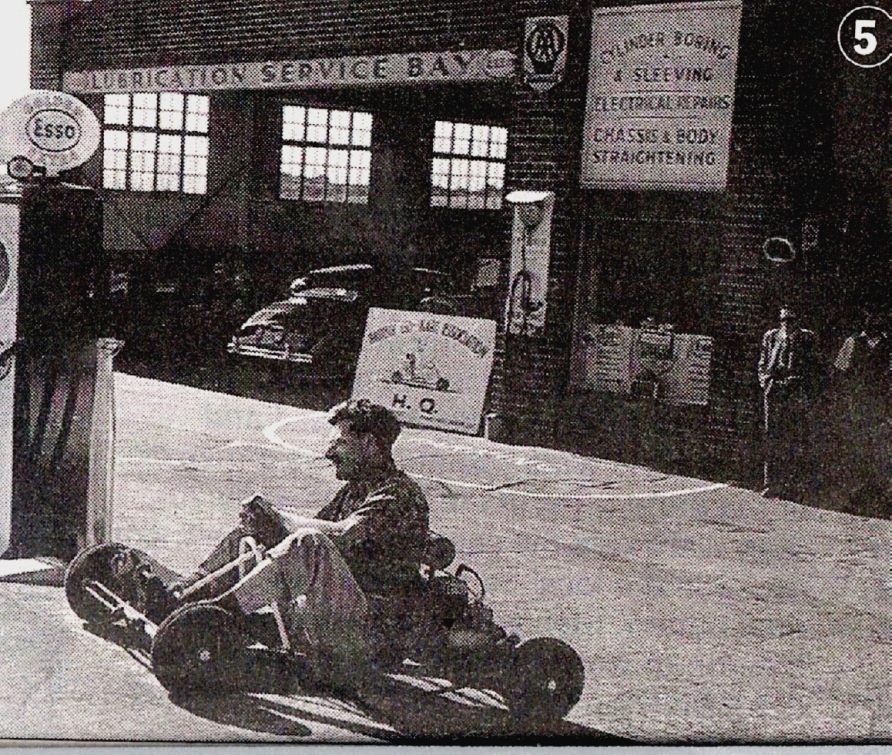
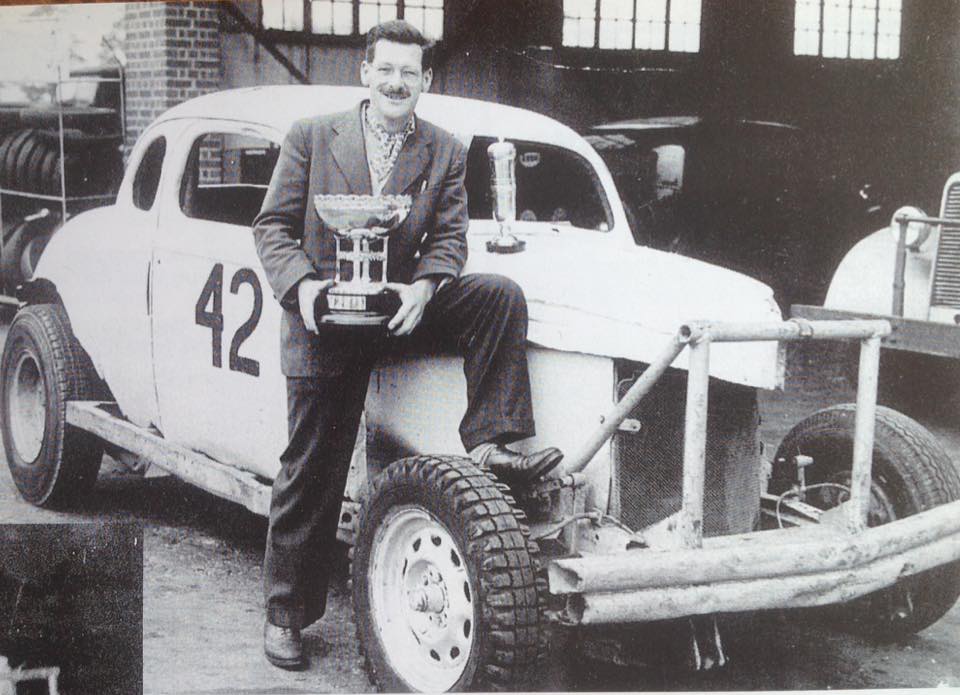
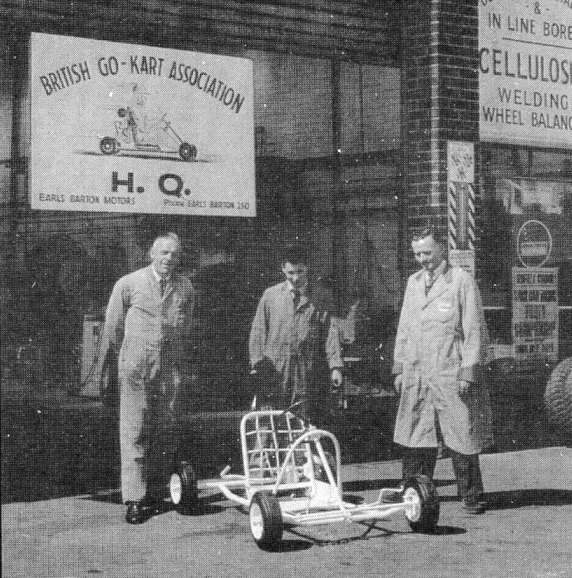
Joseph is believed to have run the garage successfully until sometime after the war and when he retired, he sold the garage to Aubrey Leighton, one of the pioneers of F1 stock car racing. Aubrey began racing in 1955 when the sport was about a year old. He went on to win 48 Finals, plus the National Points Championship in 1963. In only his third season of racing, Aubrey won the 1957 World Championship, staged at Belle Vue.
abran-garage-stock-car-4

abran-garage-stock-car-3
abran-garage-stock-car
 
abran-garage-stock-car-2


The Abram family however remained in Earls Barton. Joseph’s parents Charles and Emily who are first recorded as living there on the 1911 census can be found on the 1921 census and the 1939 census also. And on 24 March 1930 the Northampton Chronicle and Echo reported the old couple, who had lived in Earls Barton for twenty seven years, had fourteen children, six of who had served in the Great War with all of them returning home, had celebrated their 30th wedding anniversary. 

Joseph died in 1970 at which time his residence was recorded as Mears Ashby Road, Earls Barton. There is no fancy obituary for Joseph, he was not a prince or a king, a politician or a film star, he was simply an ordinary man doing his best to make a living during an extraordinary time in history — yet reading his words and those of the people who knew him bring him to life and ensure he is not forgotten. How lucky am I to call this ‘regular joe’ my ancestor?

Sources

Earls Baron Parish Council

Abram’s Buses

Abram’s Garage

Newspaper articles

  • Northampton Chronicle and Echo
    Summoned
    28 November 1924
  • Northampton Mercury
    Charge against a bus driver dismissed
    2 July 1926
  • Northampton Mercury
    Buses and competition:
    A letter to the editor of the Mercury from J C Abram, Omnibus proprietor
    5 November 1926
  • Northampton Chronicle and Echo
    Saloon buses for hire (party arrangements)
    27 May 1927
  • Northampton Mercury
    An error of judgement costs a bus driver £2 at Wellingborough
    21 October 1927

  • Northampton Mercury
    Bus overturns on joy trip to Hunstanton
    9 August 1929
  • Northampton Chronicle and Echo
    A family of fourteen
    24 March 1930

  • Northampton Mercury
    An application to run buses from Wellingborough to Earls Barton
    20 November 1931
  • Northampton Mercury
    Application for a new co-ordination
    26 February 1932
  • Northampton Mercury
    Petrol Pumps damaged
    31 May 1935

  • Northamptonshire Evening Telegraph
    Vehicles for sale
    17 June 1939

  • Northamptonshire Evening Telegraph
    Semi detached house for sale
    15 September 1939
More photos

George and Lucy Munns

I learned about George and Lucy Munns while researching the Thompson family. Lucy Munn’s name appeared on the 1871 and 1881 census returns along with William and Harriett Thompson.

1841

George and Lucy Munns, both aged 35 can be found on the 1841 census, living at Todds Lane Johnsons Square, St Sepulchre, Northampton.

1851

In 1851 George and Lucy are living at 1, Nelson Street Square, St Sepulchre Northampton, Both described as shoemakers, they have four daughters, including a daughter Harriett aged seven.

1861

In 1861 George and Lucy are living at 27, Vernon Street, Priory of St Andrew, Northampton. Harriett aged 17 is employed as a shoe machine worker.

1871

In 1871 a Lucy Manns is recorded as living with William and Harriett Thompson at Russell Street, Northampton. William is employed as a riveter, Harriett as a machinist and Lucy as a laundress.

1881

In 1881 Lucy Munns is again recorded as living with William and Harriett, living at 42 Great Russell Street, Northampton. Interestingly though, Lucy Munns, a widow also aged 75 and described as Mother in Law can be found recorded at 8 Billing Road Northampton, living with John Peach (a retired Market Gardener) and his wife too.*

* The 1901 census shows Lucy Thompson aged 21, working as a servant for a widow, aged 73, named Elizabeth Peach, at 25 Margaret Street, Northampton. Elizabeth is described as ‘living on own means’.

William and Harriett Thompson

William and Harriett Thompson were the parents of Lucy Thompson, who was the first wife of my great grandfather Joseph Charles Abram.

1841

The 1841 census shows William aged three living in Dallington, Northampton, with his parents William and Mary and six brothers and sisters – George, John, Mary, Sarah, Richard and Elizabeth.

1861

In 1861, William aged 23, can be found living in the home of John and Emma Humphrey at 5, Cavendish Terrace, Clapham, Wandsworth. John and Emma have eight children and five servants including William. William’s occupation is given as a footman and John’s occupation is given as wharfinger, which is the owner or keeper of a wharf.

1871

In 1871 William is back in Northampton, living at Russell Street. He is now married to Harriett. Living with them are two other women, Lucy Manns aged 65 and Harriett Clarke aged seven.

1881

In 1881 William and Harriett are living at 42 Great Russell Street, Northampton. They have four daughters including Lucy aged one. Lucy Munns is living with them, aged 75 and she is described as Mother in Law. Interestingly though, Lucy Munns, a widow also aged 75 and described as Mother in Law can also be found recorded at 8 Billing Road Northampton, living with John Peach (a retired Market Gardener) and his wife too.*

1891

In 1891 William and Harriett are living at Great Russell Street. Lucy is now aged 11. William is described as a gentlemen’s gardener.

1901

In 1901 still at Great Russell Street, William’s occupation is now given as a market gardener and Harriett is recorded as a greengrocer shop keeper. **

1911

In 1911 William and Harriett are living at 18 Burns Street, Northampton.*** Living with them is a Mrs Peach, a boarder and a widow aged 83, with a personal description of ‘independent means’.

* The 1901 census shows Lucy Thompson aged 21, working as a servant for a widow, aged 73, named Elizabeth Peach, at 25 Margaret Street, Northampton. Elizabeth is described as ‘living on own means’.

** The 1890 Kellys directory has William listed as the greengrocer.

*** At the time of Lucy’s marriage to Joseph she was living at 35 Burns Street, Northampton.

Lucy Thompson

Lucy Thompson was the first wife of my great grandfather Joseph Charles Abram, a Corporal in the Army Service Corps. Married on 16 April 1906 in Northampton, at the time of her wedding, Lucy was living at 35 Burns Street, Northampton and the witnesses were Lucy’s sister Alice Thompson and Joseph’s brother Frederick George Abram.

Born in Northampton in 1880, Lucy was the daughter of William and Harriett. On the 1881 census, Lucy can be found aged one, living with her parents and sisters Emily, Annie and Alice.  Living in the same house is Lucy Munns (described as mother in law).* In 1891, Lucy, aged 11,  can again be found living with her parents and sisters at Great Russell Street.  Her father William is now recorded as working as a Gentleman’s Gardener. Finally, in 1901, Lucy, aged 21, is no longer at home with her parents but is working as a servant for a widow, Elizabeth Peach, at 25 Margaret Street, Northampton.

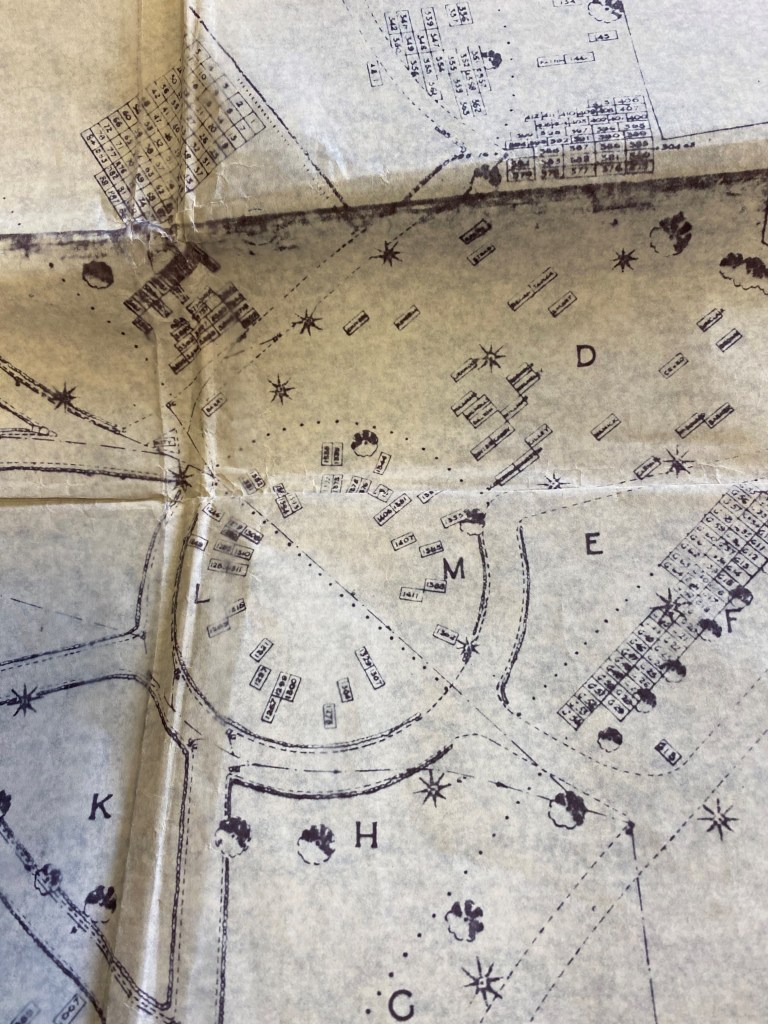
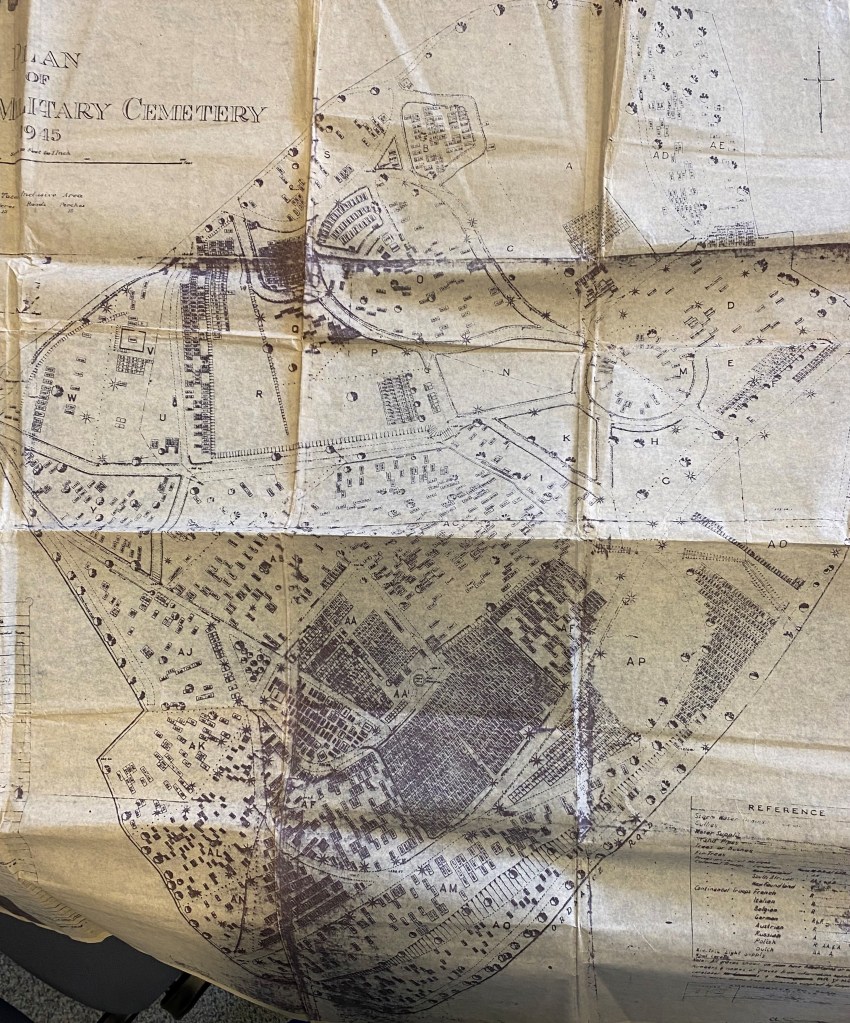
Lucy died aged 26, at 4 Ferndale Villas, Holly Road, Aldershot on 12 October in 1907 with the reason for death being instrumental labour and pulmonary embolism. The death was registered by Joseph Charles and Lucy was buried four days later on 16 October 1907 at the Aldershot Military Burial Ground, Hampshire. John Greenfield at the Aldershot Garrison has kindly helped me identify Lucy’s burial place in the cemetery, as plot number 1406, in site M.  Sadly there doesn’t appear to be a record of a burial for Joseph and Lucy’s child.

Map of Aldershot Military Cemetery.

I am interested to learn more about Lucy and her family, as she has been described to me as ‘a dark skinned lady’ and I have discovered that Northamptonshire has a significant black history, with people of Asian, African and Caribbean origin, residing in the county over many centuries.

Further information

* I have located a Lucy Munns on the 1851 and 1861 census returns. She is recorded as having been born in Riseley in Bedfordshire and is married to George Munns.  The couple have a daughter called Harriett.

Joseph Charles Abram

Joseph Charles Abram was my great grandfather.  Married to Millicent May Bowers, the couple had three children – my grandfather Louis Bowers Abram, Betty and Joseph Bowers Abram, their first son, born in Tempe, Pretoria, South Africa, in 1913, where Joseph Charles was stationed on army service.  The child lived for two short months – he died of enteritis and heart failure and is buried in South Africa.

joseph-charles-mears-ashby

Joseph served in the army from January 1901 to March 1922, receiving the 1914 Star, the British War Medal 1914 – 1918 and the Victory Medal 1914 – 1918 as well as being mentioned in Despatches on 30 December 1918.

On discharge, Joseph Charles Abram was involved in a number of projects.  He is believed to have run two pubs – the Red Lion in Stambourne, Essex (around 1924 when his daughter Betty May Abram was born) and the Kings Arms in Woodbridge,  Suffolk.

He built two houses at Mears Ashby Road in Earls Barton. Choosing to live in one of these, the second property he sold. Newspaper articles from local newspapers in 1939 advertised a semi detached house with six rooms (three being bedrooms),  central heating, bath, electricity, gas and main water. The houses still stand today.  

joseph-abram-bus

He also ran Earls Barton Motors (known locally as Abram’s garage), from which he sold vehicles and ran a bus service in the early 1930’s.  operating a small local service with trips to Wellingborough and back at weekends costing four pennies return. During the war the garage was used for repairing aircraft parts for Sywell aerodrome and in March 1943 the garage sustained a broken window when two Air Force Bombers collided and crashed.

Further information about Joseph

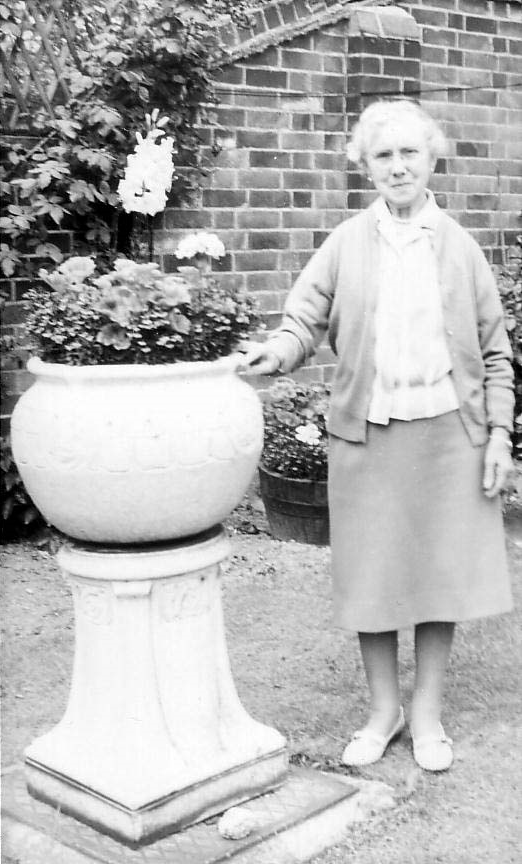
Millicent May Bowers

Millicent May Bowers was my great grandmother. Married to Joseph Charles Abram, they  had three children, my grandfather Louis Bowers Abram, Betty and Joseph Bowers Abram, their first son, born in Tempe, Pretoria, South Africa, in 1913, when Joseph Charles was stationed there on army service.

Milly May

milly-may-2-mears-ashby

Born in Bury St Edmunds, the 1901 census shows Milly, aged 17, living with her parents Henry and Eliza and working as a dressmaker. In 1911 she can be found working at the Kings Arms in Woodbridge, with her sister Kate Eliza Whitehead, a widower and Licenced Victualler, where Kate appears to have been the landlord for over 30 years.  Also living at the pub is Arthur John Bunn, a Ostler (a man employed to look after the horses of people staying at an inn), who appears to have become the landlord in 1937. The pub is now closed and the building used for mixed retail use.

Army Life

My great grandfather Joseph Charles Abram enlisted in the British Army on 22 January 1901 aged 19 years and five months and served until 1922. He worked as a Farrier Staff Sergeant (a blacksmith specialising in shoeing horses, a skill that requires not only the ability to shape and fit horseshoes, but also the ability to clean, trim, and shape a horse’s hooves) in the Army Service Corps. During his time in the army he served in South Africa, Egypt and Palestine.

The 1901 census records Joseph, aged 19, as a soldier in barrack rooms at Woolwich, London and  Kent. The 1911 census records Joseph aged 29 and single at Bulford Camp Salisbury, Bulford, Wiltshire. The same document records Harry Bowers, a Wheeler Staff Sergeant. Harry introduced Joseph to his sister Milly May while on leave — Milly May Bowers later became Milly May Abram. The 1921 census records Joseph aged 39 and married in the Armed Forces Overseas at P G H Ludd, Palestine.

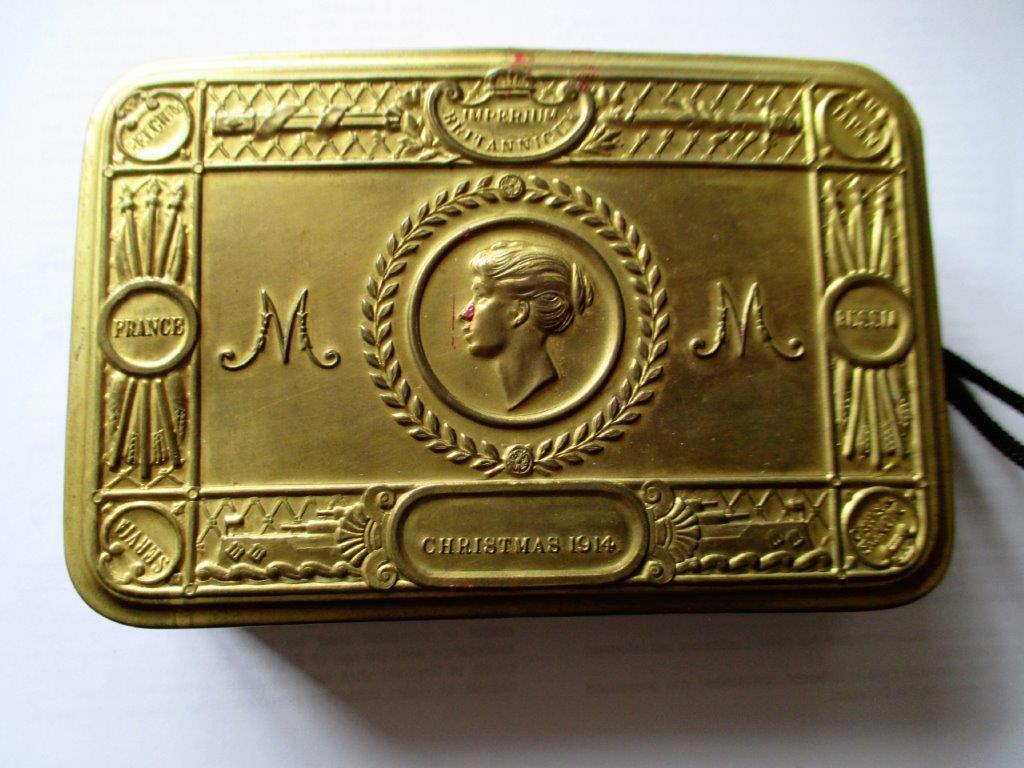
My family is fortunate to have a copy of his service record together with other mementos of his time in the army, including a brass tin (a Christmas gift from Princess Mary to those serving in the armed forces in 1914) and the Christmas card that came with this.

We have his war medals, the 1914 Star, British War Medal and Victory Medal, which were also known as Pip, Squeak and Wilfred and the Oak Leaf emblems which he received for having been mentioned in despatches on 30 December 1913 (a member of the armed forces mentioned in despatches is one whose name appears in an official report written by a superior officer, in which gallant or meritorious action in the face of the enemy is described).

Further information

Princess Mary Christmas tin

More photos

Joseph Bowers Abram

Joseph Bowers Abram was the first child born to my great grandparents Joseph Charles and Millicent May Abram.

Growing up I remember often being told about Joseph, although at the time we did not know the child’s name, born to my great grandparents during time they had spent in South Africa. My great grandfather was stationed in Tempe, Pretoria on army service and Millicent was there with him.

There was no military conflict in South Africa that would have caused them to be there but there was a substantial military presence in South Africa following the
creation of the Union at the end of the Anglo-Boer War in 1899-1902 and some British Army units remained stationed in South Africa until the beginning of the First World War.

The British had occupied the town of Bloemfontein and Tempe became a military base – Bloemfontein, as the capital of the Boer Orange Free State Republic and a large town, was established as one of the new Union’s administrative centres and consequently had a local military garrison, Tempe. Today, the Tempe base is reported to be one of the largest Army bases in South Africa.

My grandmother recalled being shown a photograph of the child’s grave which Joseph Charles is said to have carried in his wallet but the photograph can no longer be found – the grave was surrounded by iron railings made by my great grandfather, who worked as a Farrier (a blacksmith – specialising in shoeing horses, a skill that requires not only the ability to shape and fit horseshoes, but also the ability to clean, trim, and shape a horse’s hooves).

However, for many years the search for information about the child proved to be fruitless. Requests for help locating documents or a photo of the grave ran cold. The child was nothing more than an often told family story – there was no evidence he had ever lived.

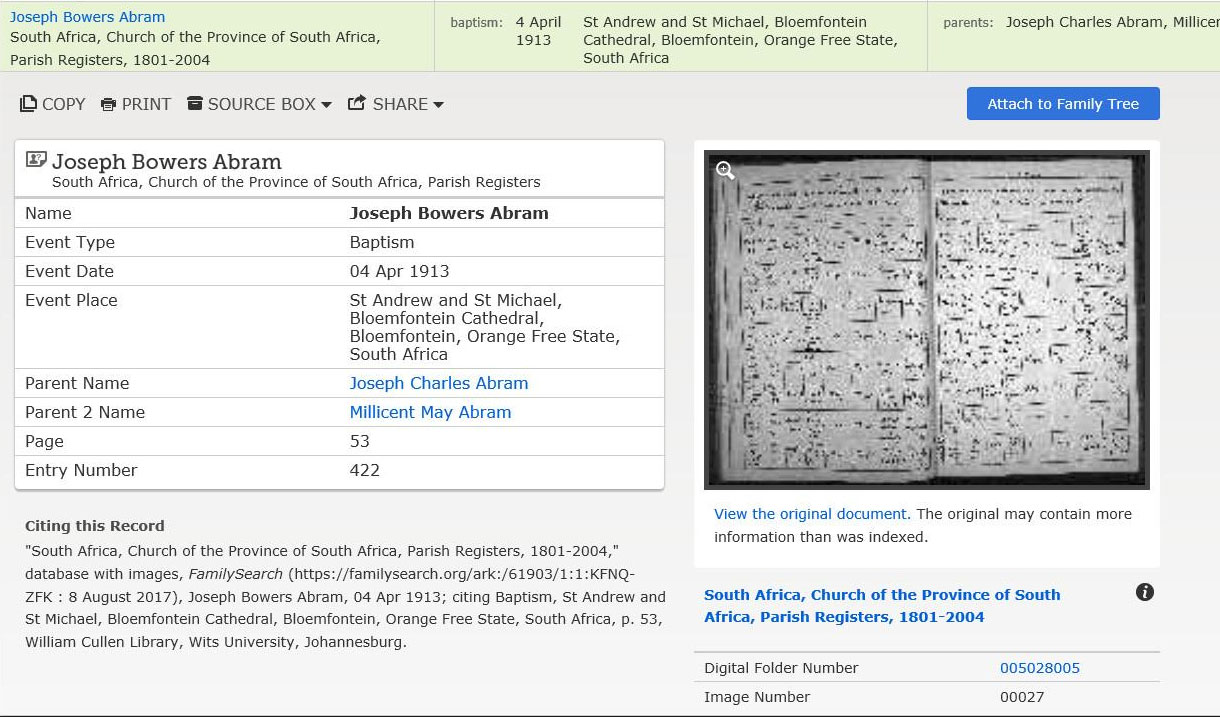
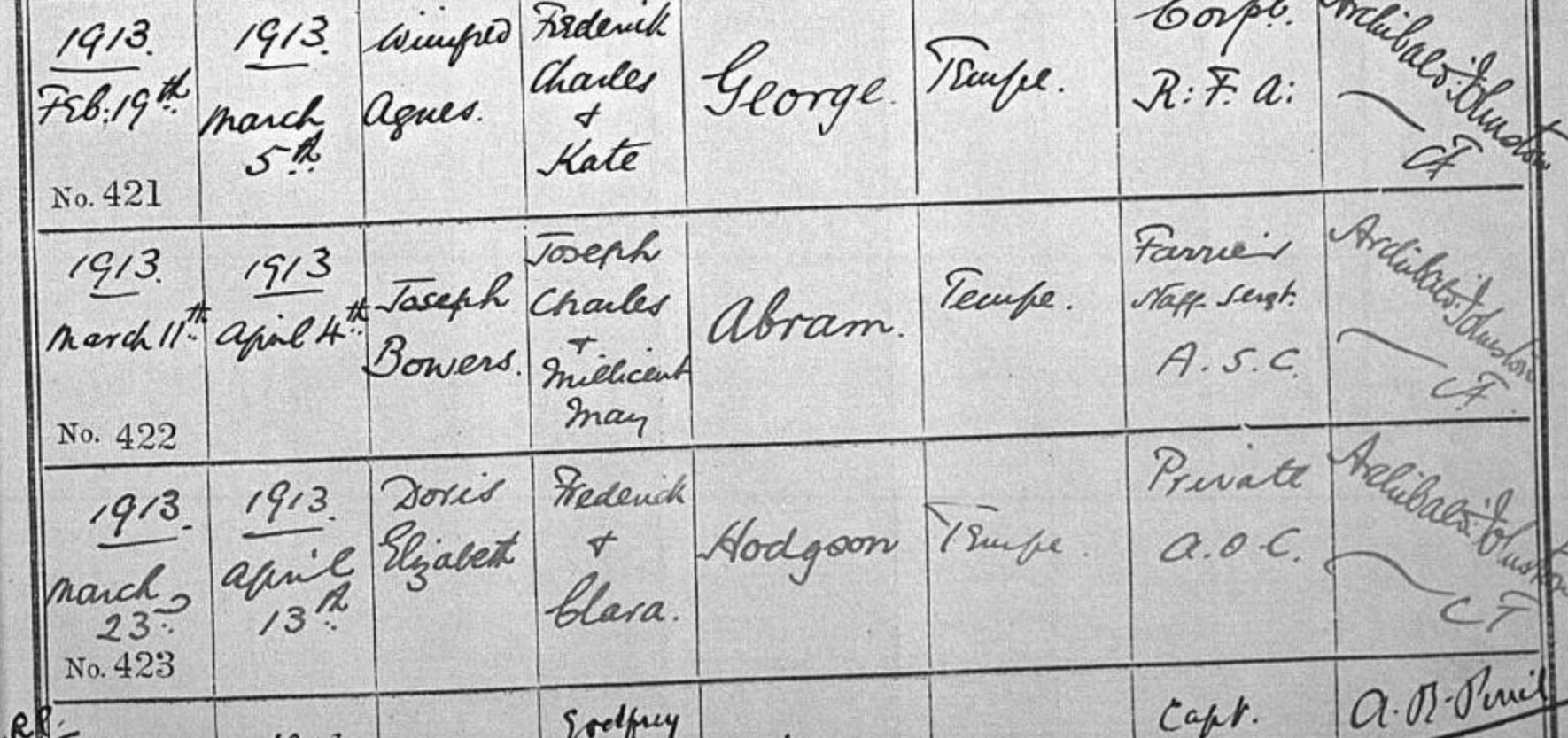
Eventually information about the child did emerge – a boy, named Joseph Bowers Abram (Joseph after his father and Bowers, his mothers maiden name) was found to have been born on 11 March 1913 – he was baptised less than a month later on 4 April 1913 in Bloemfontein Cathedral, Orange Free State, South Africa.

Detail of the baptism of Joseph Bowers Abram, 4 April 1913

Detail of the baptism of Joseph Bowers Abram, 4 April 1913

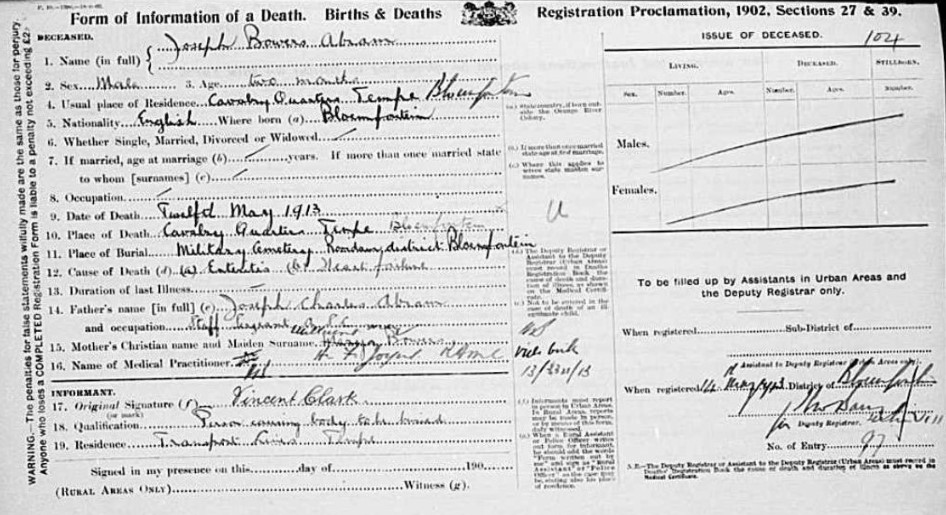
Sadly, Joseph lived for two short months – he died of enteritis and heart failure. Joseph and Milly May returned to England soon after. I can only imagine how it much have felt to leave their baby so far away.

2009

Around 2009 my dad made contact with a cemetery recording project, they advised they had the following information on a  DVD.

ABRAM, Joseph
Buried: Rooidam Military Cemetery, Tempe, District Bloemfontein, Free
State, RSA
Note: Joseph Abram
Son of S Sgt Abram. Died 1908-1913 during occupation of Tempe

The information he was told was taken from a headstone recording done in 1993 by Holden, P and Botha but sadly the information did not lead to a photo of the grave.

Both of us also made contact with The Commonwealth War Graves Commission. They advised their responsibility for graves in Rooidam Military Cemetery was limited to the war graves and those of soldiers from the Anglo-Boer War. The cemetery contained many private graves of the soldiers family members but many of the private memorials had deteriorated over time or disappeared and The Commonwealth War Graves Commission did not have records of the civilian burials in Rooidam Military cemetery.

A member of staff kindly visited and checked the private headstones that still existed but was unable to locate any that related to Joseph Bowers Abram which was terribly sad, as it appeared there had been a headstone in 1993.  He went on to advise that many infants appear to have been buried in a plot to the rear left of the central avenue but unfortunately few headstones remain. He sent the photograph of the cemetery below but could not confirm this was where Joseph was actually buried.

Rooidam Military Cemetary

Further images of the cemetery can be found below.

2018

Then in February 2018, when trying to pull together everything I knew into one place to write this story, I decided to do an internet search for ‘the occupation of Tempe’ – I wanted to know why my great grandfather was there and why Tempe was occupied.  I didn’t find the answers to my questions but the search did lead to me discovering four photos of the Tempe memorial which named both my great grandfather and his son.

Tempe memorial

Further images of the Tempe memorial can be found below.

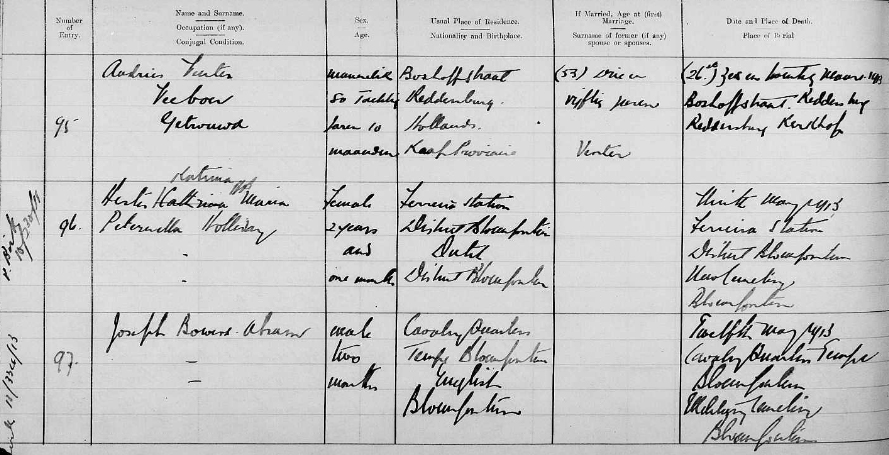
This was  swiftly followed by a church burial record and death entry.

Death entry for Joseph Bowers Abram

form-of-information-of-death-joseph-bowers-abram

Joseph Bowers Abram burial certificate

Armed with the new information I had obtained, I made contact with the South Africa War Graves Project.  They wrote back and advised that a visit to the Rooidam Cemetery had not identified the location of the grave – there are quite a few crosses with no names etc and open patches where you can see there’s a grave but no stone etc.

Updating this story in March 2018, I now believe the chance of locating an individual grave is unlikely – it has been suggested to me that there might have been an individual grave at sometime with or without a headstone. It has also been suggested to me that the graves could have been flattened and the memorial erected and/or the people named on the memorial could be buried at the site of the memorial. Whether we ever find this out remains to be seen – we may never know.

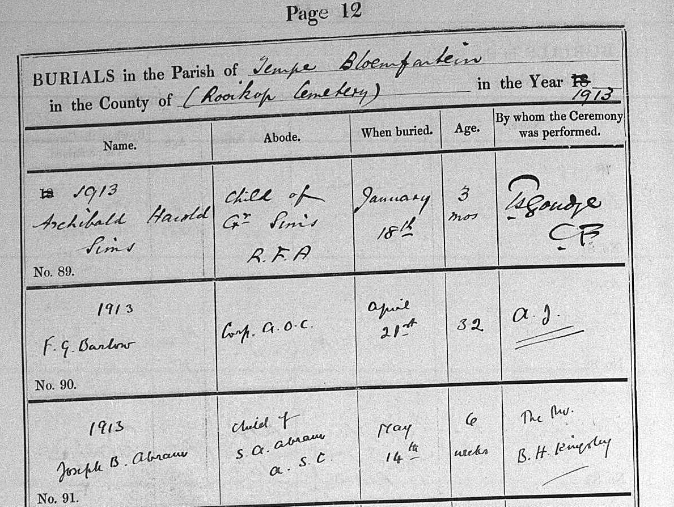
However, finally, the burial certificate shows the place where baby Joseph is buried and whilst the Tempe memorial is not the individual grave dad and I had been searching for, the memorial, clearly names Joseph and his father Staff Sergeant Abram – evidence that the baby who lived for only two short months has not been forgotten.

Acknowledgements

Many people helped in piecing together the history that appears on this page. Thank you in no particular order and hoping I haven’t missed anyone to Sandy Botha at Bloemfontein Cathedral, Terry Cawood and Glen at the South Africa War Graves Project, the eGGSA library, Cheryl Jacobs on the South African Genealogy Facebook page for providing the links to to the church burial record and the death entry, Riana le Roux, Rod Carkett at the Commonweath War Graves Commission, Rob Palmer at British Military History and the  Ministry of Defence Army Secretariat in Andover.