Charles Clay and Sons was established in 1861 by Charles Clay. An advertisement from the time records the company as inventors and patentees of the ‘low cost’ ribbon process which superseded the old method of weaving ribbons on a shuttle loom. The company had factories at Manchester, Cheapside, North Shields and Luton, where on leaving school in 1960, my dad had his first job as a trainee toolmaker.
By this time Charles Clay and Sons were now making more than ribbons. Situated on the ground floor and second floor, dad worked in the real leather department where banking items such as blotters, desk calendars and diaries were made, as well as plastic versions and other items such as tobacco stay fresh pouches, key rings and promotional gifts for companies such as BP and British Airways.
Dad was tasked with making and repairing high frequency (HF tools), setting up and repairing the HF welding machine, showing staff how to make new products, training the operators in safe loading of welding machines so as to not get HF burns to fingers and hands, organising stock arriving from the cutting room such as plastic sheet and cardboard. During his time there he also learnt to gold block and silk screen all the goods.
The first floor of the factory was offices and an in house printing press department, while the top floor was a machine sewing department making children’s shirts and ladies clothing. A small part of the factory housed ‘English Ribbons.’ Dad recalls that one of the women who worked there had previously worked as a conductress (also known as ‘clippy‘ because she would have ‘clipped‘ used tickets to prevent them being re-used) on London buses. One of her drivers had been the singer Matt Munroe.
Earls Barton is a village in Northamptonshire, situated in the borough of Wellingborough. The name comes from Bere-tun, which is Saxon for ‘a place for growing barley’. The prefix ‘Earls’ comes from a long association with the Earls of Northampton and Huntingdon. Earls Barton is known for its Anglo-Saxon and shoe making heritage — it is also the place where my ancestors lived and worked.
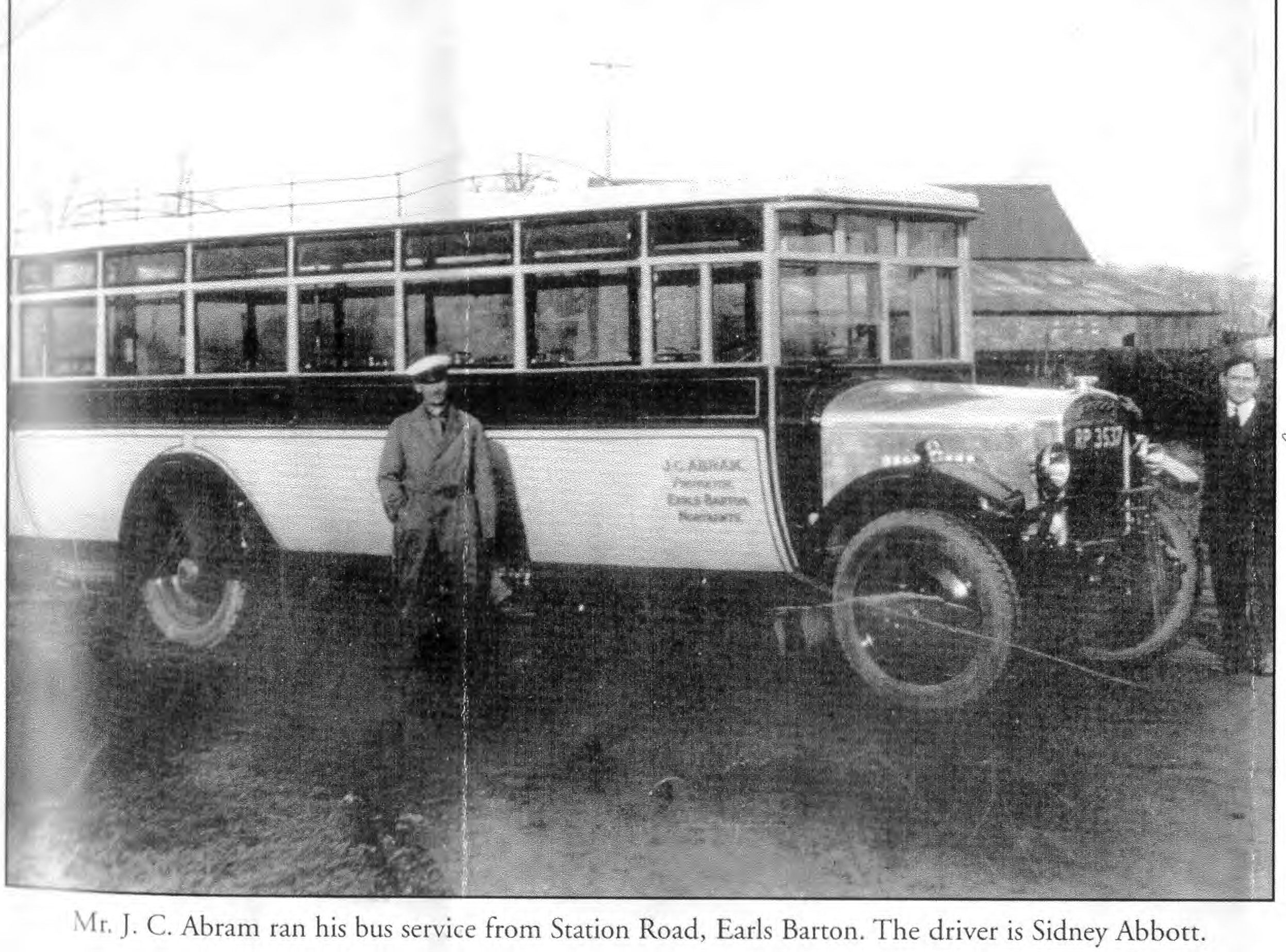
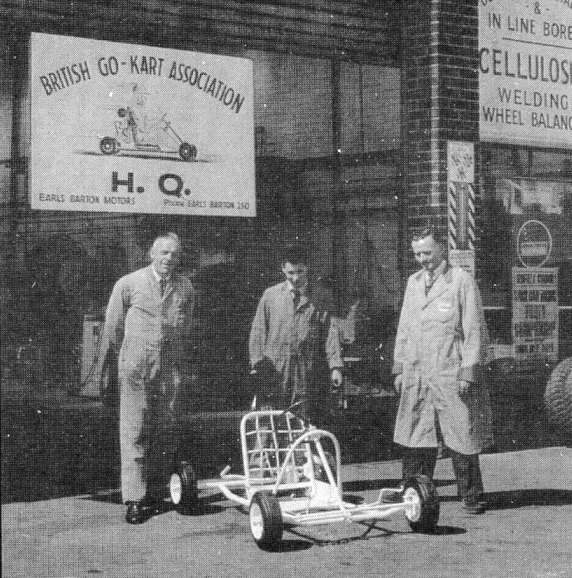
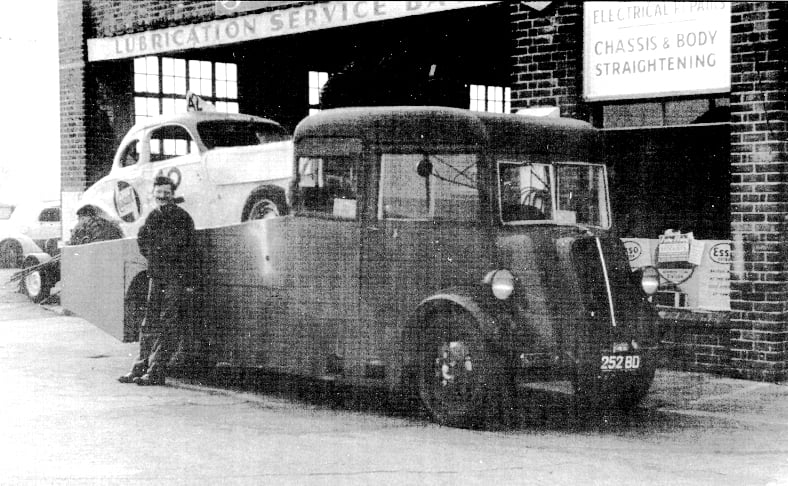
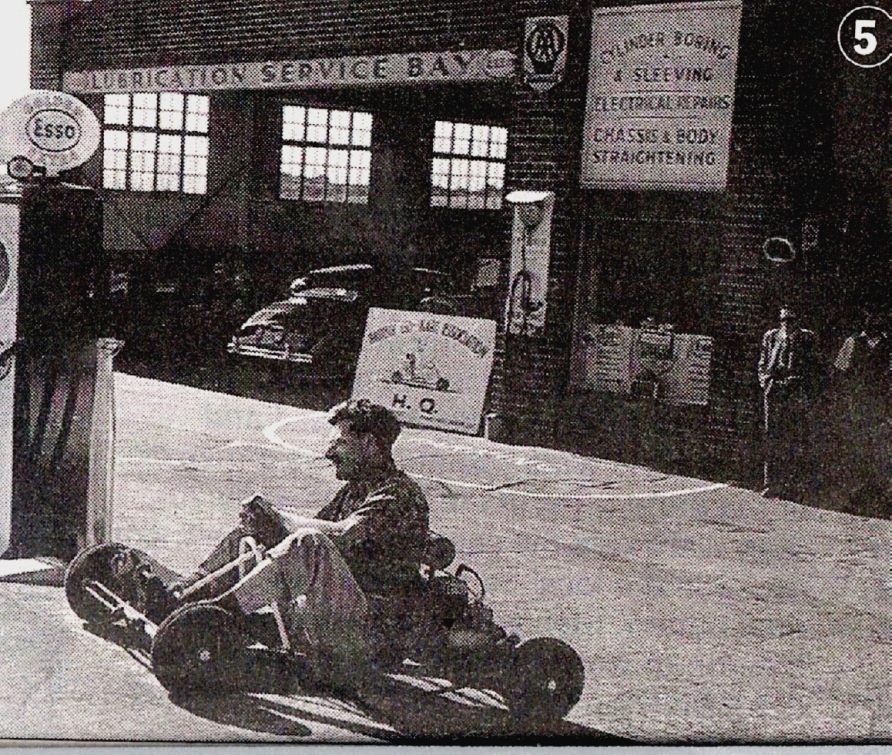
On leaving the army in 1922 my great grandfather Joseph Charles Abram returned to the village where his parents Charles and Emily lived. He built two houses on the Mears Ashby Road, choosing to live in one and sell the other. He was also the proprietor of Abram’s Buses and later Earls Barton Motors, known locally as Abram’s garage.
Abram’s Buses
The first motor bus had arrived in Earls Barton in 1921 and was owned by the village carrier who would have transported passengers and goods between towns and villages in the area. In 1924 Joseph purchased his first bus — a model T Ford saloon from Henry Oliver Ltd, a Northampton based Ford agent, for which he paid £221. The same year he was summoned for leaving a motor bus in Wellingborough without having taken due precautions to prevent it starting in his absence. Superintendent McLeod explained the vehicle had been left in Sheep Street where a constable had been able to jump on the vehicle and stop it before it had got too far. Joseph was fined £1
The main service Joseph provided operated between Earls Barton and Wellingborough but services also included a Saturday only service between the months of September to April for football supporters, services from Barker’s Shoe Factory in the village, an August Bank Holiday service to Castle Ashby, excursions to Yarmouth, Clacton and Skegness and a number of evening tour trips.
By August 1928 Joseph had a fleet of four buses. Newspaper articles from the time show that as the omnibus proprietor of a small bus company, Joseph took on the United Counties bus company on the road, in the press and in the courtroom —the much larger company had an operating area covering Northamptonshire, Bedfordshire, Buckinghamshire and Huntingdonshire, with services that reached into Lincolnshire, Leicestershire, Oxfordshire, Cambridgeshire, Rutland, London and Nottingham.
In a letter to the editor of the Northampton Mercury, Joseph wrote “I have been running my two buses (trying merely to get a living) for some few years now between Earls Barton and Wellingborough and was the first to commence early morning journeys for workmen between those places.” United Counties responded saying that “the authorities concerned should think seriously about granting a ‘small man’ a licence”.
It was also reported in the press that Joseph applied for a new co-ordination between his services and the United Counties Omnibus Bus Company Ltd between Earls Barton and Wellingborough, due to overcrowding on the route and United Counties not keeping to the scheduled times. As such “a start two minutes later could be of great importance.” Mr Troup applying on behalf of Joseph said “The last Earls Barton census had a population of 2,800, yet no fewer than 111 passenger buses ran into it every Saturday and 120 out.” He continued that “on Wednesday and Fridays 93 buses ran in and out, 68 on Monday, Tuesdays and Thursday and on Sundays 48 in and 49 out.” The Chairman (Mr J H Stirk) asked “does everybody move at Earls Barton every Saturday” and Mr Troup replied “I think they must.” William George Austin a United Counties inspector also advised that Mr Abram had complained on one occasion about a bus starting four minutes late but the driver said he started promptly having set his watch by the Regal Clock in Wellingborough which was met by laughter. It was concluded there were too many buses on the route but a decision would be deferred until loadings of the two services had been supplied.
Other newspaper reports exist of accidents, dangerous driving and a false statement made to the police by a driver for the United Counties Omnibus Company, who later admitted making the statement “because he was annoyed at the time by a woman who was one of Abrams’ customers insulting him.” When Joseph applied to run a service to Castle Ashby on the flower show day in the summer, it was report United Counties objected on the grounds there was an adequate service and that passengers had been left stranded which Joseph denied. The Chairman granted the application nonetheless saying “see you bring home all the people you take.” In the same article it was reported Joseph complained United Counties had a five minute service against him for a village of 3,000 people, so as to “squeeze the blood out of your body.”
In December 1930 Joseph offered his services and vehicles to United Counties but did not in fact sell his business to them until 1932. In March of that year Joseph advised them he was willing to dispose of his business which included four vehicles, two plots of land, a petrol pump and wooden garage — the business was sold on 23 March 1932.
On Friday 20 November 1931 the Northamptonshire Mercury reported that ‘an application had been made by J C Abram of Earls Barton to run his buses between Wellingborough and that place’ and further newspaper articles from the time show that as an Omnibus Proprietor of a small bus company he took on the United Counties bus company on the road, in the press and in the courtroom.
The document below, produced by The Omnibus Society, records Joseph’s life from September 1924 when Joseph purchased his first bus, to May 1932 when he sold his business to United Counties.
The sale of Abram’s Buses almost certainly assisted Joseph with his purchase of Abram’s Garage which Joseph advertised as ‘the reliable physicians for all motoring ailments.’ Complete overhauls and repairs were carried out to all makes of cars and commercial vehicles, with all repairs carried out by expert mechanics under personal supervision of the proprietor. Newspaper advertisements from the time also show that Joseph sold vehicles from the garage including a 1933 Austin light 124 saloon, 1934 Fordson end tipping lorry, 1932 Lanchester saloon and a 1930 Singer saloon.
In 1935 during his time as proprietor, Joseph was called as a witness at Wellingborough Police Court following an escapade by three youths who pleaded guilty to a number of offences including possessing a firearm. Joseph told how on 14 May dogs had awakened him — getting out of bed he heard clicking noises and saw a car driven away. The following morning he found two petrol pump globes had been broken apparently by bullets. Later the police found the pellets but Joseph could not say who was responsible. And the 1939 census of Earls Barton records Joseph as a Motor Engineer Garage Proprietor living at Abram’s Garage, Main Road with his wife Millicent (Milly May) and daughter Betty. Also residing with them is Albert E Evans, a haulage contractor and motor engineer.
World war two
During the war the garage was used for repairing aircraft parts for Sywell aerodrome. A document from the Harrington Museum states:
‘The number or aircraft needing repair increased rapidly during 1940 and the accommodation at the main centre at Sywell was found to be inadequate. This together with the policy of dispersal and the benefit of taking work to the people instead of the reverse with consequent saving in travelling, led to premises being requisitioned including Abram’s Garage, Earls Barton – used for undercarriage and bomb beams.’
Joseph is known to be a member of the Home Guard during World War two. The Home Guard was set up in May 1940 as Britain’s ‘last line of defence’ against German invasion. Members were usually men above or below the age of conscription and those unfit or ineligible for front line military service. The full Home Guard ledger is in Earls Barton museum and lists all the streets and homes in the village. Each home is listed with how many occupants whether they were in the Home Guard or ARP wardens it even lists if the house had a ladder or a hosepipe in case of an air raid.A document from this time also lists buildings other than dwelling houses used by the Home Guard and Abram’s Garage is shown as post number 12.
Ooold Soljer and Two Beauts
And on 31 March 1943 the garage was recorded as sustaining a broken window when, during a practice air raid, two B17 flying fortresses, Ooold Soljer and Two Beauts, collided, shedding bombs and spreading wreckage in Mears Ashby and Earls Barton — an information board now stands in Mears Ashby which advises visitors about the crash.
Aubrey Leighton
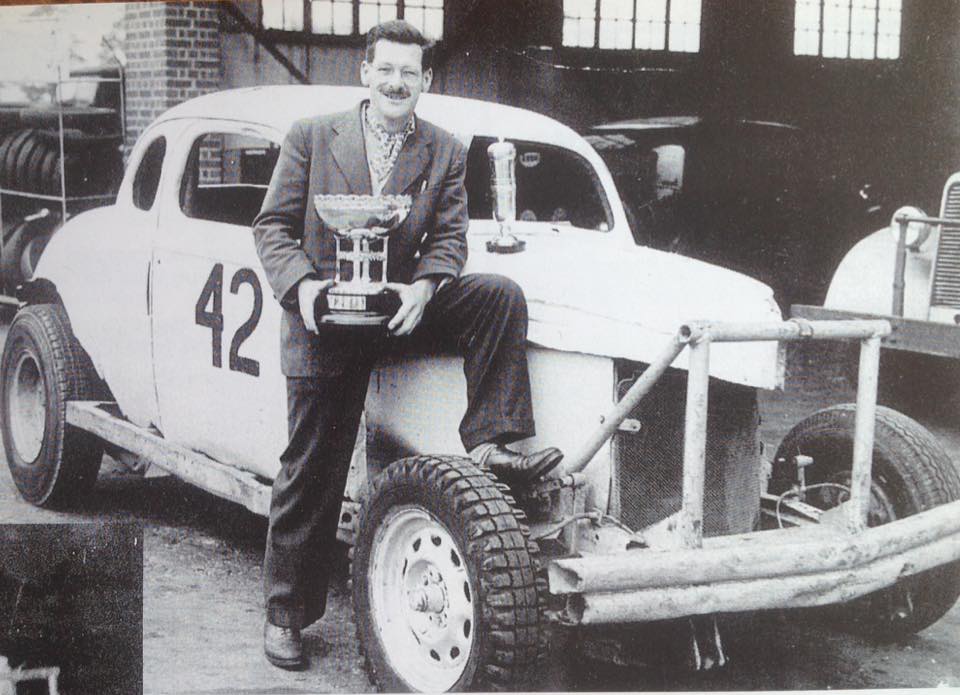
Joseph is believed to have run the garage successfully until sometime after the war and when he retired, he sold the garage to Aubrey Leighton, one of the pioneers of F1 stock car racing. Aubrey began racing in 1955 when the sport was about a year old. He went on to win 48 Finals, plus the National Points Championship in 1963. In only his third season of racing, Aubrey won the 1957 World Championship, staged at Belle Vue.
The Abram family however remained in Earls Barton. Joseph’s parents Charles and Emily who are first recorded as living there on the 1911 census can be found on the 1921 census and the 1939 census also. And on 24 March 1930 the Northampton Chronicle and Echo reported the old couple, who had lived in Earls Barton for twenty seven years, had fourteen children, six of who had served in the Great War with all of them returning home, had celebrated their 30th wedding anniversary.
Joseph died in 1970 at which time his residence was recorded as Mears Ashby Road, Earls Barton. There is no fancy obituary for Joseph, he was not a prince or a king, a politician or a film star, he was simply an ordinary man doing his best to make a living during an extraordinary time in history — yet reading his words and those of the people who knew him bring him to life and ensure he is not forgotten. How lucky am I to call this ‘regular joe’ my ancestor?
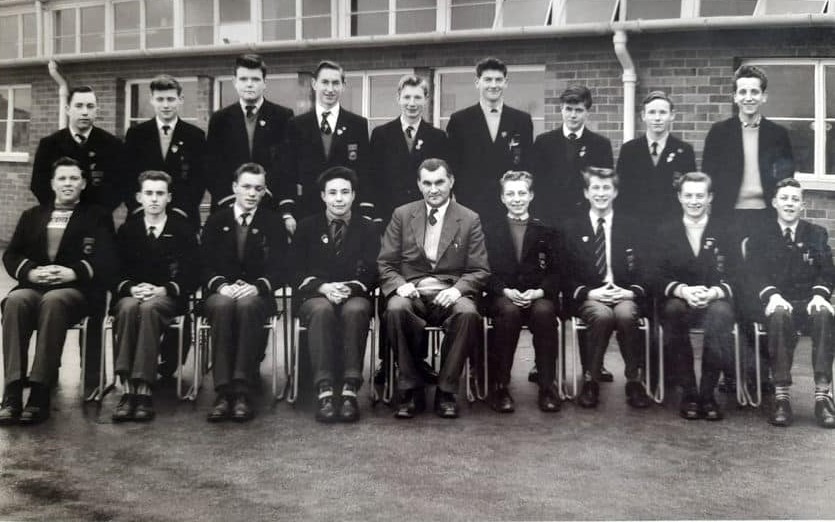
In 1960 my dad was a pupil at Stopsley High School in Luton. At the same time the BBC made a film titled ‘King’s Hill Modern’, a work of fiction which used Stopsley High school as the set.
Michael Abram (back left) and fellow pupils at Stopsley High School.
My dad was involved in the making of the film while a pupil at the school, tasked by his headmaster Dr Walter Roy to look after the film crew during the filming, which took place within the girls school and the boys school and which the filming schedule shows took place 11 – 15 July 1960.
The schools dad told me were built as left and right twins but were kept separate, so he was the first boy allowed into the girls school with the BBC. The schools joined up later in 1960.
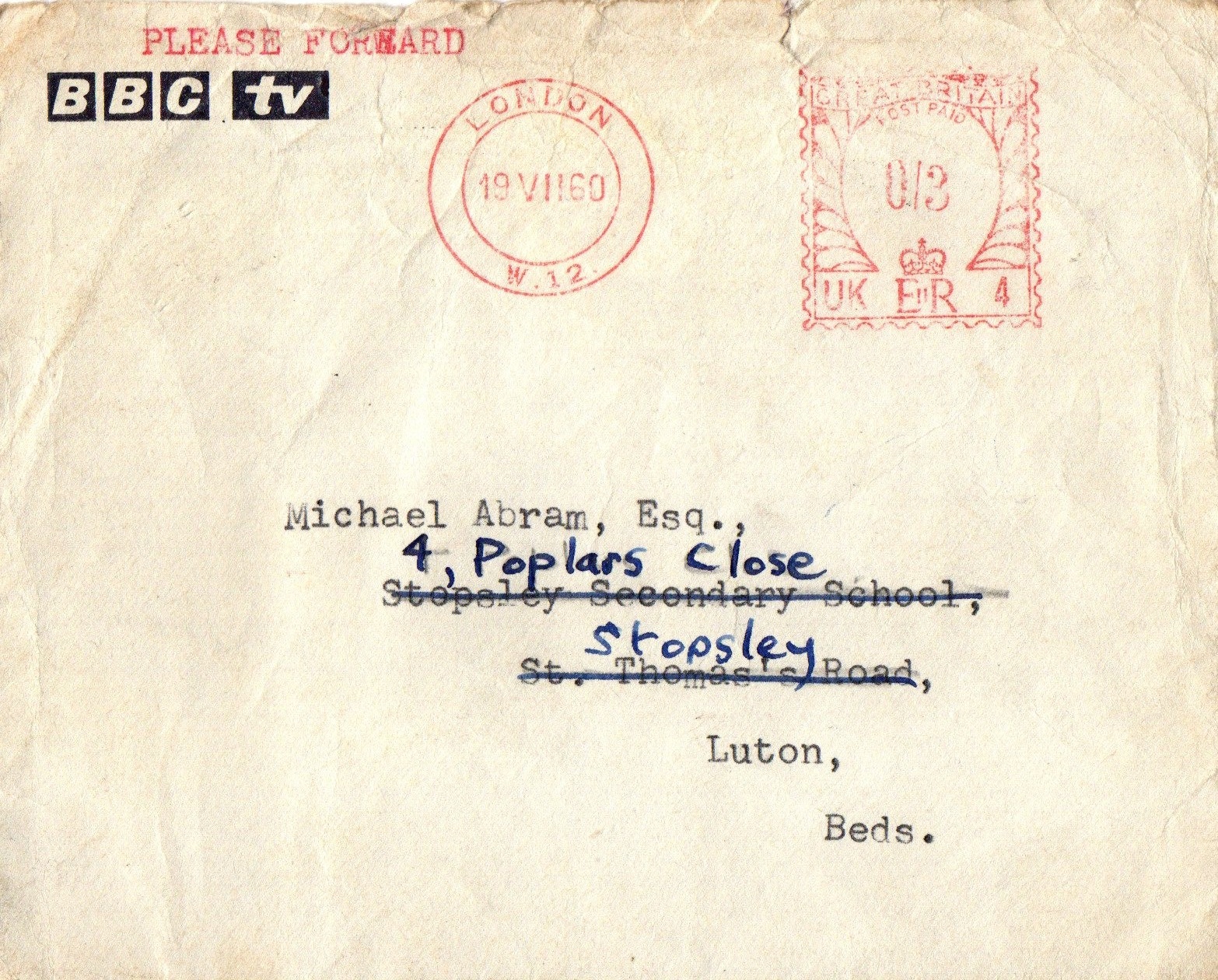
Below is the thank you letter dad received from the BBC.
Letter from Richard Francis at the BBC to Michael Abram.
Letter from Richard Francis at the BBC to Michael Abram.
I have grown alliums for a few years now, having seen them at gardening shows and falling in love with them there. I once heard them described as purple balls on sticks and there really is no better description for the ones I grow, although they do come in different colours.
All photos by Toni Abram.
My alliums were purchased as bulbs but you can purchase them as plants also. I have mine planted in my garden borders but they can be planted in pots too and there are many varieties to choose from.
Alliums normally start to appear in early spring and they go through a number of stages prior to blooming fully. Stage one looks as if the allium is discarding clothing.
Stage two reminds me of a purple troll.
The next stage looks like a pom pom and as the allium begins to unfurl, you can see it is made up of many individual flowers.
At this stage you might think that your allium has done and be a bit disappointed but over the coming few days, it will continue to bloom into something fabulous.
Once an allium has done flowering, the flower head will turn brown but they are not unattractive and can add interest to a garden or you could add them to a flower arrangement. You can also save the seeds to sow in spring to grow more alliums in your garden another year.
As alliums grow, I have noticed the leaves turn yellow the nearer they get to flowering. I have tried researching why this happens and it seems to be a common trait that frustrates other gardeners too. I cut the yellow leaves off, as they are a bit too messy for my taste but you could also plant your alliums at the back of your border, with other plants in front to hide the leaves.
The Oxford English Dictionary describes menopause as ‘the ceasing of menstruation’ and menstruation as ‘the process in a woman of discharging blood and other material from the lining of the uterus at intervals of about one lunar month from puberty until menopause, except during pregnancy.’
Over 60% of women going through the menopause experience symptoms resulting in behaviour changes which can last up to fifteen years and one in four women will experience severe debilitating symptoms. The Local Government Association estimate that over 13 million people in the UK are either menopausal or perimenopausal, yet until relatively recently no one really talked about it.
Menopause usually occurs between 45 and 55 years of age, as a woman’s oestrogen levels decline. In the UK, the average age for a woman to reach the menopause is 51. Over 60% of women going through the menopause experience symptoms resulting in behaviour changes which can last up to fifteen years and one in four women will experience severe debilitating symptoms.
My experience
My periods have been erratic for a number of years now. I was fully aware of the reasons why but aside from the nuisance of going from having periods like clockwork to having, what I thought were an increased number of periods, that occurred really randomly, I felt I was managing well with ‘the change’. However, in late summer 2021, things took a turn for the worse. My periods stopped (a day I had looked forward to for almost 40 years) but soon afterwards I began to experience other symptoms. Definitely a case of be careful what you wish for and better the devil you know.
Following a heatwave, I was still feeling incredibly hot, even though the temperature had dropped. The heat I soon realised was hot flushes and night sweats. Initially, I thought I could manage these too. ‘Don’t be a baby, you’re just a bit hot’ I told myself. However, for six weeks I didn’t sleep through a single night without waking multiple times feeling that I needed to be wrung out, or have a single day without multiple hot flushes, which started as a tingling sensation around my eyes and cheek bones and quickly crept around my whole body, as if the heat was trying to escape, leaving me feeling so hot I felt as if was going to pass out. If that was not bad enough, I watched, as my hair, which had become incredibly dry, disappeared down the plug hole every time I washed it, pulled masses of it out of my hair brush and from the carpet — hair loss and hair thinning was not something I was at all prepared for. I felt anxious, couldn’t concentrate, got really forgetful, had horribly itchy skin, particularly an itchy scalp, generally feeling rather miserable and as if I was not coping well with anything,
Perimenopause
The symptoms I had been experiencing, I now know were the perimenopause, that is when a women experiences symptoms due to hormone changes but still has periods that are changing in nature or frequency. During perimenopause, because hormone levels are fluctuating, women may have a normal period one month, then it can be heavier or missed altogether, before going back to normal for a time and the odd excess periods that I experienced, I now know courtesy of a friend, are not periods at all, but ‘breakthrough bleeding’ that occurs when a woman starts having less periods. Essentially, she explained to me, when you ovulate, a follicle releases an egg, after which the follicle ‘collapses’ in on itself and becomes a gland. The gland releases progesterone, a hormone that stops the lining of the womb from thickening, preparing the womb to receive and implant the egg. However, without progesterone to stop the lining from thickening, the thickening keeps on going until it has to stop because it sort of ‘can’t take any more’ and this causes ‘breakthrough bleeding’, with the womb lining coming away in the absence of egg production and therefore not producing progesterone. So, rather than menopause being a short sharp event, it is actually the culmination of a gradual process which begins with perimenopause and ends with menopause, when a woman has not had a period for twelve months.
Hormones
Pre menopause the hormones oestrogen and progesterone work together to regulate menstrual cycles and the production of eggs, however a lack of oestrogen can trigger a range of symptoms and as humans have hormone receptors in cells all over our bodies, changes in hormones can affect many parts of our body, even those we wouldn’t expect. The Greene Climacteric Scale (GCS) tracks a list of twenty one symptoms that are often associated with the menopause, these are:
Heart beating quickly or strongly
Feeling tense or nervous
Difficulty in sleeping
Excitable
Attacks or anxiety, panic
Difficulty in concentrating
Feeling tired or lacking energy
Loss of interest in most things
Feeling unhappy or depressed
Crying spells
Irritability
Feeling dizzy or faint
Pressure or tightness in the head
Parts of the body feeling numb
Headaches
Muscle and joint pains
Loss of feeling in hands or feet
Breathing difficulties
Hot flushes
Sweating at night
Loss of interest in sex
I have experienced many of the symptoms on the list but it is not exhaustive and there are many other symptoms too. It should also be noted that 25% of women will experience no symptoms. One thing I have learned about the menopause is there doesn’t seem to be a ‘normal’ at all, with women having both similar but also very individual menopause experiences. It should however be possible to diagnose the menopause on symptoms alone and before I saw my doctor, I completed a symptom checker document which can be downloaded from websites that provide information about menopause.
The importance of oestrogen
Oestrogen is important in various ways. Firstly, it provides lubrication for joints and prevents inflammation, it can also affect the texture of hair, with a lack of oestrogen leaving it prone to breaking. As oestrogen declines, androgens (a collective term for male hormones) sometimes become more prominent. This imbalance of hormones shrinks hair follicles making hair fine and it is also responsible for facial hair.
It also helps protect against osteoporosis. Around 10 per cent of a woman’s bone is lost in the first five years of the menopause and this increases the risk of osteoporosis which weakens bones and makes them more likely to break. Until we are around 30 we normally build more bone than we lose, however during menopause bone breakdown occurs at a faster rate than bone build up, resulting in a loss of bone mass. Oestrogen also protects against other long terms health issues such as cardiovascular disease, diabetes and dementia. While hot flushes are one of the most well known symptoms of the menopause, the reason for these is not really known. Some believe falling progesterone levels affect noradrenaline, another hormone that regulates our body temperature. Oestrogen also directly affects the thermoregulatory areas of our brain. There is no normal number, frequency or duration for these.
Here and now
At the time of writing this post I have been on HRT for around twelve months. I would not dream of telling anyone they should or should not take it, I know it will not be for everyone and I know there are some women who are unable to take it but I do think that education is important so that people can make their own informed decisions. Taking HRT was never something I thought I would do — I had expected to just muddle through but it quickly became apparent that muddling through was not going to be an option. I was anxious about starting the treatment but it has helped me feel more like me again. It hasn’t been a cure all but I feel more settled and as if am managing better than I was twelve months ago.
I feel very fortunate, that at the time I am going through this, people are beginning to talk about menopause openly, rather than it being a taboo subject. I am grateful for not going through this even ten years ago, to have friends who were happy to talk to me and signpost me to information when I was feeling at my worst. I am grateful also for an understanding doctor who did not for one minute make me feel as if I was making a fuss or wasting her time, telling me ‘it can be very challenging’ and ‘there is no point suffering if you don’t have too.’ I know that is not everyone’s experience.
However, although massive steps have been taken in the last few years there is still a long way to go. Women still feel embarrassed to discuss the menopause, fear going to their doctor, don’t know there is a wealth of information out there to help them and simply don’t know how to cope when menopause hits. I was one of those women, so writing this blog post has partly been about me trying to understand what is happening to my body but also wanting to raise awareness and encourage women to educate themselves about the menopause before it happens to them. Half the population will experience menopause and the other half will know someone going through menopause whether that be a mother, daughter, sister, cousin, niece, friend or colleague, so education is vital for everyone. It really only touches the surface of all things menopause but I hope it will help someone who needs it right now.
Further information
The Balance website and The Balance App have been an enormous help to me. The website has a fabulous search function so you can search for specific symptoms and find articles, factsheets and videos relating to these, while the app allows users to journal their symptoms. The book Preparing for the Perimenopause and Menopause was a big help to me too.
Since 2011, World Menopause Day has taken place in October each year and as a result of campaigning, from September 2020, menopause was added to the RSE curriculum in England. The Make Menopause Matter campaign is calling for all GPs to receive mandatory menopause training and for a mandatory menopause module to be taught at every medical school, meaning that women in the future will be much more informed than I was. From April 2023 a pre-payment scheme will begin to enable HRT to be issued through a paper prescription at the single cost of £18.70 for a year, a saving of £205 per year.
If you want to go on HRT but are struggling with getting this prescribed, guidelines to improve the consistency of support and information provided to women in menopause can be found on the National Institute for Healthcare Excellence website.
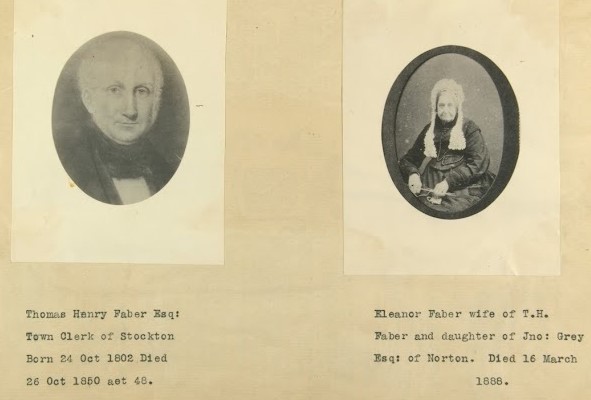
Thomas and Eleanor were Henry’s great grandparents. The 1841 one census shows Thomas aged 55 and Eleanor aged 36, living with their children Anne, Eleanor, Frank, Edward, Elizabeth and Mary in Stockton. On the 1851 census Eleanor, aged 46, can be found living at High Street, Stockton, Durham, England with daughters Elizabeth, Mary, Emma and Caroline. She is described as a widow and her occupation is given as Annuitant.In 1871 Eleanor is recorded as a widow aged 66, still living in Stockton with her daughters Mary Grey Faber and Caroline Grey Faber. On the 1881 census, Eleanor can again be found, now living only with her daughter Caroline.
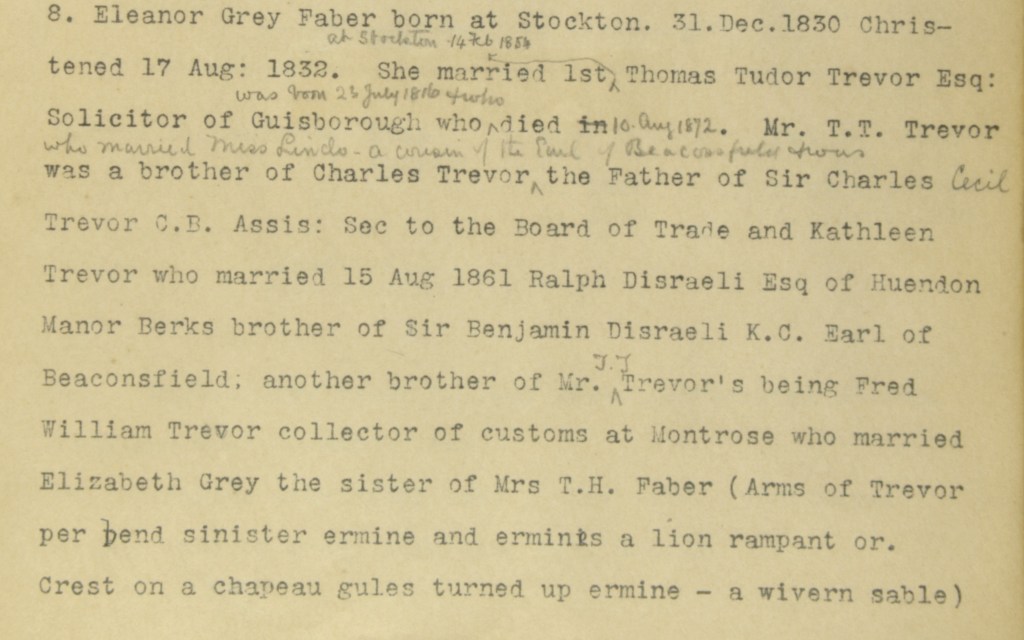
The ages I have gathered from searches of census returns I have undertaken, do do correspond with the information from the Hamilton Stanley Faber papers, so this page is a work in progress.
Images of Thomas and Eleanor Faber.
Family tree showing Eleanor Grey married to Thomas henry Faber.
Henry’s grandfather was also called Henry Grey Faber. Henry was the first son of Thomas Henry and Eleanor Faber, born 30 November 1829 and baptised on 1 December 1829.
Henry can be found on the 1841 census, aged 11, at Shincliffe, St Oswald, Durham and Lanchester, Durham, England which appears to be a school. In 1851 aged 21 Henry can be found lodging in the household of George and Hannah Harrision at Church Street, Guisborough, Yorkshire & Yorkshire (North Riding), England and employed as a Solicitor’s Articled Clerk. In 1871 he can be found aged 41 residing with the Moore family.
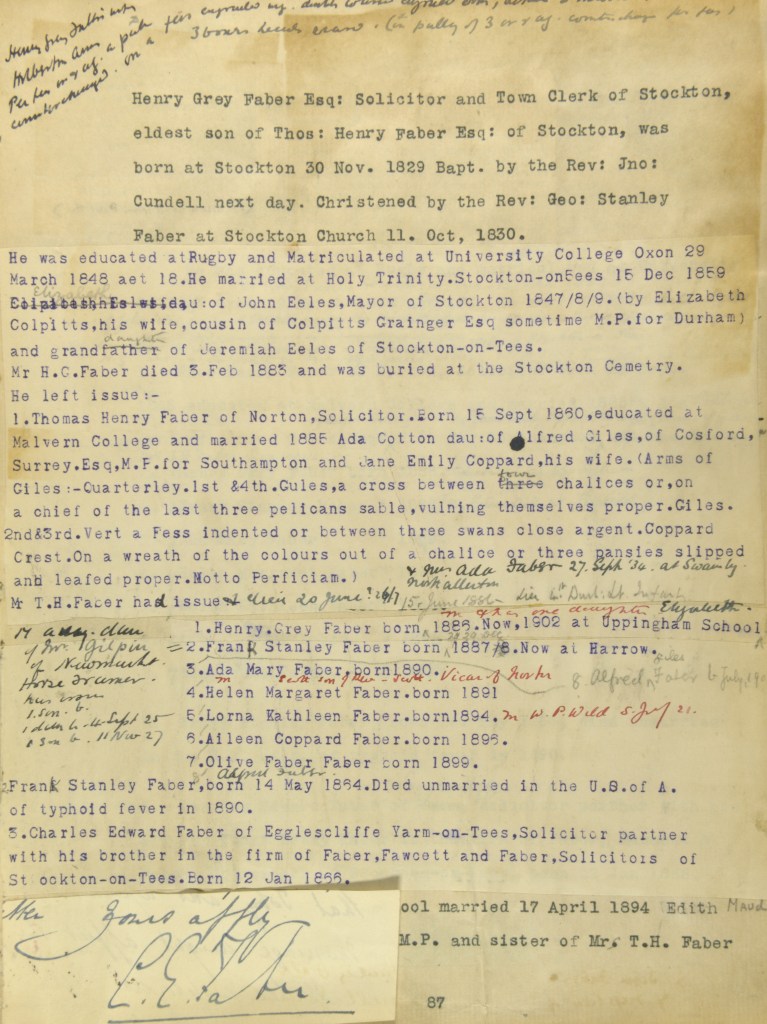
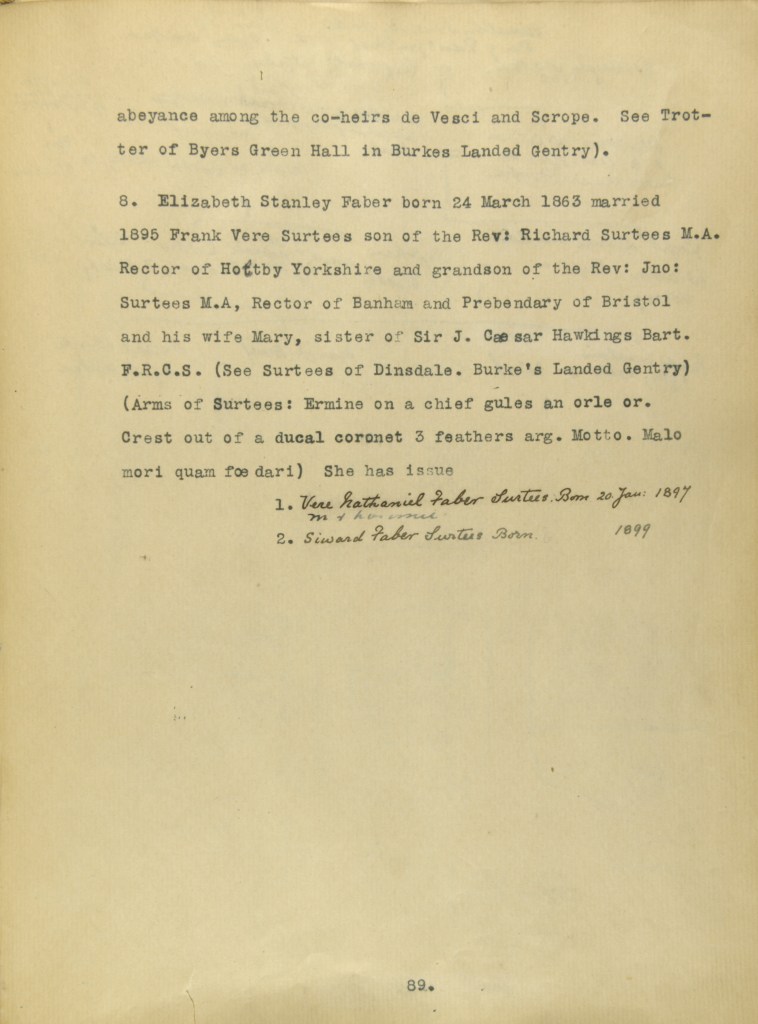
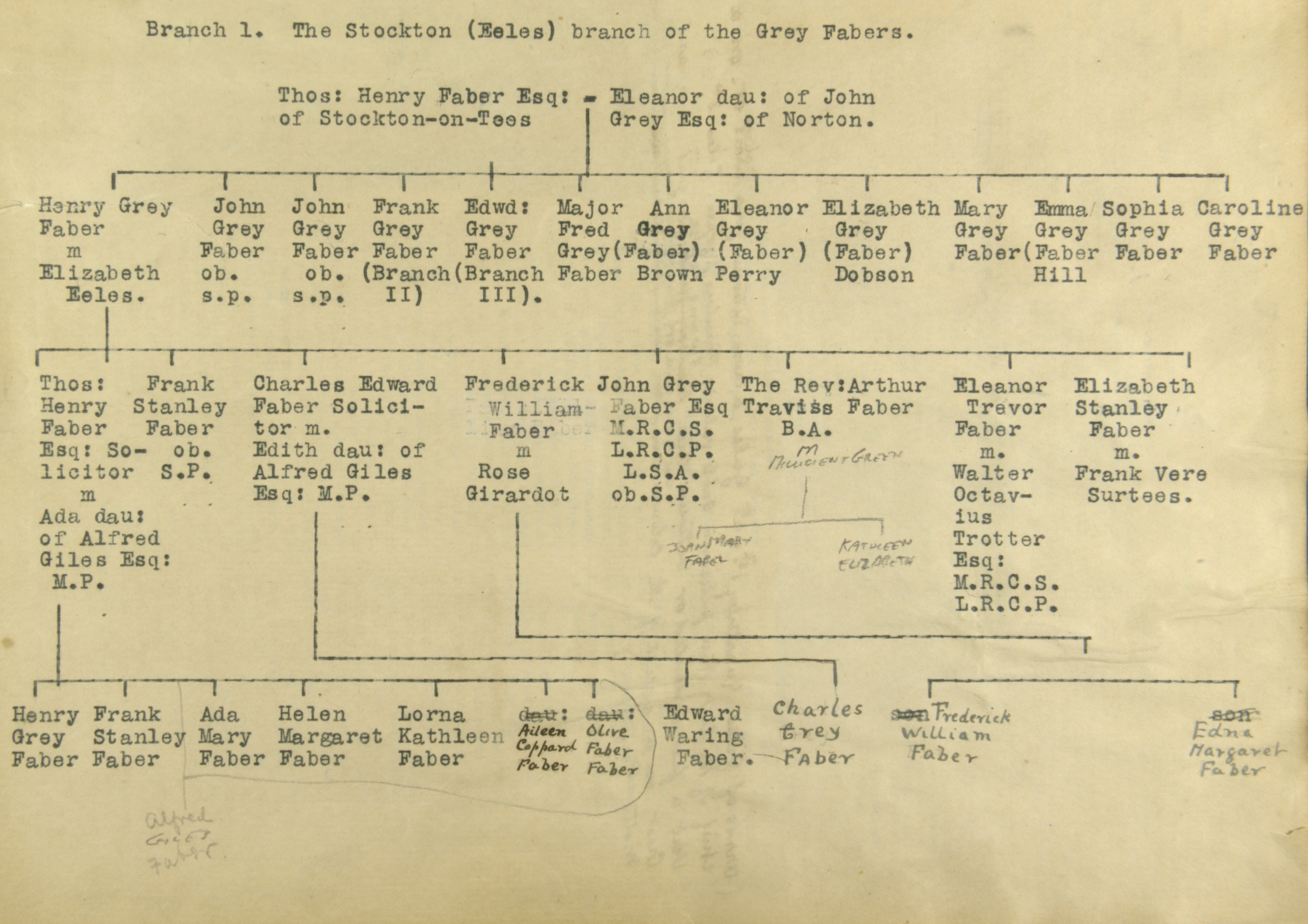
Further information can be found in the papers of Hamilton Stanley Faber in which the family are referred to as ‘Branch 1 – The Stockton (Eeles) branch of the Grey Fabers’ and in which Eleanor is recorded as the daughter of John Grey Esq of Norton.
Henry’s father was Thomas H Faber, born 1861. Thomas can be found on the 1871 census at Middleton One Row, Middleton St George, Darlington, Durham, England, aged 10, with his parents Henry Grey Faber, aged 41 (born 1830 in Durham) and Elizabeth Faber, aged 38 (born 1833 in Durham). Also four brothers and two sisters – Eleanor J Faber, Elizabeth S Faber, Frank S Faber, Charles E Faber, Frederic William Faber and John G Faber. The Faber family are recorded as visitors to Sarah Moore aged 75 and her daughter Mary A Moore aged 37.
On the 1891 census, Thomas, aged 30, is recorded as living with his wife Ada C Faber and his sons Henry G Faber and Frank S Faber. Thomas is recorded as a solicitor. On the 1901 census, Thomas and Ada can again be found. They have five daughters named Ada, Helen, Lorna, Culeen and Olive. And in 1911 the family can be found at 100 High Street, Norton On Tees. Henry Grey Faber, aged 24, is again living with them and father and son are both recorded as solicitors.
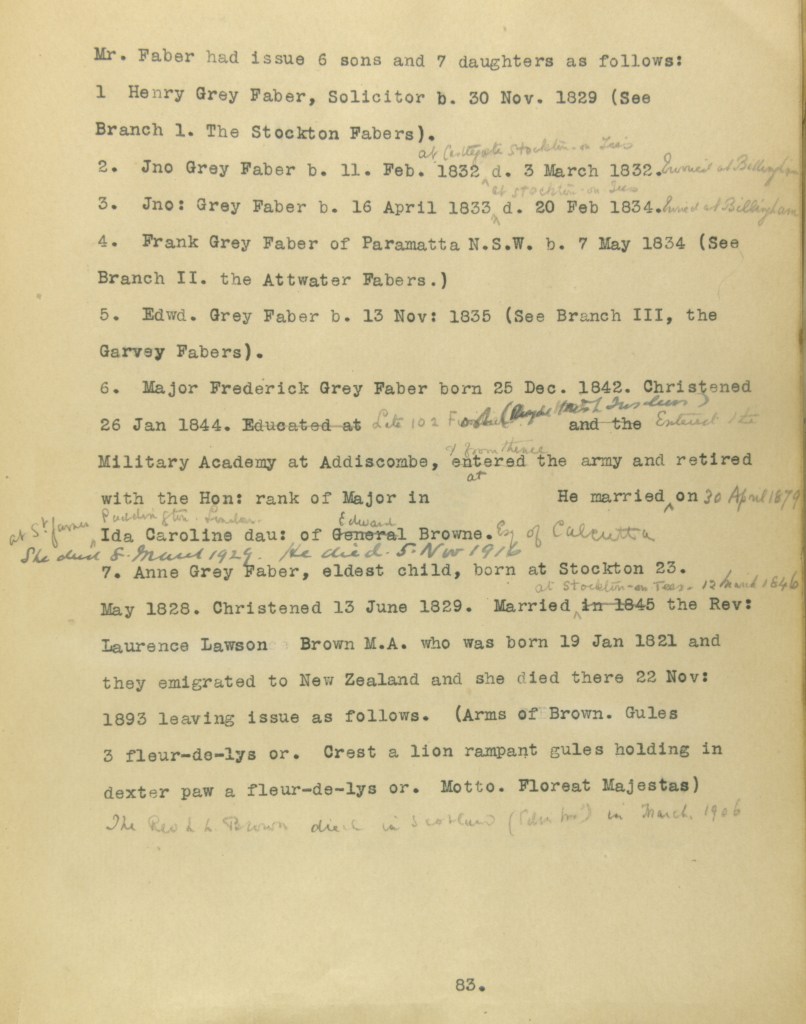
This information is also corroborated in the Hamilton Stanley Faber papers, which displays a family tree in which the family are referred to as Branch 1 – The Stockton (Eeles) branch of the Grey Fabers.)
Family tree showing the Stockton (Eeles) branch of the grey Fabers.
I stumbled across this story when researching Henry Grey Faber. An article in the Yorkshire Evening post dated 29 June 1950 reports on regimental badges in the Sudan, in the hills near Atbara. The article states these badges reminded the writer of the Kilburn white horse and displays an image of the West Yorkshire Regiment badge on a hillside in the Sudan.
The article explains how the badges are made and goes on to quote Henry Faber of Leeds who spent nine months in the Sudan with the Green Howards as saying ‘the patch of hillside is first cleared and then the badge is carefully mapped out. The rocks are manhandled by the troops and gradually the badge takes shape. Most of the Green Howards’ badge was built on free afternoons and it was mighty hot work.’ I do not believe the Henry Faber quoted in the article is the one I have researched on this website but the story fascinated me, so I wanted to include it here.
David Love
Further investigation found a blog post on the Love Adventures website by David Love, a British adventurer, mountaineer and expedition leader. In the post, David describes going in search of a British Army Memorial, built by the last serving unit in Sudan before the country gained independence in 1956.
Turning to satellite imagery to study the area around Gebeit did not reveal any possible locations of the lost memorial but did find some very odd looking images on a nearby rocky hillside, blurry effigies which seemed to resemble old military insignia. If David wanted to find the memorial, he would need to go to Gebeit.
Leaving Khartoum and heading north along the River Nile, David reached the rocky foothills at the edge of the remote village of Gebeit in Northern Sudan, at the fringes of the Sahara desert, where he had previously identified the blurry effigies on satellite imagery and saw, towering some 200ft above him what he describes as 130 year old Squaddie graffiti but on a totally epic scale.
David writes ‘As I edged backwards to take in more of the landscape, I began to make out even more of what was instantly recognisable as military insignia. In total there were 18 massive images covering an area roughly two kilometres in length across the face of the hillsides. On closer inspection, the incredibly detailed images were made from piles of different coloured rocks from the surrounding foothills.’
Memories from Sudan
Other recollections in the Yorkshire Evening post article included Mr Butterill who described how white stone from the surrounding hills was built up gradually in a pattern of a badge. The work was done after sundown and in the early morning he recalled.
And Mr P Addison who spent 24 years in the Sudan said the badges in the hills at Gebeit are some 200 miles from Atbara, on the railway line to Port Sudan. They are not cut out of the hillside he explained but are made of white stones set close together. Most of them date immediately to a period immediately after world war one. Gebeit is nearly 3,000 feet above sea level and in the summer has a more agreeable climate than Khartoum or Atbata. It was the custom to send all detachments of British garrison troops to camp at Gebeit to have a few weeks change from the summer heat and sandstorms of the Sudan. It became the fashion for these detached units to occupy their leisure in constructing their regimental badges on the hillside. Each is carefully set out and contains many hundreds of stones.
Other examples of badges
The badges in the Sudan are not the only examples of regimental badges.
The Fovant Badges
The Fovant badges are a set of regimental badges on the Downs of Wiltshire at Fovant. During World War I there was a need to establish training camps for troops engaged in the battlefields of France and one of the areas chosen was at the village of Fovant.
The church of St George in the village of Fovant has rows of war graves of British and Australian soldiers and in memory of those who had died, regimental badges were carved by their comrades. Many of the original carvings failed to survive the elements and at the end of world war I there were 20 identifiable badges.
During World War II, the badges were allowed to overgrow in order that they could not be used as landmarks by enemy aircraft. Following the end of the war the local Home Guard formed themselves into an Old Comrades Association and took on the arduous task of restoration. In the years 1948 – 1951 two Wilshire badges were cut and in 1970 a Royal Signals Badge was added.
Cherat badges
Cherat, located in the Peshawar District of India, was a hill a military garrison and sanatorium for British troops stationed in the Peshawar Valley. Many of the troops sent there, carved and painted their regimental insignia on to nearby rock faces to mark their service on the frontier.
Dorothy Faber or aunt Dorothy as I knew her was my great aunt (my grandmother’s sister on my fathers side). In 1960 she married Henry (Hal) Grey Faber. Dorothy was Henry’s second wife and the couple were married at Holy Trinity Church, Micklegate, York in 1960.
Dorothy and Hal lived in the village of Husthwaite in Yorkshire which is situated about 17 miles north of York. Husthwaite is an ancient settlement, one of the oldest buildings being St Nicholas’ Parish Church dating from the twelfth century, which, with the village green, forms the centre of the village. The village is a designated conservation area and is adjacent to the North Yorkshire Moors National Park.
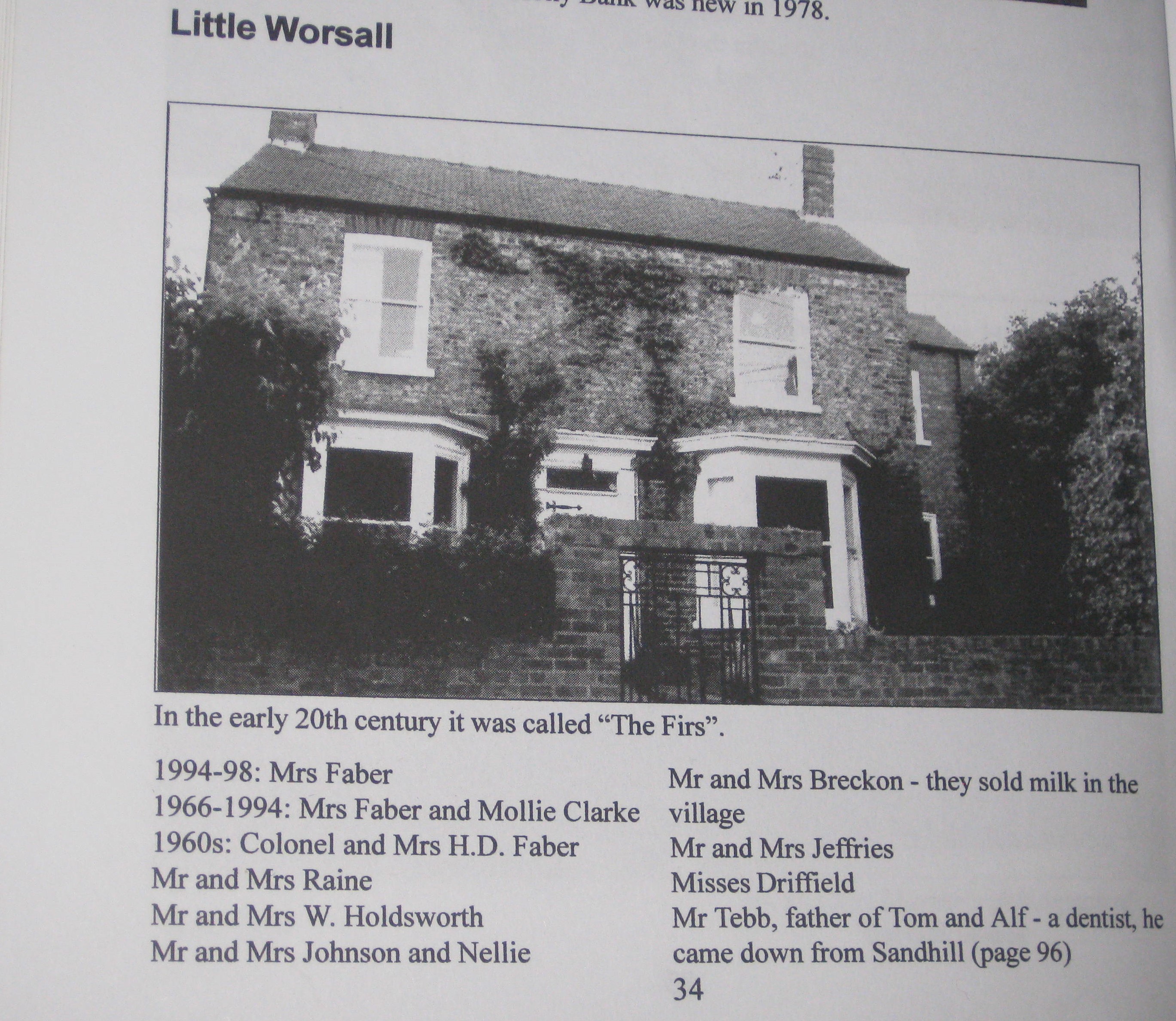
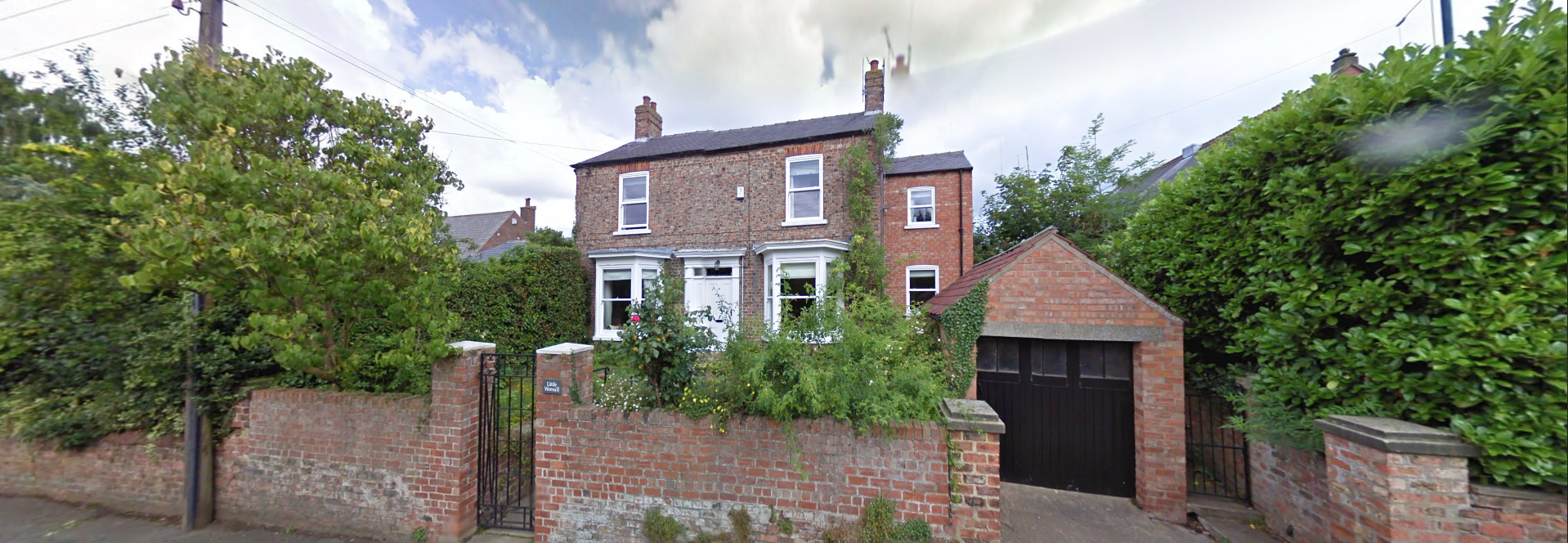
They lived in a house called Little Worsall, situated between the Methodist Chapel, a newer house and The Manor House which was once a farm. However, until I came to write this piece I never knew the name of the property or the house number. Letters were addressed simply to Mrs D M Faber, Husthwaite, York. ‘The postman knows the house’, my parents were told.
Dorothy and Hal lived at Little Worsall for six years. Henry died in 1966 before I was born but Dorothy continued to live there, with her sister Molly until 1994, then alone until her own death in 1998.
Worsall Grange
The 1939 register records Henry living at Worsall Grange, Stokesley, Yorkshire (North Riding), England, working as a solicitor and living with his wife Ellen G Faber and daughter Elizabeth H F Faber. Living with them are two domestic servants, Bridget Dowd and Madelaine Nugent
Today Worsall Grange is a listed building, described in estate agent particulars as a delightful grade II listed detached country house set in 2.44 acres approx, between the villages of Low Worsall and Kirklevington, well placed for the thriving market town of Yarm and with a small paddock laid to grass that extends to 18 acres.
The Cleveland and Teeside History Society record the place name Low Worsall as ‘Modern English low + place-name Wercesal, Wirceshel, Werchesal(e) 1086 Wi- Wyrkesale 1285-1367, Wirsal (1316) 16th, 1369, Parva Worsall“Little Worsall” 1483.’
Little Worsall
It seems that when Henry moved to Husthwaite, his new home was named after Worsall Grange. The Husthwaite History Society records the following information about Little Worsall.
In the seventeenth century the property described here had 4½ acres at the back, stretching down to Elphin Lane. Later this tract was farmed as part of the Manor House land and by 1841 some rearrangement of boundaries had taken place. The tenants of the early eighteenth century were called Wood and survival of the fieldnames Wood Garths suggests a reconstruction. This leads to the conclusion that the frontage of the old tenement would have extended from Little Worsall to Colton House.
Several facts about this property in the early seventeenth century suggest that it was of importance in the management of the manor. It lay alongside the Hall and Hall Garths. It belonged to the family who held the lease and hence lordship of the manor. It had a dovecote (the only one known in Husthwaite), a privilege of manorial lords.
Image of Little Worsall and information about the people who lived there.
Dorothy
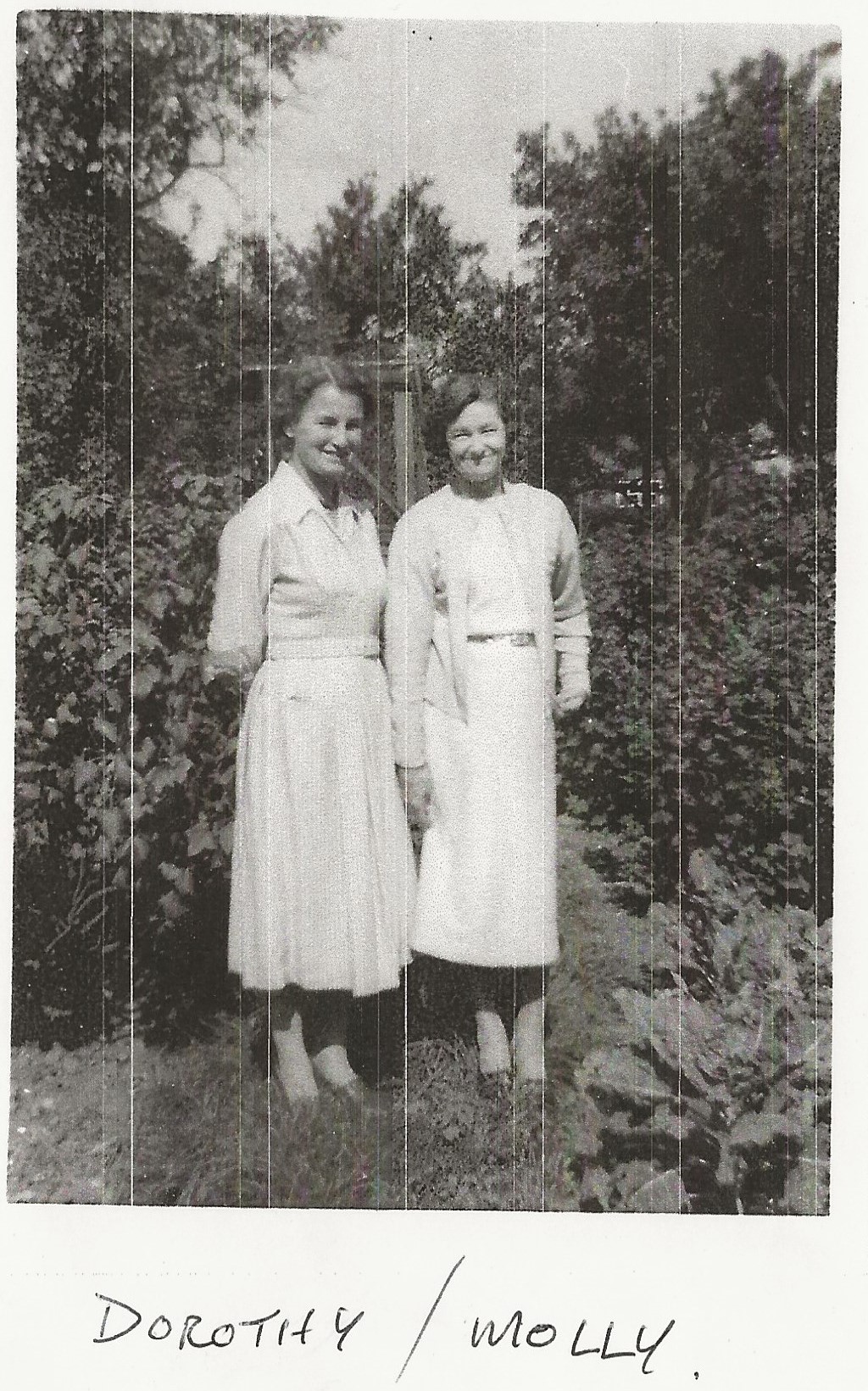
Dorothy Margaret Clarke was born in Northamptonshire in 1904. She was the daughter of Louisa Jane Shortland and Albert Edward William Clarke, a police sergeant in the Northamptonshire Constabulary. She had one brother named Edward Alexander and three sisters, Cecily Mary (known as Molly who lived with her at Little Worsall from 1966 – 1994), Kitty Alexandra and my grandmother Delia Eileen.
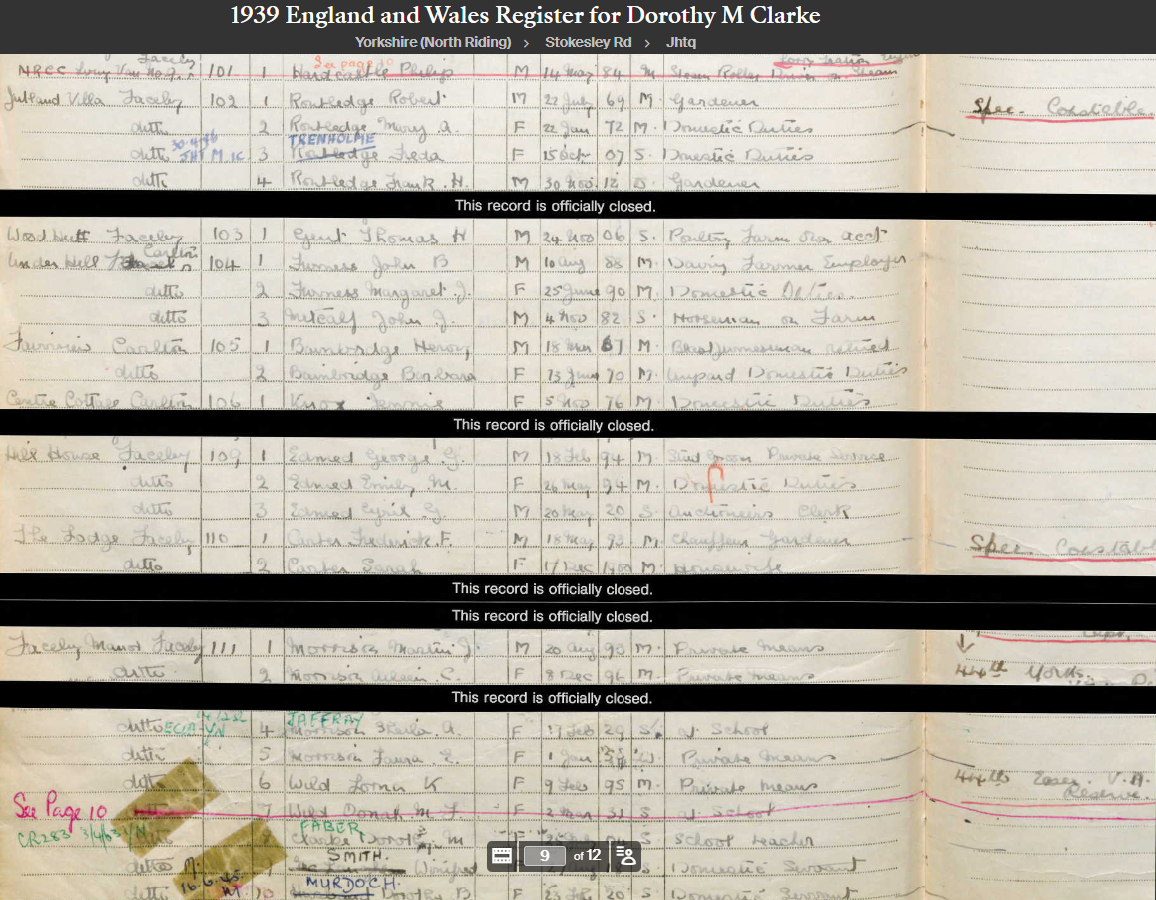
The 1939 register shows Dorothy, working as a school teacher, living in the Morrison household at Faceby Manor, Faceby, Stokesley R.D., Yorkshire (North Riding), England. Today Faceby Manor Lodge is a Grade II listed building.
It also appears that Dorothy worked as a governess. One of the most interesting things Dorothy sent to me was the letter below from a Miss Lennox-Carr of Piccadilly (according to the biography of the historical novelist Georgette Heyer, Miss Lennox-Carr ran a registry office for governesses), recommending Dorothy for the post of governess to the young King of Iraq. I don’t believe that Dorothy took up the offer but nevertheless it is a lovely piece of family history.
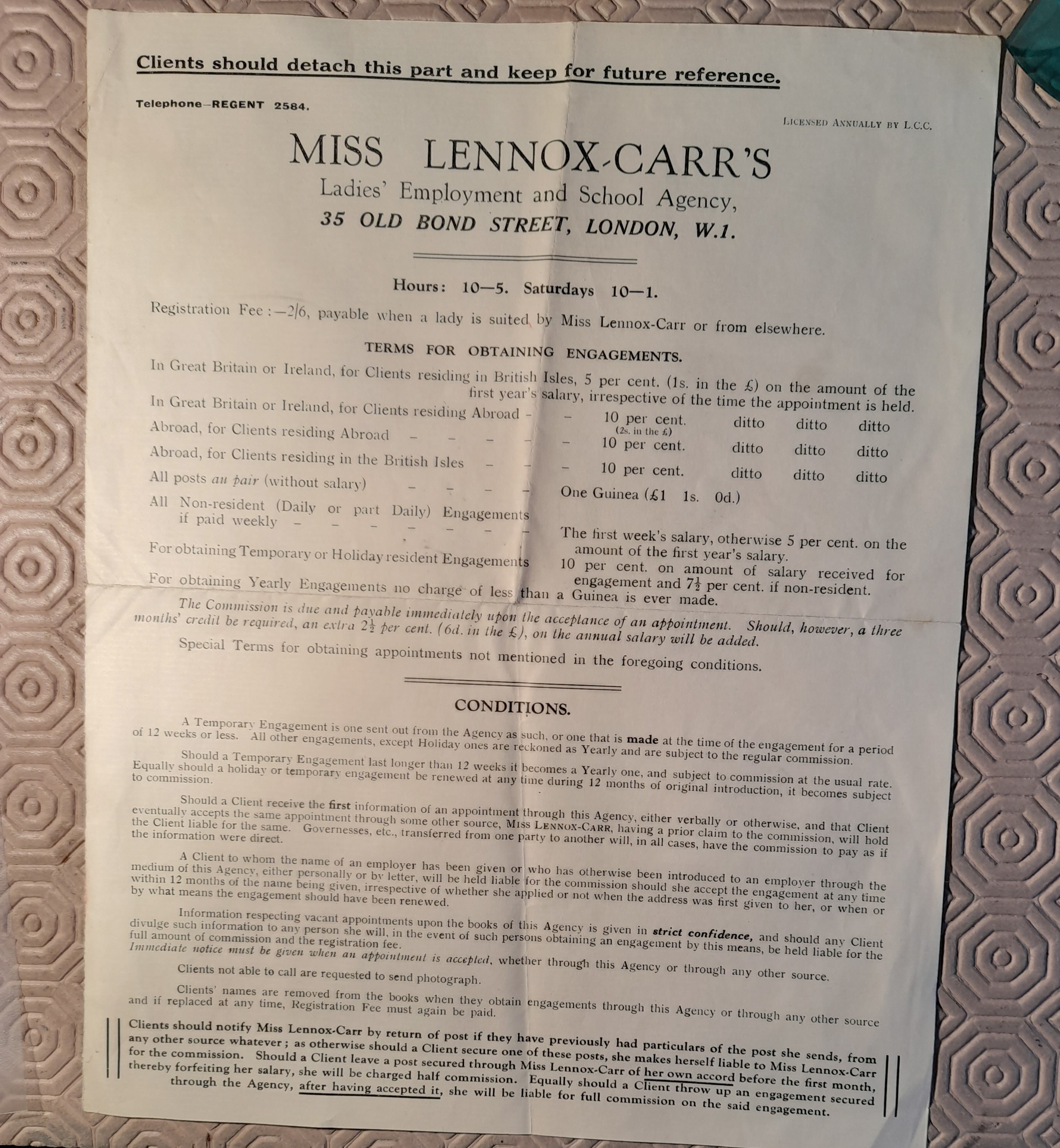
In January 2022 I was contacted by Tony Walker who had seen this blog. He had come across a document for Miss Carr’s agency when sorting through some some historical papers and asked if I would like a copy. The document can be viewed below.
The things I remember about Dorothy are firstly her two dogs, Otter and Toby – sausage dogs, one smooth haired and one wired haired. The second, the incredible view from her garden of the Kilburn white horse, one of the most famous landmarks in North Yorkshire and one of the most northerly turf-cut figures in Britain. Dating from 1857, the outline of the horse was marked out by the Kilburn village schoolmaster and his pupils. Finally, the way she encouraged my interest in my family from a young age, with letters, stories and photos. Dorothy is hugely responsible for my love of history today..
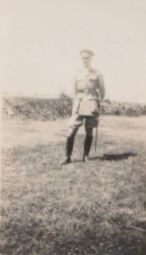
Henry G Faber in uniform.
Hal
Henry Grey Faber was a solicitor. His occupation is recorded in census returns and I have also found mentions of Henry’s legal career in the Gazette newspaper.
The 1891 census shows a Henry G Faber was born in Durham in 1887, to Thomas Faber, aged 30 (born 1861 in Durham) and Ada Faber aged 29 (born 1862 in Wimbledon, Surrey). A younger brother and sister, Frank S and Ada L are recorded too. Aged 14 in 1901, Henry appears to have been a boarder at a school in Harrogate and in 1911, aged 24, he is recorded as being a solicitor, living again with his parents Thomas and Ada and with more sisters and a brother.
The North Yorkshire history website records Henry as ‘Admitted Oct 1911. Member of Faber, Fawcett & Faber, of Stockton-on-Tees. Mobilised Aug 1914 as Capt., 5th Batt. Durham Light Infantry, promoted Major June 1916. Once mentioned in Dispatches. Served at Home and in Flanders and France. Wounded May 24, 1915.’
I believe Henry married his first wife Ellen Holberton in Totnes, Devon in 1916. Their daughter Elizabeth was born in Knaresborough in 1917 and in 1939 her occupation is shown as VAD, which I have learned stands for Voluntary Aid Detachment, a voluntary unit of civilians providing nursing care for military personnel in the United Kingdom and various other countries in the British Empire. Searching for Henry Grey Faber on the Find My past website, I found details of his service, medals and awards and his first world war record. Ellen it seems also served in the army as a staff nurse.
Thomas Faber (Henry’s father)
Henry’s father was Thomas H Faber, born 1861, He can be found on the 1871 census at Middleton One Row, Middleton St George, Darlington, Durham, England, aged 10, with his parents Henry Grey Faber, aged 41 (born 1830 in Durham) and Elizabeth Faber, aged 38 (born 1833 in Durham). Also four brothers and two sisters – Eleanor J Faber, Elizabeth S Faber, Frank S Faber, Charles E Faber, Frederic William Faber and John G Faber. The Faber family are all recorded as visitors to Sarah Moore aged 75 and her daughter Mary A Moore aged 37.
On the 1891 census, Thomas, aged 30, is recorded as living with his wife Ada C Faber and his sons Henry G Faber and Frank S Faber. Thomas is recorded as a solicitor. On the 1901 census, Thomas and Ada can again be found. They have five daughters named Ada, Helen, Lorna, Culeen and Olive. And in 1911 the family can be found at 100 High Street, Norton On Tees. Henry Grey Faber, aged 24, is again living with them and father and son are both recorded as solicitors.
This information is also confirmed in the documents of Hamilton Stanley Faber in which the family are referred to as ‘Branch 1 – The Stockton (Eeles) branch of the Grey Fabers.)
Henry Faber (Henry’s grandfather)
Henry’s grandfather was also called Henry Grey Faber. He was the first son of Thomas Henry and Eleanor Faber and was baptised on 1 December 1829 in Durham. This information is again confirmed in the documents of Hamilton Stanley Faber in which the family are referred to as ‘Branch 1 – The Stockton (Eeles) branch of the Grey Fabers and in which Eleanor is recorded as the daughter of John Grey Esq of Norton.
Henry can be found on the 1841 census, aged 11, at Shincliffe, St Oswald, Durham and Lanchester, Durham, England which appears to be a school. In 1851 aged 21 Henry can be found lodging in the household of George and Hannah Harrision at Church Street, Guisborough, Yorkshire & Yorkshire (North Riding), England and employed as a Solicitor’s Articled Clerk. In 1871 he can be found aged 41 residing with the Moore family as described above.
The papers of Hamilton Stanley Faber advise the following about Henry.
Henry Grey Faber Esq was a solicitor and town clerk of Stockton. Eldest son of Thomas Henry Faber Esq of Stockton. Born at Stockton 30 November 1829. Baptised by the Rev: Jno: Cundell next day. Christened by the Rev: Geo: Stanley Faber at Stockton church 11 October 1830.
He was educated at Rugby and matriculated at University College Oxon 29 March 1848 at 18. He married at Holy Trinity Stockton-on-Tees 15 December 1859 Elizabeth Eeles daughter of John Eeles, Mayor of Stockton 1847/8/9 (by Elizabeth Colpitts. his wife. cousin of Colpitts Grainger Esq sometime MP for Durham) and grandfather of Jeremiah Eeles of Stockton-on-Tees.
Mr H G Faber did 5 February 1885 was was buried at the Stockton cemetery. He left issue:
1. Thomas Henry Faber of Norton
Solicitor born 18 September 1860, educated at Malvern College and married 1885 Ada Cotton daughter of Alfred Giles of Cosford, Surrey Esq. MP for Southampton and Jane Emily Coppard his wife.
Mr T H Faber had issue.
Henry Grey Faber born 1886.
Frank Stanley Faber born 1887/1888.
Ada Mary Faber born 1890.
Helen Margaret Faber born 1891.
Lorna Kathleen Fabert born 1894.
Aileen Coppard born 1895.
Olive Faber born 1899.
2. Frank Stanley Faber
Born 14 May 1864. Died unmarried in the USA of typhoid fever in 1890.
3. Charles Edward Faber
Egglescliffe Yam-on-Tees, solicitor partner with his brother in the firm of Faber Fawcetts and Faber of Stockton-on-Tees. Born 12 January 1855.
Origin of the names Faber and Grey
Information about the origin of the Faber and Grey surnames can be found on the Ancestry.co.uk website.
I am interested to learn more about the surnames Faber and Grey, as the name Grey appears to have been used as a middle name by many people with the surname Faber, both male and female, including Henry and Edward, largely in Stockton on Tees. However, I have also found the name connected to Dorset, London, Middlesex and Essex and would very much like to know more about this.
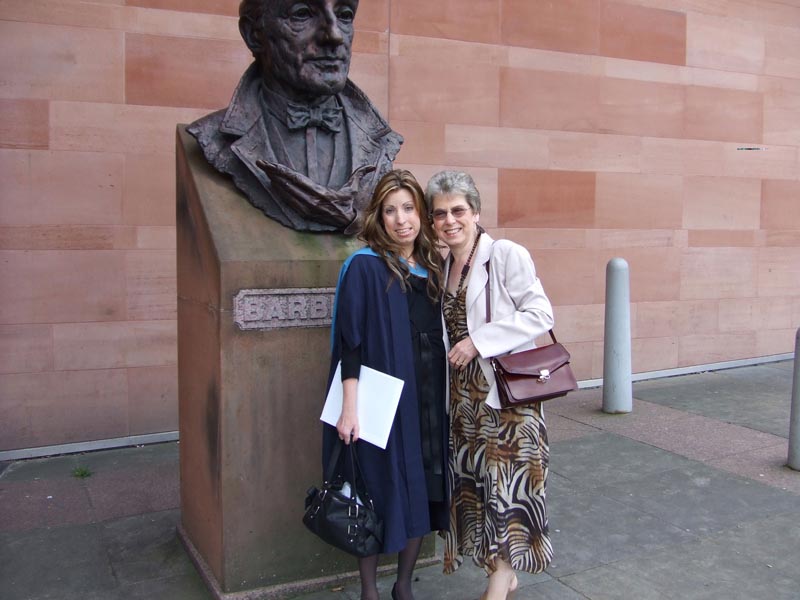
In July 2021 I graduated from the Open University with a Bachelor of Science First Class Honours degree.
I had began studying with The Open University in 2002 and in June 2009 I graduated without Honours. For someone who didn’t enjoy school and was painfully shy, never wanting to put her hand up in class to give an answer or ask a question, for fear of drawing attention to herself, this felt like a huge achievement.
I always tried hard in school but the grades I got for effort, never matched my attainment grades, which were often disappointingly low. I chose to leave school at 16 years of age having convinced myself it wasn’t the place for me but when I told my English teacher I was going out to work, she told me I could do better for myself than that. It was as I recall, a short exchange of words but it was the first time anyone had indicated they thought I could achieve anything and the words stayed with me, niggling way, until eventually I embarked on my first OU course, some 15 years after I left school.
Beginning with a short course about The Human Genome, a subject I was interested in because I am diagnosed with a genetic condition. The course was only for a few weeks long but it gave me a chance to get back into learning and also get into distance learning, which is quite different to studying in a classroom and requires much more discipline. My final course was titled ‘Innovation: designing for a sustainable future’ and was a project based course. The blog I created during the project can be viewed below.
Steps and a shiny floor are not a good combination for someone with a neuromuscular condition and as I watch the film my dad took of me graduating, it really shows but I was so proud of myself that day and even more so when I watch the film and hear my dad shouting as I collect my award – I didn’t hear that on the day, as we were sat miles apart, although I see me looking for him and having safely reached the foot of the stairs I remember turning and giving him a big wave, as I now knew he was sat somewhere up in the Gods.
Exhausted, having worked full time throughout, I decided to take a year out before completing my Honours year and that year turned into twelve. However, in late 2020, I found myself with the opportunity to finish what I started and I enrolled to complete my Honours year. When given the opportunity to write my own research question, I chose to write about the material and attitudinal barriers faced by people with disabilities and gained my second distinction. It was a tough year as I knew it would be, made tougher still by a global pandemic but in July 2021 I proudly accepted an offer of a First Class Honours degree, the same year that I turned fifty years old.
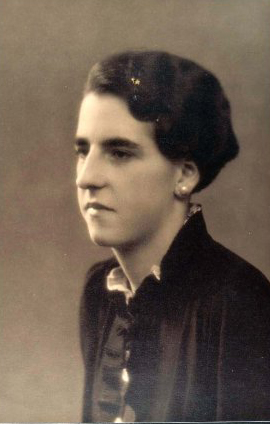
During world war two, my grandmother, Delia Eileen Abram (nee Clarke) worked at Sywell Aerodrome in Northamptonshire, repairing the Irish linen skin covering on the bodywork of Wellington bombers.
The aerodrome dates back to 1927 when local landowner, Mr Harold Brown agreed to let 55 acres of his land off the Holcot Lane, adjacent the Belman Gate, to the Northamptonshire Aero Club. Today it has evolved from a world war two RAF facility into general aviation airfields.
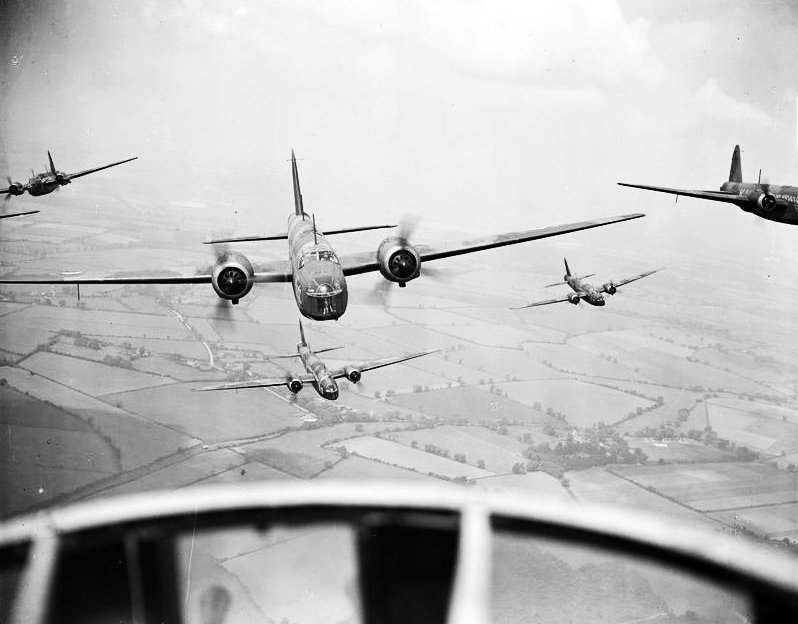
During the second world war activities at Sywell included the expansion of flying training, repairs to 1,841 of the RAF’s Wellington bombers and completion and flight testing of some 100 Lancaster mark two, four engined bombers. Brooklands Aviation Ltd oversaw the use of the ‘shadow factory scheme’ and saw two major sites used for aircraft overhaul and maintenance.
Site number one concentrated on Wellington repair and Lancaster construction.
Site number two site was based at Buttocks Booth in Moulton mainly for Wellington work.
Wellington Bombers flying in formation.
Other local engineering shops and businesses were subcontracted to undertake specific component repair too, including Earl’s Barton Motors (Abram’s garage) which was run by my great grandfather Joseph Charles Abram. A document from the Harrington Museum states:
‘The number or aircraft needing repair increased rapidly during 1940 and the accommodation at the main centre at Sywell was found to be inadequate. This together with the policy of dispersal and the benefit of taking work to the people instead of the reverse with consequent saving in travelling, led to premises being requisitioned including Abram’s Garage, Earls Barton – used for undercarriage and bomb beams.’
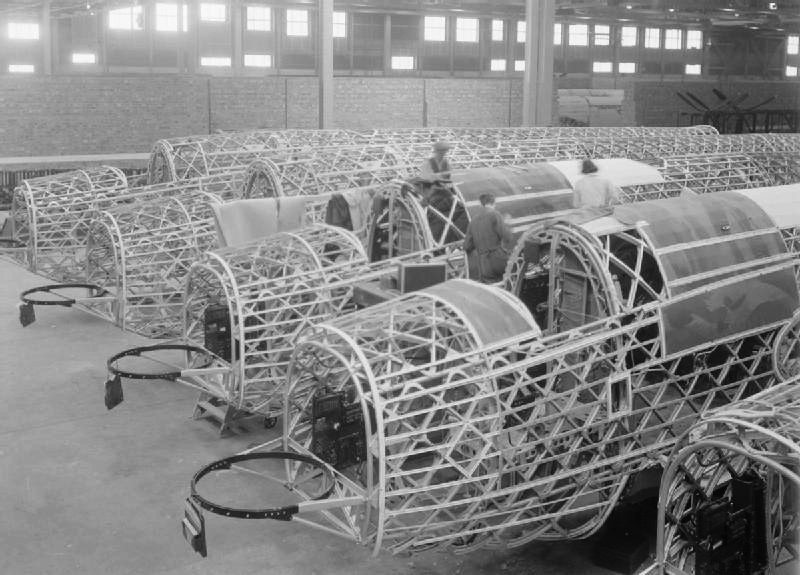
Around 2,000 people worked for Brooklands either directly or indirectly during world war two. However, as the men were conscripted, much of the work fell to women to undertake, including driving the roof cranes that shifted wings and tail fins into position, installing electrics and stitching a planes linen carapace.
The women who recovered and stitched the linen on airframes were nicknamed ‘Dope Judies’. The word dope referred to the layers of dope that formed the outer skin of the aircraft that the Irish linen was treated with.
Flight Mechanic website explains:
‘Fabric-covered aircraft play an important role in the history of aviation. The famous Wright Flyer utilized a fabric-covered wood frame in its design, and fabric covering continued to be used by many aircraft designers and builders during the early decades of production aircraft. The use of fabric covering on an aircraft offers one primary advantage: light weight. In contrast, fabric coverings have two disadvantages: flammability and lack of durability.Finely woven organic fabrics, such as Irish linen and cotton, were the original fabrics used for covering airframes, but their tendency to sag left the aircraft structure exposed to the elements. To counter this problem, builders began coating the fabrics with oils and varnishes. In 1916, a mixture of cellulose dissolved in nitric acid, called nitrate dope, came into use as an aircraft fabric coating. Nitrate dope protected the fabric, adhered to it well, and tautened it over the airframe. It also gave the fabric a smooth, durable finish when dried.’
Wellington bombers under construction, showing the airframe.
Stitching tightly with a curved needle, at a regulation eight stitches per inch, so the wind could not rip the seams open, the mostly female workforce worked 12 hour shifts, six days a week, in damp unheated hangars.














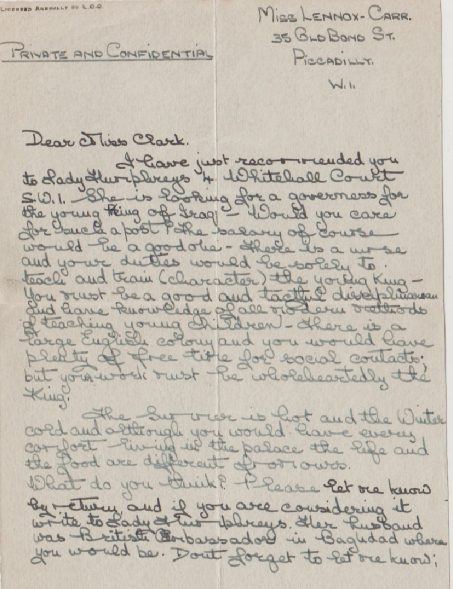
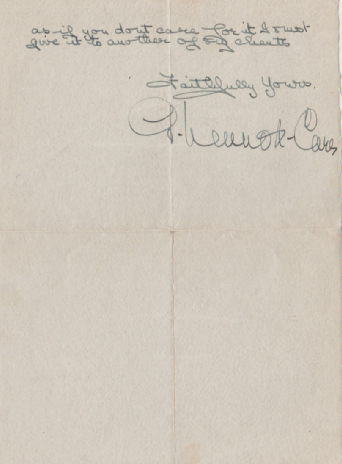 In January 2022 I was contacted by Tony Walker who had seen this blog. He had come across a document for Miss Carr’s agency when sorting through some some historical papers and asked if I would like a copy. The document can be viewed below.
 Wellington Bombers flying in formation.
 A little bit of this ~ A little bit of that